Showing posts with label Early America. Show all posts

Monday, October 7, 2013

George Washington's Original Thanksgiving Proclamation $8-$12 Million

by Stephen J. Gertz


The original manuscript proclamation establishing the first federal Thanksgiving Day in the United States of America is being offered by Christie's-New York on Thursday evening November 14, 2013 in a  single-lot special event sale. Signed by George Washington on October 3, 1789 it is estimated to sell for $8,000,000 - $12,000,000.

The proclamation reads in full:

By the President of the United States of America, a Proclamation

    Whereas it is the duty of all Nations to acknowledge the providence of Almighty God, to obey his will, to be grateful for his benefits, and humbly to implore his protection and favor, and whereas both Houses of Congress have by their joint Committee requested me "to recommend to the People of the United States a day of public thanksgiving and prayer to be observed by acknowledging with grateful hearts the many signal favors of Almighty God especially by affording them an opportunity peaceably to establish a form of government for their safety and happiness."

    Now therefore I do recommend and assign Thursday the 26th day of November next to be devoted by the People of these States to the service of that great and glorious Being, who is the beneficent Author of all the good that was, that is, or that will be. That we may then all unite in rendering unto him our sincere and humble thanks, for his kind care and protection of the People of this Country previous to their becoming a Nation, for the signal and manifold mercies, and the favorable interpositions of his providence, which we experienced in the course and conclusion of the late war, for the great degree of tranquility, union, and plenty, which we have since enjoyed, for the peaceable and rational manner, in which we have been enabled to establish constitutions of government for our safety and happiness, and particularly the national One now lately instituted, for the civil and religious liberty with which we are blessed; and the means we have of acquiring and diffusing useful knowledge; and in general for all the great and various favors which he hath been pleased to confer upon us.

    And also that we may then unite in most humbly offering our prayers and supplications to the great Lord and Ruler of Nations and beseech him to pardon our national and other transgressions, to enable us all, whether in public or private stations, to perform our several and relative duties properly and punctually, to render our national government a blessing to all the people, by constantly being a Government of wise, just, and constitutional laws, discreetly and faithfully executed and obeyed, to protect and guide all Sovereigns and Nations (especially such as have shown kindness unto us) and to bless them with good government, peace, and concord. To promote the knowledge and practice of true religion and virtue, and the encrease of science among them and Us, and generally to grant unto all Mankind such a degree of temporal prosperity as he alone knows to be best.

    Given under my hand at the City of New York the third day of October in the year of our Lord 1789.


Prior to its sale, the proclamation will be on tour, exhibited October 17-20 in Los Angeles at the Reagan Library; October 22 in Dallas at the Harlan Crow Library; October 24 at Christie's-Chicago; October 30 in Boston; November 4 in Washington, D.C. at the Library of Congress; November 5 in Philadelphia at the National Constitution Center; and November 7-13 in New York at Christie's Galleries.

The proclamation followed the request to President Washington by the House and Senate, on the day after ratification of the 1st Amendment to the Constitution, to proclaim a day of thanksgiving for “the many signal favors of Almighty God." Congressman Elias Boudinot of New Jersey said that he “could not think of letting the session pass over without offering an opportunity to all the citizens of the United States of joining, with one voice, in returning to Almighty God their sincere thanks for the many blessings he had poured down upon them" (The Annals of the Congress, The Debates and Proceedings in the Congress of the United States 1, Washington, DC: Gales and Seaton, pp. 949–950).

Massachusetts Centinel, October 14, 1789.

This was not the first time that a day of thanksgiving had been proclaimed. On October 11, 1782, John Hanson, first president of the newly independent United States under the Articles of Confederation, declared the fourth Thursday of every November to be a national Thanksgiving Day. The holiday, however, was by the authority of each state, not the national government. Under the new Constitution it was to be a federal holiday.

But not an annual observation. George Washington again proclaimed a Thanksgiving Day in 1795. John Adams declared Thanksgiving Days in 1798 and 1799. In response to resolutions in Congress at the close of the War of 1812, James Madison renewed the tradition in 1814 and 1815. But it was not until Abraham Lincoln proclaimed a national Thanksgiving Day on October 3, 1863 to occur in November of that year that the holiday has been annually celebrated.

Washington's proclamation is a foundational document in the history of the United States of America's grand national tradition of Thanksgiving. One of the great documents of Americana, it's no turkey.
____________

Document images courtesy of Christie's, with our thanks.

Newspaper clipping courtesy of the Washington Post, with our thanks.
____________
____________

Monday, August 8, 2011

The First and Most Important American Political Cartoon Comes to Auction

by Stephen J. Gertz

By Benjamin Franklin
From the Pennsylvania Gazette, May 9, 1754.


On May 9, 1754, the Pennsylvania Gazette, a newspaper published by Benjamin Franklin and the most successful in the American colonies, featured a cartoon by Franklin with accompanying text  by him that rallied the American colonies to unite and defend against the French in the looming French and Indian War. It was the first time that the colonies were asked to act as one.

That issue is among the rarest pieces of all early American history, the most ephemeral of ephemera. The only known surviving copy of that issue of the Pennsylvania Gazette lies in the Library of Congress. But another copy has surfaced and will be auctioned at Heritage Auctions Historical Manuscripts Signature® Auction September 12-14, 2011 in Beverly Hills, CA. It is estimated to sell for $100,000 - $200,000. There is no reserve. The estimate may be conservative. This is major, major offering, the only copy to ever come to auction and quite possibly the last.

The cartoon, Join, or Die, would, in 1765, be republished in the September 21st issue  (its only issue) of the Constitutional Courant as a clarion-call against the Stamp Act. calling for the unification of the colonies in their struggle for justice from Great Britain. In 1774 Paul Revere altered the cartoon to fit the masthead of the Massachusetts Spy.


"This rare and historic newspaper holds the earliest publication of the first and most celebrated editorial cartoon in American history," says Sandra Palomino, director of historical manuscripts at Heritage Auctions.

In the cartoon, the snake represents the the colonies, eight individual sections labeled with abbreviations for New York, New England, New Jersey, Pennsylvania, Maryland, Vermont, North Carolina and South Carolina. There was, at the time, a long-held superstition (with roots in the legend of Osiris)  that held that a snake cut to pieces would come back to life if the pieces were put together before sunset. Separate, they are inert and impotent. United, they are active,  and powerful. Delaware and Georgia were omitted, for reasons that remain unclear.

The image, redrawn, was later co-opted by each side during the American Civil War.
__________

Image courtesy of Heritage Auctions, with our thanks.
__________ 
__________

Wednesday, October 20, 2010

In Virgin Virginia, 1590 (Not Queen Elizabeth I)

by Stephen J. Gertz

De Bry, Theodor. Wunderbarliche, doch Warhafftige
Erklärung von der Gelegenheit und Sitten
der Wilden in Virginia welche newlich
von den Engelländern so im Jahr 1585.
Frankfurt: Johann Wechel, 1590.
First edition in German.
Engraved title page.
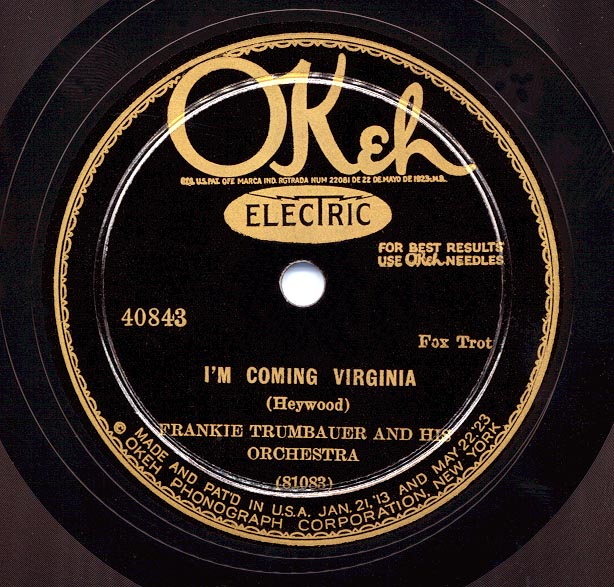
"I'm Coming Virginia"! (Bix Beiderbecke, 1927, with Frankie Trumbauer). Great for Bix. But what about Virginia?


In 1590, when Theodor De Bry, an engraver and publisher originally from Flanders who resettled in Germany, was in his early sixties, he and his two sons undertook a massive book project. With the assistance of British geographer Richard Hakluyt, they gathered up every illustration and description of the new voyages of exploration available, redrew the images and revised and re-imagined the tales that went with them. The project would end in 1634 with thirty stunningly illustrated volumes under the title Collectiones peregrinationum.

They are the most detailed reports of the 16th-century Americas that we have.

In that first year, 1590, De Bry published the first of these volumes, within which was a map of Virginia,  "one of the most significant cartographical milestones in Colonial North American history" (Burden), and "one of the most important type-maps in Carolina cartography" (Cumming). The map, in its first state, is extremely rare.

Plate: Indian Village.
The map had originally been drafted by John White, an English artist who had been sent by Sir Walter Raleigh as Sir Richard Grenville's artist-illustrator on his first voyage to the New World (1585-6) to establish a British colony. Illustrating Thomas Hariot's text of the expedition, White's was the most accurate map drawn in the sixteenth century of any part of the North American continent.

Plate 18. An Indian Water-Rite.
It was the first map to delineate the Chesapeake Bay and contains the first printed use of the name "Chesapiooc Sinus." De Bry had originally intended to use Jacques Le Moyne's drawings of the French expedition to the Southeast for the first part in his series, but Raleigh convinced him to devote the first book to Virginia instead, in an effort to encourage colonization. The White/De Bry map had an enormous influence on the mapping of both Virginia and Carolina.

Americae Pars Nunc Virginia 1st State, w/village to right of native woman
and child engraved "Ehesepiooc."
(Follow the "h" in "right," above,
in a straight line up to compass terminal  point).


This volume, the scarce first edition in German with the extraordinary map of Virginia in its first state, is being offered at Christie's - London on October 27, 2010 as lot 14 in The Arcana Collection Part II sale. The book has not been seen at auction for over thirty-five years. It is estimated to sell for $46,000 - $75,000.
__________ 

BRY, Theodor de (1528-1598). Wunderbarliche, doch Warhafftige Erklärung, von der Gelegenheit und Sitten der Wilden in Virginia welche newlich von den Engelländern so im Jahr 1585. Frankfurt: Johann Wechel, 1590. First edition in German.

2° (331 x 244mm). Collation: a4, b6, c4, d6, e2(e1 + \kc\K2 [map of Viriginia]), A6, B6(B4 + \kc\K2), C6(C3 + \kc\K2), D6, E4, [2E4], F6, complete with blank F6. German title and imprint on slips mounted on engraved title. Adam and Eve plate signed 'Theodore de Brij fe' not 'se.'  23 numbered half- or full-page engravings above or facing German letterpress descriptions (all but the first numbered), 5 plates of the Picts, all contemporaneously hand colored; hand-colored engraved arms on dedication leaf, woodcut tail-pieces.

Burden 76; Church 176; Cumming Southeast in Early Maps 12; Sabin III p.49.
__________

Images courtesy of Christie's.
__________

N.B.: "Virgin Virginia" should not be confused in any way with Virgin America, a carrier which recently blew any further chances with me when they canceled a flight for an  important, tight-budget  one-day trip  two days prior and then, two hours later, canceled the second flight they booked me on as an alternative.  Their other offered flights were a no-can-do day early or same day, too-late.  Refusing to find alternate flights for me on another carrier I had to scrub the entire trip; short notice with  dramatically higher fares precluded booking elsewhere. They initially lured me with a introductory discount mailer.

"Cheap deals and no hassle booking."

It's getting fliers off the ground that's a problem.
__________
__________

Tuesday, October 12, 2010

The Very Rare First Account of New York in English

by Stephen J. Gertz

DENTON, Daniel. A Brief Description of New-York:
Formerly Called New Netherlands.
With the Places thereunto Adjoyning.
Together with the
Manner if its Scituation, Fertility of the Soyle,
Healthfulness of the Climate, and the
Commoditites thence produced.
Also
Some Directions and Advice to such as shall go thither:
An Account of what Commodities they shall take
with them; The Profit and Pleasure
that may accrue to them thereby.
Likewise
A Brief Relation of the Customs of the Indians there.
London: Printed for John Hancock, 1670.


Daniel Denton, an early American colonist of Long Island, NY, was the town clerk for Hempstead, later Jamaica, and, later still, in 1666, Justice of the Peace for New York. He was one of the purchasers of the land tract that would become Elizabeth, New Jersey.

In 1670, after returning to England, he published A Brief Description of New-York: Formerly Called New Netherlands, the first eyewitness account in English of the colony recently acquired from the Dutch, and designed to promote the region for English settlement.

"The first account of New York printed in English and very rare" (Sabin).

FERRIS, Jean Leon Gerome. The Fall of New Amsterdam.
Peter Stuyvesant, in 1664, standing on shore among residents of
New Amsterdam who are pleading with him not to open fire on
the British who have arrived in warships waiting in the harbor
 to claim the territory for England
An outstanding copy of this rare book is coming to auction at Christie's - London on October 27, 2010 in Part II of The Arcana Collection. It is estimated to sell for $46,000 - $60,000.

New York is the land of milk and honey. Give me your tired, your poor, your industrious yearning  for the good life!

"Do men expect profit in what they carry with them to a foreign land? - They need not fear it here, if their goods but suit the country. Would they live in health? - no place so likely to live so in, in this part of America. Would they have plenty of necessaries for food and raiment? - New York, in these, is not unkind; but though a stepmother to those who came from England, yet furnishes them as plentifully, if equally industrious, as their natural county does those who stay behind.

"In short, there is nothing wanting to make the inhabitants thereof happy..."

Come on over, settle down, and take a bite  of the Big Apple, no worms inside.

Yet New York did have its disadvantages, six worms, by Denton's count:

"I shall not speak of every slight and trivial matter, but only those of more considerable importance, which I count to be six. 1st, The wickedness and irreligion of the inhabitants; 2d, want of ministers; 3d, difference of opinion in religion; 4th, a civil dissension; 5th, the heathenism of the Indians; and, 6th, the neighborhood of Canada."

Canada? What gives? Gangs in the 'hood, it seems. You couldn't go to the corner for a bottle of maple liquor without incident.

"By now, of late, since some people are become wealthy enough to purchase and have by them what is worth the taking away, and that the out-parts of the province (where the best land is) towards Canada are so harassed by the French and their Indians, that men are fearful to plant and dwell there..."

It gets worse; welcome to Fun City, in 1670 already earning a dubious reputation:

"...people have fallen into so great debauchery and idleness, thieving is become more frequent; and many considerable robberies have been committed in my time in New York, to the great discouragement of industrious people, and increase in vice and sin."

That's Lou Reed in the background, wandering troubadour in black breeches, waistcoat, and tricorn, singing Walk on the Wild Side while gently strumming his lute.

Don't blame Jews: at the time Denton published, he charted only twenty Jewish families living in New York. It was impossible to get a decent bowl of matzoh ball soup if you weren't well-connected, much less dim-sum.

One passage in the book is considered to be an early proclamation of Manifest Destiny:

"A Divine Hand makes way for them [the English settlers] by removing or cutting off the Indians, either by Wars one with the other, or by some raging mortal Disease."
 
In over thirty-five years only two copies of this book in first edition have come to auction and this copy was one of them, offered at Sotheby's in 1987. This particular copy is exceptional for  another, very important reason. Because of the height of the text on the titlepage, out of proportion relative to the margins of the rest of the book, the "A" at the top or the date at the bottom of the titlepage is usually trimmed by the binder's knife. The date is often completely lost. Not here.

This is an extraordinary copy of an extraordinarily rare book.
__________

References: Church 608. Howes D-259. Sabin 19611. Wing D-1062.

Titlepage image courtesy of Christie's.
__________
__________
 
Subscribe to BOOKTRYST by Email