Showing posts with label cartoons. Show all posts

Wednesday, January 15, 2014

James Thurber Illustrates Poetry

by Stephen J. Gertz

The four original illustrations by celebrated American humorist, cartoonist, author, and journalist, James Thurber (1894-1961) to accompany Charles Kingsley's poem The Sands o' Dee, as published in The New Yorker magazine March 25, 1939, have come to auction. Offered by Swann Galleries in its 20th Century Illustration sale January 23, 2014, they are estimated to fall under the hammer at $4,000-$6,000.

Executed in ink on paper, the artwork and poem appeared as part of The New Yorker's popular Thurber feature, Famous Poems Illustrated. Each drawing appeared above one of the four six-line stanzas:


 O Mary, go and call the cattle home,
          And call the cattle home,
          And call the cattle home,
      Across the sands of Dee."
    The western wind was wild and dank with foam
      And all alone went she.


 The western tide crept up along the sand,
          And o'er and o'er the sand,
          And round and round the sand,
      As far as eye could see.
    The rolling mist came down and hid the land;
      And never home came she.


Oh! is it weed, or fish, or floating hair,--
          A tress of golden hair,
          A drownèd maiden's hair,
      Above the nets at sea?
    Was never salmon yet that shone so fair
      Among the stakes on Dee.


They rowed her in across the rolling foam,
          The cruel crawling foam,
          The cruel hungry foam,
      To her grave beside the sea.
    But still the boatmen hear her call the cattle home
      Across the sands of Dee.

Each original illustration is 279 x 216 mm (11x8 1/2 or smaller). Thurber's signature appears at lower left on the final drawing. Three of the illustrations possess faint preliminary drawings on their versos.

Thurber illustrated nine poems for The New Yorker, the others being  Excelsior (Henry Wadsworth Longfellow); Lochinvar (Sir Walter Scott); Locksley Hall (Lord Alfred Tennyson); Oh When I Was ... (A. E. Housman); Curfew Must Not Ring To-Night (Rose Hartwick Thorpe); Barbara Frietchie (John Greenleaf Whittier); The Glove and the Lions (Leigh Hunt); and Ben Bolt (Thomas Dunn English). They were collected in Thurber's 1940 anthology, Fables For Our Time and Famous Poems Illustrated.

Established in 1997, the annual Thurber Prize honors outstanding examples of American humor.
__________ 
__________

With an affectionate tip o' the hat to Thurber keeper of the flame, fanatic and collector, Jay Hoster, who knows more about the man and his books than anyone alive.
__________

Images courtesy of Swann Galleries, with our thanks.

Sands o' Dee reprinted via WikiSource under the Creative Commons Attribution/Share-Alike License.
__________
__________

Thursday, June 27, 2013

Dr. Seuss, Political Cartoonist

by Stephen J. Gertz

Seuss's Uncle Sam.

From 1941 through 1943, Theodore Seuss Geisel (1904-1991) created political cartoons for PM Daily, wartime propaganda for the left-leaning newspaper issued in New York by Field Productions, ultimately contributing 400 to PM's editorial and front page.


A complete run of PM featuring all of Geisel's wartime cartoons - all 146 issues - has just come into the marketplace. Each of the cartoons is highlighted by his pro-American, anti-isolationist views, and signed "Dr. Seuss," long before Geisel became the beloved Dr. Seuss, grand master of children's literature.


The Saturday Evening Post had published his first cartoon under the name Seuss in 1927. He subsequently became a successful advertising artist and writer, and, in 1937, had the first of his over sixty children's books published, And To Think That I Saw It On Mulberry Street.


The 500 Hats of Bartholomew Cubbins followed in 1938, The King's Stilts and The Seven Lady Godivas in the next year, and Horton Hatches the Egg in 1940.


The crisis in Europe troubled him deeply. Mussolini irritated him and Seuss drew a cartoon lampooning Il Duce, submitted it to PM, which accepted it and then kept him busy warning of Fascism and isolationism, taking particular glee against American hero, isolationist, and Nazi-sympathizer Charles Lindbergh. He attacked wartime prejudice against Jews and black Americans. He took shots at anyone who criticized President Roosevelt's handling of the war, including Congress and the press; criticism of aid to the Soviet Union; anti-Communist paranoia; rumor-mongers; and anything and anybody he considered to be giving aid to the Nazis and Japanese, sowing disunity, and undermining the war effort.


Dr. Seuss's experience as a wartime political cartoonist influenced his later books for kids. Horton Hears a Who (1954) is a parable about post-war relations amongst the U.S., the Soviet Union, and Japan. Yertle the Turtle (1958) warns of the dangers of those who wish to rule the world, Yertle standing in for Hitler. Seuss later admitted that when he first drew Yertle the turtle had an Adolf brush mustache.

The faces, figures, creatures, and backgrounds we associate with Geisel's children's books are on display in these cartoons, which share remarkable similarities to the unique worlds he created for children, Dr. Seuss before he became DR. SEUSS.
__________

Images courtesy of Royal Books, currently offering this collection, with our thanks.
__________

Of Related Interest:

Lost, Unpublished Dr. Seuss Manuscript Surfaces.

Lost Dr. Seuss Manuscript Sells For $34,004.

Rare, Unpublished Dr. Seuss Original Artwork Comes To Auction.
__________
__________

Friday, November 2, 2012

Women are Children: Don't Let Them Vote

by Stephen J. Gertz

"The Militant" by G.T. (?), c. 1910-1912.

This political cartoon, in ink and watercolor, was likely inspired by and in sympathy with the Women's National Anti-Suffrage League (1908-1918) which opposed granting women the vote in Parliamentary elections within the United Kingdom.

The same sort of battle against women's suffrage was occurring simultaneously in the United States, ongoing since the Seneca Falls Convention of 1848 proclaimed voting rights for women.

Here, a little girl is arrested by two bemused policemen. She's in tears holding a can of oil, the prime suspect of arson to the house ablaze at right in the background.  On the house's fence the girl has chalked the demand, "Voats fer Wimmen."

The message is clear: English domestic life is threatened by immature women demanding the vote. Militants are particularly irresponsible and dangerous; the whole of society will go up in flames if women stuff the ballot box with their foolishness. A more condescending view of the issue is difficult to imagine. It was not, however, unusual. Casting women suffragettes as little children was a standard weapon in the anti-suffragette arsenal.

In the United States, a similar anti-suffragette theme was expressed at the very same time by Ten Little Suffragettes, a scarce eleven-page comic based upon the folk-song, Ten Little Indians. Ten little girls in pinafores carry protest signs supporting women's suffrage but are undone by their pre-pubescent behavior until only one remains and, petulant, she breaks her doll's head.

That women are children and incapable of making informed decisions about things they care about is a sentiment that remains amongst many to this day. Why should adults cede power to emotionally labile kids?

Particularly female children who are now increasingly dominating college enrollment, often out-earning their husbands and boyfriends, and are members of Congress, the Supreme Court, and the Cabinet.

Next thing you know, there'll be a female President of the United States. Somehow, the United States will survive - though a segment of the male voting population may feel their manhood whither and retract into their gut to disappear with their last vestige of superiority in everything except, perhaps, the ability to fix a toaster - a skill that many men have yet to master, this writer included whose grand philosophy regarding broken small household appliances boils down to, Buy a new one.
__________

[ANTI-SUFFRAGETTE ORIGINAL CARTOON]. G.T. [?]. The Militant. [London?]: c. 1910-1912. 39 x 35 cm original ink and watercolor drawing.
__________

Image courtesy of John Drury Rare Books, currently offering this item, with our thanks.
__________

Of related interest:

Ten Little, Nine Little, Eight Little Suffragettes...(And Then There Were None).
__________
__________

Tuesday, August 14, 2012

Breaking Rare Book News: Tarzan Dumps Jane, Boy Broken-Hearted

By Stephen J. Gertz

I suppose it had to happen. Another episode of Splitsville. I had no idea their relationship was on the rocks.

After living in sin and swinging around the jungle with Jane Porter for years, Tarzan, Lord of the Apes, né Lord Greystoke, has decided, it seems, to throw her to the lions and monkey around with Gloria, another Great White Woman, here in trés chic Chanel, who, apparently, on the way to Altoona, PA, got on the wrong Trailways bus and wound up in Africa.

She met the Ape-Man, who, reportedly in the midst of a mid-life crisis, was vulnerable to her charms. She put the pep back into his tired jungle cry. He was a goner.

These are the first editions in French of Tarzan comic books Nos. 1 & 2 (1936, 1937), originally published in the United States in 1929 and illustrated, as here, by Hal Foster.  P.F. Caillé was responsible for the French adaptation.

Hal Foster (pseudonym of Harold Rudolph Foster, 1892-1981) quit his art studies and followed an adventurous life, big-game hunting and searching for gold. He returned to his home town, Chicago, in 1921, resumed his art education, first at the Art Institute of Chicago, later at the National Academy of Design, and committed himself to art. 

He began as a book and advertising illustrator and soon developed a solid reputation. In 1929, he was asked to illustrate the comic-strip and comic book editions of Tarzan, based upon the 1914 (Chicago: A.C. McClurg) novel by Edgar Rice Burroughs, Tarzan of the Apes,  that spawned the successful series of books that captured the imagination of children and adults and led to a multimedia empire. 

The family in happier times..

Tarzan and Gloria? It could have been worse. Tarzan and Sheila, Tarzan and Gertrude. Tarzan and Hermoine. Tarzan and Tallulah. Or, in a more up-to-date mating with a  light bestial touch, Tarzan and Bambi.

Decades will pass before the full impact of his parents' split hits Korak ("Killer") aka Boy, by then, hopefully, Man, and he fully grasps that his failed relationships, anger and depression, substance abuse, spotty employment record, and unnatural attraction to lower primates of either sex stem from this tragedy when his mom, Jane, disappeared,  and Tarzan took sides with his evil step-mother, Gloria, making his adolescence a living hell and conflict with Pops a daily routine. Divorce is a jungle.
__________

Booktryst is pleased to have scooped TMZ  the National Enquirer, the Huffington Post, the Star, Daily Mail, and other tabloids on this story.  
__________

BURROUGHS, Edgar Rice. Tarzan No. 1 and No. 2. Illustrations de H, Foster. Adapt. française de P.F. Caillé. Paris: Hachette, 1936, 1937. Tall octavos. 64; 48 pp. Quarter yellow cloth over pictorial boards.
__________

Why P.F. Caillé kicked "Jane" to the curb and instead used the name Gloria remains a mystery, Hachette has a lot to answer for.
__________

Book images courtesy of Harteveld Rare Books Ltd, currently offering this item, with our thanks.
__________
__________

Wednesday, January 18, 2012

Planet of the Monkey-Men, 1827

by Sam Simian

Sam Simian is the former proprietor of Darwin's Body Shop in the former Leopoldville in the former Belgian Congo ("Ubangi, We Fixy") in  the current Africa. Now, having made his fortune in used Mongolian auto parts, he is master of all that he surveys from his eponymous hilltop castle overlooking California's central coast.


I'm not happy about all that I survey. At the moment, I'm surveying Monkey-ana, or Men in Miniature.


It's a suite of twenty-four mordantly satiric caricatures by Thomas Landseer (1795-1880), brother of Edwin Landseer (1802-1873), the famed painter of horses, dogs, and stags, and captioned with quotations from Shakespeare, Pope, etc.  It is one of the few works engraved by Landseer after his own designs, was originally issued in six parts, each with four etchings, bound in pictorial wrappers reiterating the engraved design of the title-page, on chamois-colored paper, and  originally published in 1827. Its engravings depict human men as members of my family.

How do you spell condescending? Remove the mask and all humans are monkeys? I don't think so. Remove the mask and all humans are even more human than you thought, and it ain't pretty. Thank Hanuman, the Monkey God, for masks (though the last syllable of his name is a scandal).


You wanna parody the vices of men, fine by me; it's more fun than a barrel of humans with pistols and a bottle of Jack Daniels and less dangerous. I resent, however, the choice of my brethren as somehow, somewhere below humanity on the tree of life yet ripe for close comparison. From my branch the view is the other way around. If Darwin was right and men are descended from monkeys, then it's time for us monkeys to do the right thing, travel back in time, commit mass suicide, and stop evolution in its tracks. You think we wanted our legacy to be genetic ancestors of Glenn Beck?


In 1971 I dropped LSD. Ten hours later, as it wore off, it seemed to slowly drain from my head, descend my torso, run down my legs and exit my big toes into a pool on the floor. Twelve hours after that I saw an  aging macaque in Pucci and pearls walking a Pomeranian on Beverly Drive in Beverly Hills. I wasn't sure whether the leash was attached to the dog or the dowager and who was taking who for a walk. It did my heart good, though, to see a monkey mocking a denizen of The Bistro, the dearly defunct hangout for Hollywood primates past their prime.


Suffice it to say, if you're going to depict a kangaroo court kindly depict kangaroos.

I've just about had it in general with anthropormorphic literature and art, and I'm not alone. Some of my best friends are butterflies and they're still pissed-off at Grandville for what he did to them in Les Papillons Métamorphoses Terrestres de Peuples de l'Airs. A pear I know takes Charles Philipon's caricature of his great-great-great-great grandfather as Louis-Philippe personally. Whatever you do, don't bring up Varin's L'Empire des Légumes to an eggplant. Purple with rage is all I can say.


If you want to satirize a despot don't look to monkeys for inspiration.  King Kong was a gentle giant who loved blonds and whose only political gripe was with NYC authorities for approving the Empire State Building without provision of a single piton or Alpine cock ring to give him a leg up. The rest we know.

How 'bout Mighty Joe Young? You croon Beautiful Dreamer to the big guy and what does he do? He gets all goofy and smiley, lies down and plays with flowers. You sing Beautiful Dreamer to a mafia gorilla and you're dead meat - no offense to gorillas intended.

Thomas Landseer "became one of the most gifted and innovative engravers of his generation, being particularly adept in the use of textural etching. Much of his career was taken up with reproducing the works of his brother, Edwin...he subsequently made prints after all of his brother's most famous works...In all, he made more than 125 engravings after his brother's paintings. He also produced original etchings, including the book Monkey-ana, or Men in Miniature...At the Royal Academy he exhibited both engravings and original works of art, but it was not until 1868 that he was finally honoured by being elected ARA. In 1871 he edited and published Life and Letters of William Bewick, Artist, a book about his former colleague" (Oxford Grove Dictionary of Art).

A word to the wise, Landseer: Take your stinking paws off me, you damn dirty Homo Sapien. You ain't gonna make a human outta me!
_________


LANDSEER, Thomas. Monkey-ana, or Men in Miniature. Designed and Etched by Thomas Landseer. [London]: F.G. Moon, August 1827. Engraved title and twenty-four  engraved  plates on china paper mounted on wove rag (watermark A.H. Holdsworth & R.S. Phillips, Dartmouth.) Folio. Three-quarter leather over contemporary marbled boards.

A second edition appeared in 1828, London: Moon, Boys, and Graves.

British Museum Satires 15638.
__________

Images courtesy of Ars Libri Ltd., with our thanks.
__________
_________

Monday, August 8, 2011

The First and Most Important American Political Cartoon Comes to Auction

by Stephen J. Gertz

By Benjamin Franklin
From the Pennsylvania Gazette, May 9, 1754.


On May 9, 1754, the Pennsylvania Gazette, a newspaper published by Benjamin Franklin and the most successful in the American colonies, featured a cartoon by Franklin with accompanying text  by him that rallied the American colonies to unite and defend against the French in the looming French and Indian War. It was the first time that the colonies were asked to act as one.

That issue is among the rarest pieces of all early American history, the most ephemeral of ephemera. The only known surviving copy of that issue of the Pennsylvania Gazette lies in the Library of Congress. But another copy has surfaced and will be auctioned at Heritage Auctions Historical Manuscripts Signature® Auction September 12-14, 2011 in Beverly Hills, CA. It is estimated to sell for $100,000 - $200,000. There is no reserve. The estimate may be conservative. This is major, major offering, the only copy to ever come to auction and quite possibly the last.

The cartoon, Join, or Die, would, in 1765, be republished in the September 21st issue  (its only issue) of the Constitutional Courant as a clarion-call against the Stamp Act. calling for the unification of the colonies in their struggle for justice from Great Britain. In 1774 Paul Revere altered the cartoon to fit the masthead of the Massachusetts Spy.


"This rare and historic newspaper holds the earliest publication of the first and most celebrated editorial cartoon in American history," says Sandra Palomino, director of historical manuscripts at Heritage Auctions.

In the cartoon, the snake represents the the colonies, eight individual sections labeled with abbreviations for New York, New England, New Jersey, Pennsylvania, Maryland, Vermont, North Carolina and South Carolina. There was, at the time, a long-held superstition (with roots in the legend of Osiris)  that held that a snake cut to pieces would come back to life if the pieces were put together before sunset. Separate, they are inert and impotent. United, they are active,  and powerful. Delaware and Georgia were omitted, for reasons that remain unclear.

The image, redrawn, was later co-opted by each side during the American Civil War.
__________

Image courtesy of Heritage Auctions, with our thanks.
__________ 
__________

Wednesday, May 25, 2011

The Early Books of Artist Raymond Pettibon

by Stephen J. Gertz

PETTIIBON, Raymond. Pig Cupid.
Lawndale, CA: SST, 1985. Limited edition of 500 (i.e. 100).
Octavo (21.6 x 14 cm). Original stapled pictorial wrappers.
Hand-numbered in red ink.
Ohrt, Raymond Pettibon: The Art 1978-1998, 31.
"Why do I dream of undertow when I don't even know what it is?

Comics, books, film noir, pulp fiction, TV, politics, advertising, violence, the famed and the infamous: Artist Raymond Pettibon inhales pop-culture and, gas exchanged, exhales its carbon dioxide into a teeming mosh-pit. It is no accident that warnings of global warming began to increase in volume when he established his career as Southern California's  - and, ultimately, the world's - prince of Punk Art (though he rejects labels). For better or worse, when Pettijavascript:void(0)bon puts pen and ink to paper the temperature rises. His books have become rare and highly desirable.

PETTIIBON, Raymond. Capricious Missives.
Lawndale, CA: SST, 1983. Limited edition of 500 (i.e. 100).
Octavo (21.6 x 14 cm). Original stapled pictorial wrappers.
Hand-numbered in red ink.
Ohrt 9.
"Even toothless she can still bite off a boy's head."
PETTIIBON, Raymond and Michael Gira. Selfishness.
Lawndale, CA: SST, 1985. Limited edition of 500 (i.e. 100).
Octavo (21.6 x 14 cm). Original stapled pictorial wrappers.
Hand-numbered in red ink.
Orht 32.
"I want her to dream about what I did to her when she passed out."

Charles Manson, Ronald Reagan, various and sundry speed freaks on a high wire,  hippies, punks,  baseball players, surfers, and, good grief, it's Gumby, etc., populate his images, an idiosyncratic ensemble exploding from Pettibon's cerebral popcorn popper onto paper with an occasional un-popped kernel breaking a tooth. Who said art wasn't risky?

PETTIIBON, Raymond. The Navigator's Wives.
Lawndale, CA: SST, 1985. Limited edition of 500 (i.e. 100).
Octavo (21.6 x 14 cm). Original stapled pictorial wrappers.
Hand-numbered in red ink.
Ohrt 27.
"I am still working on my public face!"
PETTIIBON, Raymond. Cars, TV, Rockets, H-Bomb - You Name It.
Lawndale, CA: SST, 1985. Limited edition of 500 (i.e. 100).
Octavo (21.6 x 14 cm). Original stapled pictorial wrappers.
Hand-numbered in red ink.
Ohrt 21.
"Perhaps the fact that I hadn't had sex in 3 whole days left me vulnerable."

William Blake, Henry James, the Bible,  Portuguese poet Fernando Pessoa - Pettibon co-opts their work and others' and reprints or reshapes it, his personal warp jump-starting their text and driving it into another direction, disturbing, ironic and ambiguous. The work in toto is provocative and vital.

PETTIIBON, Raymond. Jane's Book of Fighting.
Lawndale, CA: SST, 1985. Limited edition of 500 (i.e. 100).
Octavo (21.6 x 14 cm). Original stapled pictorial wrappers.
Hand-numbered in red ink.
Ohrt 24.
"She even had a little moustache."

Raymond Pettibon began life in Tucson Arizona in 1957 as Raymond Gill. He earned a degree in economics from UCLA and was working as a math teacher when his brother, Greg, established the seminal Punk band, Black Flag, in 1977. Raymond provided the group's name and designed their logo. He changed his surname. He created posters and handbills for the L.A. punk scene. He designed record covers for Black Flag's label, SST (Super-Sonic Transport, in homage to the now dearly-departed Concorde). By the early 1980s, he had established a reputation as the music movement's visual brother and had begun to produce small, simply produced books published and distributed through SST.

PETTIIBON, Raymond. A Can at the Crossroads.
Lawndale, CA: SST, 1985. Limited edition of 500 (i.e. 100).
Octavo (21.6 x 14 cm).  Original stapled pictorial wrappers.
Hand-numbered in red ink.
Ohrt 20.
"I saw Christ. I was drunk but still lucid to be searching."
PETTIIBON, Raymond. New Wavy Gravy.
Lawndale, CA: SST, 1985. Limited edition of 500 (i.e. 100).
Octavo (21.6 x 14 cm). Original stapled pictorial wrappers.
Hand-numbered in red ink.
Ohrt 29.
"Of course he became a Christian."

The books from the early 'eighties through 1985 were released in limited editions of 500 copies. Despite their $1.25 price the books, however, did not sell well at all. It was Remainder City at Pettibon-central in Venice Beach, CA and, according to the artist, he destroyed the bulk of the print run for each volume, only 100 copies, slightly more or less, of each title escaping the compost heap.

PETTIIBON, Raymond. Tripping Corpse #6.
Lawndale, CA: SST, 1985. Limited edition of 500 (i.e. 100).
Octavo (21.6 x 14 cm). Original stapled pictorial wrappers.
Hand-numbered in red ink.
Ohrt 36.
"It doesn't matter where they were raised or by whom.
By the time they get to Venice Beach they all look like this."
PETTIIBON, Raymond. Lana. Lawndale, CA: SST, 1984.
Limited edition of 500 (i.e. 100). Octavo (21.6 x 14 cm).
Original stapled pictorial wrappers. Hand-numbered in red ink.
Ohrt 16.
"OK, OK, I never even met her. But even just pretending with her is so
much more intense and fulfilling than the real thing with anyone else."

Sit down, dear book collector-punkster or innocent bystander. If you had originally bought any one of these little books at their cover price of $1.25 they have now appreciated in value to upwards of $450 each in fine condition. If you had any of the originals and, over the years, tossed them or lost them you may now genuflect, hari-kari huff a can of Black Flag, the Punk pesticide of choice, and experience the  grim, writhing  death that greets all book collectors when we realize how we have blundered, big-time. Having in ignorance and  without an in to the oracle at Delphi forsaken an Antiques Roadshow bonanza, we can only, as the tetramethrin kicks in and fricassees our neurons, lamely express a cosmic, aching and disconsolate "Who knew?" before life drips into eternity's inkwell and blots out, dark matter that didn't see the light soon enough. Sic transit gloria collectori de libri...
__________

All images courtesy of Brian Cassidy, Bookseller, with our thanks, who recently offered the above titles in his Catalogue Five, April 2011. They sold within moments. Sic transit gloria Pettibon.
__________

Of related interest:

New Book Documents the L.A. Punk Scene.
__________

Our apologies for the slightly blurred images; the hi-res wasn't high enough.
__________
__________

Friday, January 14, 2011

Comics Get Stripped At The Museum Of Sex

By Nancy Mattoon


A History Of Dirty Drawings By Craig Yoe,
Curator of the
Comics Stripped Exhibit.


One of the greatest things about art, whether it consists of words or images, is that it can create fantasy worlds that have never existed, and never could. Mention the literary genre of fantasy, and the first images that come to mind might be unicorns, fairies, swords and sorcerers, or other stock elements of children's books. But another kind of fantasy, the adult, sexual kind, has also inspired a genre of art with its own instantly recognizable icons: voluptuous women and muscle-bound men; fetish clothing featuring six-inch stilettos, leather, lace, and latex; bondage gear including handcuffs, masks, and corsets; and sadomasochistic props like whips, chains, and ropes.

Craig Yoe's Arf Forum,
"Celebrating The Unholy Marriage
of Art & Comics."


Call it erotica or pornography, the art that sexual fantasies inspire is as transcendent, and as impossibly unrealistic, as anything found in the worlds of Harry Potter or The Wizard of Oz. New York City's Museum of Sex has just mounted (pun intended) a new exhibition of the erotic art of comic strips and comic books in the 20th and 21st centuries, to "reveal how the comic book medium has been used over time to depict sexual fantasy, poke fun at taboo topics and lampoon icons of popular culture." Comics Stripped, a show made up of over 150 artifacts, including original drawings, illustrated books, comic books, magazines and videos, chronicles the history of "dirty drawings" from the Great Depression to the present day.


A Selection Of Tijuana Bibles.
(Image Courtesy of The Museum of Sex.)

The exhibit begins with 18 examples of the rare, underground comic books known as "Tijuana Bibles." These cheaply-produced pulp paperbacks, clandestinely published in the 1930's, often featured well known mainstream comic strip characters, such as Blondie and Dagwood, or Popeye and Olive Oyl, engaged in graphic sexual activity. In what may well be the most shocking statement in the exhibit's press release, the Museum of Sex staff maintains these crude little comics were frequently used by teenagers as sexual "instruction books." (A reminder that responsible sex education in the home is always the smart move...) Despite their lowbrow pedigree, the Museum points out that some notable comic book artists moonlighted by producing "bibles," including Wesley Morse, who created the Bazooka Joe and Gang characters featured inside the wrappers of Topps' bubble gum.

Cartoonist Wally Wood's
Erotic Take On Superman.

(Image Courtesy of The Museum of Sex.)

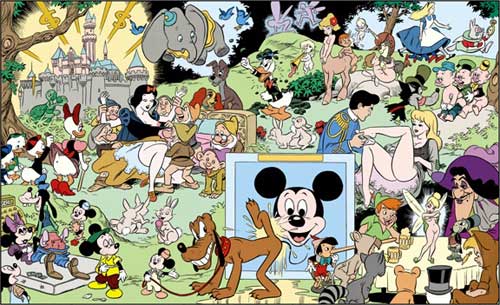
Tijuana Bibles also took on the most sacred cows of wholesome cartoon characters, those created under the auspices of Walt Disney. Featured in the Museum of Sex exhibit are two rare (and Disney wishes rarer) "bibles" featuring Donald Duck and Snow White and the Seven Dwarfs in compromising positions. Another artifact lampooning the squeaky-clean Disney characters is a centerpiece of the show. The Disneyland Memorial Orgy, a tableau drawn by Wally Wood, and published by Paul Krassner in his counterculture magazine, The Realist, hit the newsstands in 1967. Surprisingly, the ever litigious Magic Kingdom chose not to sue the orgy's creators, in order to avoid bringing any more attention to the blasphemy. (For those of you can't wait to see Goofy having his way with Minnie Mouse, a link is thoughtfully provided here.)


Joe Shuster's Cover Illustration
For The First Issue of Nights Of Horror.

(Image Courtesy of The Museum of Sex.)

But Goofy and Minnie Mouse were far from the only comic icons to be eroticized by the sexual comics, or comix, movement. Artist Joe Shuster, co-creator of DC Comics world-famous Superman, drew sadomasochistic scenarios featuring Lois Lane and Clark Kent for his Nights of Horror, a fetish comic book series. And Eric Stanton's Blunder Broad series starred a less-than-wonderful version of Wonder Woman, forever enduring sexual humiliations due to her own ineptitude. Five original issues of issues of Nights of Horror will be on display during the exhibition as well as six original illustrations from Blunder Broad.


Cover Image Of A Collection Of
Playboy Cartoons By Eldon Dedini.


The exhibit also features the erotic cartoon art of risque "men's magazines" from Captain Billy's Whiz Bang, through Ballyhoo, and on to Playboy. Of the Playboy cartoonists, the Museum's press release notes, "Visitors to Comics Stripped will enjoy original art, on loan from the Playboy Enterprises, Inc., of iconic Playboy artists Jack Cole (1914-1958) and Eldon Dedini (1921-2006). Cole may be best known for creating the superhero Plastic Man. His cartoons for Playboy became the gold standard for creating cartoons published in the popular men's magazine. Dedini's watercolor depictions of horny satyrs chasing voluptuous nymphs were an iconic Playboy feature."

A Candy Bar Wrapper Featuring R. Crumb's "Devil Girl."
(Image Courtesy of The Museum of Sex.)

Comics Stripped also examines the ongoing censorship of erotic comics in the United States, culminating in the creation of Comics Code Authority in 1954. The repressive legislation of the red-baiting McCarthy Era ironically led to the proliferation of underground publications, containing outrageous, shockingly graphic images, deliberately unsuitable for publication in even the raciest mass market men's magazine. The most famous artist who got his start in those publications was R.Crumb, the creator of such characters as Fritz the Cat, Mr. Natural and Devil Girl. Comics Stripped includes many of Crumb's original drawings, which have recently been on display at the Hammer Museum in Los Angeles, and the Whitechapel Art Gallery in London. Homoerotic comic art from gay underground publications is also on show at the Museum of Sex, including the iconic work of Tom of Finland, who proudly proclaimed: "If I don't have an erection when I'm doing a drawing, I know it's no good."

Craig Yoe's Well Reviewed Book On
The Fetish Art Of Joe Shuster.


Comics Stripped was created by Museum of Sex Curator Sarah Forbes, and Guest Curator Craig Yoe. Yoe has been called "Indiana Jones of comics historians," the "archivist of the ridiculous and sublime," and "a fine cartoonist and a comic book historian of the first water." He is the author of the definitive work on Superman's co-creator, Secret Identity: The Fetish Art of Joe Shuster (Abrams ComicArts, 2009). Yoe himself modestly says of his curatorial duties for Comics Stripped, "Many artists of 'dirty drawings' had full time gigs in mainstream entertainment. I consider myself to be following in a fine tradition of men who knew what they wanted and how to put it on paper." Knowing what you want, and knowing how to put it down on paper--a perfect description of the art of sexual fantasy.

Comics Stripped opened at the Museum of Sex on January 13, 2010, and continues indefinitely.
__________

Friday, August 7, 2009

Book Do's and Don'ts For the 21st Century

Sad that it has come to this but signage has now been created to prevent those whose experience with books is severely limited from making serious, life- or book threatening gaffes when in their presence.

The signs are appropriate for libraries, book stores, reading rooms, or general household use, and delightfully capture the current, confused book zeitgeist.

It is unlikely that ebooks will ever require warning signs beyond a Magritte-ish This Is Not a Book poster. Kindles, however, may need an additional caveat, the Do Not Taunt This Book alert with image of Jeff Bezos wagging his finger at us.


Subscribe to BOOKTRYST by Email