Showing posts with label Science. Show all posts

Tuesday, October 29, 2013

19th C. Breast Cancer Lithograph Makes Surgery Look Beautiful

by Stephen J. Gertz


A copy of the first edition of the most complete anatomical atlas and arguably the most beautiful of the nineteenth century, Jean Baptiste Marc Bourgery's Traité complet de l’anatomie de l’homme, comprenant la médecine opératoire (1831-1854), is being offered by Christie's-Paris in its Importants Livres  Ancienes, Livres d'Artistes, et Manuscrits sale November 6, 2013.

Amongst the 726 beautifully designed lithographed plates within its sixteen books in eight folio volumes is Fonctionnant sur une tumeur cancéreuse (Operating on a Cancerous Tumor), which depicts a neat and bloodless breast ablation upon a beautiful woman in calm repose as two sets of hands perform the surgery as if the horror was Photoshopped out leaving only the sheen of precision and 19th century state-of-the-art medicine.

How 'bout those clean, well-manicured, bare hands so gracefully intruding into the patient's flesh as if dancing a finger ballet? The two inset images show the successful result of the surgeons' efforts, and the whole presents a procedure sterile of reality if not of pathogens. The blood-curdling screams have been excised for your comfort; surgical anesthesia was in its infancy and ether and chloroform were not yet standard. This is an artistic exercise in medical aesthetics.

Bourgery studied medicine in Paris with René Laennec, inventor of the stethoscope, and Guillaume Dupuytren, the French anatomist and military surgeon who won fame treating Napoleon's hemorrhoids as the imperial proctologist, before Bourgery continued his work his work at Romilly. 

Published over a period of twenty-three years, this atlas was the result of titanic work by Bourgery, who died before the last volume's publication. This huge artistic work was supervised by Nicholas-Henri Jacob (1782-1871), student of Jacques-Louis David

"Without issue one of the most beautifully illustrated anatomical and surgical treatises ever published in any language" (Heirs of Hippocrates).

We post this today to remind all that breast cancer needs to be early detected and treated. Despite Bourgery's neat and tidy depiction scrubbed of life and death, breast cancer surgery is not pretty. National Breast Cancer Awareness Month ends tomorrow.
__________

BOURGERY, Jean Baptiste Marc (1797-1849). Traité complet de l’anatomie de l’homme, comprenant la médecine opératoire. Paris: C.-A. Delaunay, 1831-1854. First edition. Sixteen tomes in eight folio volumes (425 x 310 mm). Eight lithographed title pages, 724 plates (of 726, lacks vol. V plate 5 and vol. VII plate 36). Lacks the frontispiece. Some foxing, a few tears. Contemporary half black morocco, smooth spine.

Heirs of Hippocrates 1569. Waller 1342. Wellcome II, p. 214.
__________

Image courtesy of Christie's, with our thanks.
__________
__________

Monday, August 19, 2013

The Glorious Future Of Detroit Under Glass, Including Television And The Hyperloop, In 1884

by Stephen J. Gertz

Poetical Drifts of Thought or, Problems of Progress. Treating Upon The Mistakes of the Church - The Mistakes of the Atheist Infidel and Materialist - God Not the Maker of the Universe - Progress the Evidence of a Merciful But Not All-Powerful God. Reconciliation of Science and Christianity. The Formation of a Solar System - Evolution - Human Progress - Possibilities of the Future - Including Spicy Explanatory Matter In Prose. Embellished with Nearly 200 Illustrations. Together with a Number of Fine Poems on Popular Subjects. Including Sketches of the City of the Straits - Past, Present and Future.
Speramus meliora; resurget cineribus (We hope for better things; it will arise from the ashes”) - Motto of Detroit.

Current reports of Detroit's collapse are premature. Lyman E. Stowe, a citizen of pre-Motor City, saw the present in 1884, was pleased, and predicted a future for the metropolis that makes anything H.G. Wells ever wrote seem the product of a pedestrian mind completely lacking in imagination.

The first three of fifty-five stanzas to be recited to the tune of Yankee Doodle.

It's a future based upon electricity, chemistry, the abolition of ignorance, and the reconciliation of science and religion. It's a future told, for the most part, in poems that threaten the very existence of poetry. Scansion, smansion, who needs it? When you write fifty-five quatrains in praise of Detroit's present and direct that they be recited to the tune of Yankee Doodle, Erato sticks a feather in her cap, calls it macaroni, gets buried in poetical snowdrifts of thought and prays for a St. Bernard to find her beneath the avalanche.

Detroit in 1884.

Poetical Drifts of Thought is one of the many eccentric self-published works of American 19th-century imaginative writing yet it stands out from the usual crowd of crazy texts by sewing utopian literature, futurology, freethought, Swedenborg, Darwin, and social engineering into a crazy quilt that just won't quit. Lyman E. Stowe was a rugged individualist in the sea of rabid individualists that emerged during the Second Great Awakening in the United States, when the American ethos of individualism met evangelicalism and singular opinions and beliefs were tossed into a Christian fruit salad to present to the world a medley of motley ideas, many radical, in search of acceptance by someone, anyone - please listen!

The Flying Machine of the near Future.

Amongst the many visions Stowe has of Detroit in the year 2100 are air travel; television (“Seeing Distant Friends by Electricity’s Aid”); control of global weather patterns...

Elon Musk's Hyperloop.

...and travel by cars through underground pneumatic tubes. And you thought Elon Musk's Hyperloop was futuristic?  Late!

Food inhaled, not eaten, with acid-reflux vanquished.
Inhaling nutriment in gaseous form via electrical and chemical process.

How 'bout the replacement of solid foods with “nutritive gasses”? Combined with nitrous oxide for belly laughs?

Manufacturing clothes by gathering the particles direct from
water, earth, and atmosphere by electricity and chemistry.

Clothes may make the man but in Detroit's future man doesn't make the clothes. In a stunning blow to the Amalgamated Clothing and Textile Workers Union, clothing will be manufactured using a combination of electricity and chemistry to process particles of water, earth, and atmosphere into a three-piece, custom-made 100% merino wool canvassed suit with structured waist, single vent, hand-rolled lapels, padded shoulders, and handsome silhouette.

Preface as excuse for the book.

Typical in books of this nature, the author has his own ideas about book format and punctuation. Since he believes that a preface is nothing more than an excuse for a writer to rev-up before mouthing off, he calls it like he sees it. Then makes his excuse for writing the book.

Super-sized quotations marks lest the author forget them,
to be inserted by the reader where appropriate.


Stowe makes every attempt to be scrupulous with crediting other writers "but for fear that I might sometimes miss, I place these large quotation marks, large enough for all to see, and ask the fastidious reader to place them where they belong." In short, he leaves the copy editing to the reader.

Eden on Lake Michigan in the year 2100.

Current denizens of Detroit will be pleased or piqued to learn that in the year 2100 they will become peasants under glass, sharing life with hothouse flowers and exotic fruits in a greenhouse gotham where it's sunny, warm, and wonderful all year 'round.

Detroit in the year 2100, the City covered in glass and iron for
20 square miles. Heated by the internal heats of the earth, lit up
with electricity, with perpetual summer days and tropical fruits and
flowers growing all year 'round.

La dolce far niete aside,

All have a certain work to do,
Yet all are gents and ladies too;
All free from strife and toil and care,
They float and breathe the perfumed air.
Sweet music's swelling chorus rings,
And soothing echoes outward flings,
From cheering bands, their sounds inspire
Like sweet Aeolian harp or lyre


Here, Stowe apparently references The Funk Brothers, the uncredited and largely unheralded studio musicians who were the house band hand-picked by Berry Gordy in 1959 for Detroit's Motown Records.

The Battle of the Future.
Detroit's favorite son, Ted Nugent, at upper far right
(of course), attacks those at left (naturally)
who would undermine the Bill of Rights.

You'd think that one who envisions a paradise city under glass would avoid war - the results would be shattering - but no. Aeriel ballets with bullets n' bombs will still have their place as long as man has an immortal soul.     
"The mind is but organized matter, there's no immortal soul.

In a blow, however, to Christianity as we know it, Christian Lyman E. Stowe asserts that "the mind is but organized matter, there's no immortal soul," a strange sentiment from an anti-materialist but "a foolish consistency is the hobgoblin of little minds, adored by little statesmen and philosophers and divines" (Ralph Waldo Emerson).

"
Discovery of the Art of Renewing Life.
 
Then again, who needs an immortal soul when life can renewed as if a subscription to LIFE magazine? I see Ford's River Rouge factory repurposed, renewing life on an assembly line.

In what will be major news to the faithful of all monotheistic religions, Stowe asserts that God didn't make the universe and God's not All-Powerful. Then who, Henry Ford? (Ford thought so). 

Other books by Lyman E. Stone include: My Wife Nellie and I; a Poetical Sketch of Love and Fancy with Other Poems, Including Blank Lines for Autograph and Remarks (1895); What Is Coming is a Wonderful Exposition of the Prophecies and Comparison with Ancient and Modern Historical and Political Events Together with an Ample, Though Concise History of Money from King Solomon's Time to the Present (1896); Stowe's Bible Astrology: the Bible Founded on Astrology (1907); Astrological Periodicity: A Book of Instructions, Showing Man, Beast and Plant are Subject to the Influences of the Planets ... [which gives good and evil periods, which can be taken advantage of and be a benefit, not only to the individual, but to all classes of people (1907); Right Hours to Success (1907); Karmenia; or, What the Spirit Told Me, "Truth Stranger Than Fiction" a Series of Short Occult Stories, Real Experiences During the Life of a Man 72 Years of Age, Garnished in the Clothes of Fiction (1918).

All to be read to the tune of Yankee Doodle.


As for Poetical Drifts of Thought, "The book is what the title implies - 'Drifts of Thought.' You say you don't believe it or agree with it all. Well, I don't blame you, for I don't know as I do my self. Yet my theory is grounded upon logic that seems indisputable within the bounds of anything come-at-able.

"We all have a right to express our thoughts, and by free expression of our thoughts we learn from one another, but I must now say for the present, Good By. Good By."

See you later, alligator. Bankruptcy? Don't have a goiter, you Detroiter. This, too, shall pass - like that gaseous meal you just inhaled.
__________


STOWE, Lyman E. Poetical Drifts of Thought or, Problems of Progress. Treating Upon The Mistakes of the Church - The Mistakes of the Atheist Infidel and Materialist - God Not the Maker of the Universe - Progress the Evidence of a Merciful But Not All-Powerful God. Reconciliation of Science and Christianity. The Formation of a Solar System - Evolution - Human Progress - Possibilities of the Future - Including Spicy Explanatory Matter In Prose. Embellished with Nearly 200 Illustrations.. Together with a Number of Fine Poems on Popular Subjects. Including Sketches of the City of the Straits - Past, Present and Future. Detroit, Mich.: Lyman E. Stowe, Publisher, 1884.

First edition. Tall octavo. 319, [1] pp. Illustrated throughout with woodcuts. Publisher's gilt-pictorial green cloth over beveled boards.

Not in Negley, Utopian Literature, nor in Sargent, British and American Utopian Literature. 
__________
__________

Tuesday, June 11, 2013

Alan Turing Takes Off At Christie's

by Stephen J. Gertz


A copy of Alan Turing's On Computable Numbers, With an Application to the entscheidungsproblem (1936), the foundation of modern digital computing and Turing's most important and lasting achievement to mathematics, is being offered by Christie's-London in its Valuable Printed Books and Manuscripts sale tomorrow, June 12, 2013. It is estimated to sell for between $22,830 - $30,440 (£15,000-£20,000).

It's one of ten lots of Turing material being offered, a trove for the collector of rare science, mathematics, or technology books.

"In 1935 while at Cambridge, Turing attended M.H.A. Newman's course on the Foundations of Mathematics. While Kurt Gödel had demonstrated that arithmetic could not be proved consistent, and it was certainly not consistent and complete (see lots 137 and 138), the last of mathematics' fundamental problems as posed by David Hilbert remained: is mathematics decidable? In other words, was there a definite method which could be applied to any assertion which was guaranteed to produce a correct decision as to whether that assertion was true. Known by its German name Entscheidungsproblem, Newman posed the question as to whether a mechanical process could be applied to this. By the words 'mechanical process' what Newman really meant was 'definite method' or 'rule;' but for Turning 'mechanical' meant 'machine.'

"Turing imagined a machine set up with a table of behavior to add, multiply, divide, etc. If one assembled lots of different tables for lots of different calculations, and then ordered them by rank of complexity, starting with the simplest, then in theory it would be possible to produce a list of all computable numbers. However, no such list could possibly contain all the real numbers (i.e. all infinite decimals), and therefore the computable could give rise to the uncomputable. Thus Turing understood that no machine -- or "definite method" "mechanical process" -- could ever solve all mathematical questions; and therefore the answer to the Entscheidungsproblem was that mathematics was undecidable.

"Unfortunately, Alonzo Church had fractionally pre-empted Turing by coming to the same conclusion on the Entscheidungsproblem. However, Church had used the very different approach of lambda calculus, and Newman realized the greatness of Turing's paper lay in his unique approach and conception of machines to attack mathematical problems. Thus, this paper also laid the foundations for modern digital computing. It was a brilliant amalgamation of pure mathematical logic and theory with a practical engineering component. The abstract machines described in 'On computable numbers' would become the reality of Colossus and modern microprocessors."


This copy was the property of acclaimed mathematician and author R.O. Gandy, who inscribed the first leaf in ink below half-title "with a few corrections to misprints etc. by ROG," and added some pencil marginalia.

• • •

My thanks to Sven Becker of Christie's for tolerating my wholesale reprint of his catalog note for this lot. If I had to study the material all by myself I'd be thrown back to 1979, when I gamely attempted to read and understand Douglas R. Hofstadter's Pulitzer Prize-winning Godel, Escher, Bach. An Eternal Golden Braid: A Metaphorical Fugue on Minds and Machines in the Spirit of Lewis Carroll,  and soon ran out of luck when I ran out of smarts, this area of thought lost in a fifth cerebral ventricle which only I possess: the sinkhole at the center of my brain.
__________

TURING, Alan. On computable numbers, with an application to the Entscheidungsproblem. Offprint from: Proceedings of the London Mathematical Society, ser. 2, vol. 42. London: November 12th 1936. Octavo (275 x 184mm). 34pp., 230-262 (only, lacking last two leaves, pp.263-266). Stapled (lacking the original wrappers, first leaf almost detached, soiling and staining). Provenance: R.O. Gandy.

[With:] 

On Computable Numbers, with an Application to the Entscheidungsproblem. A correction. Offprint from: Proceedings of the London Mathematical Society, ser. 2, vol. 43. London: 1937. 8° (275 x 184mm). 4pp., 544-546. (Creasing and soiling to gutter.) Original olive-green wrappers, stapled (one staple lacking, the remaining one rusted, soiling and staining, wrappers detached. Provenance: R.O. Gandy (small correction in pencil to first page).
__________

UPDATE 6/15/2013: Sold for $29,325 (£18,750), incl premium.
__________

Images courtesy of Christie's, with our thanks.
__________
__________

Monday, February 11, 2013

The Elegantly Macabre Anatomical Plates Of Gautier-D'Agoty

by Stephen J. Gertz

A rare, stunning first edition, first issue copy of Jacques-Fabien Gautier-D'Agoty's  unsettlingly beautiful, elegantly macabre and disarming color-printed book, Anatomie des parties de la génération de l'homme et de la femme, published in 1773, has come to market. Within, what might best be described as fashionably attractive and eroticized living cadavers as still-life subjects depict the  reproductive as well as the musculatory, circulatory and nervous systems of man and woman.

Comprised of eight color mezzotints forming four pairs of figures with accompanying text, the plates are often found joined together, as reproduced here. Colin Franklin, in A Catalogue of Early Colour Printing From Chiaroscuro to Aquatint (1977), provides a spirited and enthusiastic description of the book:


"The Anatomie des Parties de la Génération begins with tall plates of a man and woman, each formed from two sheets and folding out from the book. All the old art is here, with a new discretion and moderation of tones. These first plates showing muscles, arteries and the nervous system are worked out and tabulated in detail. Behind the man is a ghostly arm and shoulder showing the patterns of veins. Among other adjuncts by his foot is an elegant wine-glass meant to demonstrate the texture of male semen mixed with water 'dans le moment de l'ejaculation.' Anyone may make this experiment, he says encouragingly, and repeat it several times.


"The female figure is a typical Gautier plate, stripped and dissected but with healthy head and throat, charming classical face and hair in perfect order, standing poised as a dancer. Indeed, a Gautier ballet might be devised with dancers in such disguise."

I'm thinking Saint-Saëns Danse Macabre, performed in Le Théâtre du Grand-Guignol.


Franklin continues: "These later learned works have longer descriptive and discursive texts than the merely explanatory sheets with accompanied the early plates [he produced in 1745-46, 1748, 1752 and 1754]. Gautier became fascinated by his subject. In the next folding illustration we find a fair instance of his semi-erotic treatment of a scientific theme - one woman standing in profile, her living head looking back to us above a naked breast; the womb open, with folded figure of a foetus. At her feet and knees, almost in a lesbian attitude, a nude figure finely modeled sits to show the 'parties de la génération' and from the front her dissected womb.


"The final folding illustration is of a similar sort, two figures of which the lower seems a curious relaxed classical nude with impeccable hair, her child just born and resting on her lap, the umbilical cord still uncut. Woman and child are in open dissection. At the mother's feet is a debris of palcenta and cords as if they have not yet been cleared from last night's party.

"That Gautier found the whole theme a fascinating one is clear from his text, which ranges from moral and physical distinctions on the nature of virginity, to an anecdote about Mary Queen of Scots" (pp. 47-48).

Jacques-­Fabien Gautier d’Agoty (1717–1785) studied briefly with Jacob Christoph Le Blon, the "inventor" of color printing, before embarking on his own career with a series of anatomical and natural history illustrations that successfully exploited the potential of color printing. Gautier worked with an anatomist, Guichard Joseph Duverney, lecturer in anat­omy at the Jardin du Roi. Duverney prepared the corpses, Gautier drew them, and then transferred each drawing  to four mezzotint plates, yellow, blue, red, and black, that were printed in succession to achieve the desired result. This printing technique demanded precision in registration, often absent in the images but present here. Many of the larger plates were then covered in varnish, in part to hide the imperfections in registration, as well as to give them the glossy look of varnished paintings. In this copy with sharp registration varnish was unnecessary and the plates (the first dated 1771, the remainder 1773) are far more attractive. 

No copies have come to auction within the last thirty-six years. The asking price is £16,500 ($26,070).
___________

GAUTIER D'AGOTY, Jacques-Fabien. Anatomie des parties de la génération de l'homme at de la femme: représentés avec leur couleurs naturelles, selon le nouvel art, jointe a l'angéologie de tout le corps humain, et ce qui concerne la grossesse et les accouchements. Paris: J.B. Brunet and Demonville, 1773. First edition, first issue. Folio (422 x 273 mm). [ii], 34, [4]. Eight color-printed mezzotint plates. Publisher's card portfolio with plates loose in pocket at rear as issued.

Wellcome III, p. 97. Blake, J., NLM 18th cent.,p. 169. Roberts and Tomlinson, Fabric of the Body n111.
___________

Images courtesy of William Patrick Watson Antiquarian Books, currently offering this volume, with our thanks.
___________
___________

Tuesday, February 5, 2013

Guericke's Got Plenty O' Nothin', and Nothin's Plenty For Him (1672)

by Stephen J. Gertz


One day in 1656, the citizens of Magdeburg, Germany were startled by the appearance of strange unidentified flying objects hovering over their town. Documented by a now-famous contemporary engraving, it should have led to panic in the streets. The town's mayor, however, Otto von Guericke (1602-1686), calmed the crowd with confidence empty of any reassurance whatsoever: Nothing to worry about, it's nothing at all. Nothing's happening. You are seeing nothing in action.

It was a great day for nihilism.

What the good folks of Magdeburg actually saw were two teams of eight horses try to pull apart two 20-inch diameter copper hemispheres that were greased at their mating rims and sealed when all the air was pumped out. It couldn't be done. Guericke had dramatically demonstrated the existence of a vacuum, of nothingness within the sealed hemispheres. In short, he proved that nothing could exist within something.


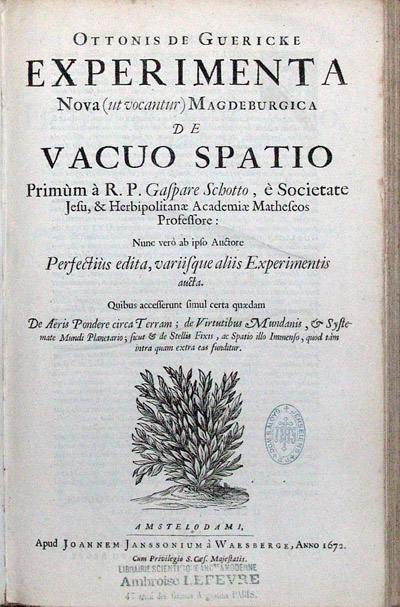
This was major. It was also controversial. The results are found in Guericks's Experimenta nova (1672), one of the great classics of science.

The subject of a vacuum or void, that is, nothingness, vexed natural philosophers and theologians. Ecclesiastic Jacques du Bois and Jesuit scholars Athanasius Kircher and his assistant and protégé, Gaspar Schott were in the middle of it along with Guericke, a scientist and inventor as well as politician.

"Schott first published what had originally been intended as a brief guide to the hydraulic and pneumatic  instruments in Kircher's Roman museum, expanding it into the first version of his Mechanica  hydraulico-pneumatica [1658]. But he added as an appendix [pp. 441-488] a detailed account of Guericke's experiments on vacuums, the earliest published report of this work. This supplement contributed greatly to the  success of Schott's compendium; and as a result he  became the center of a network of correspondence  as other Jesuits, as well as lay experimenters and  mechanicians, wrote to inform him of their inventions  and discoveries. Schott exchanged several letters  with Guericke, seeking to draw him out by  suggesting new problems, and published his later investigations" (DSB).


Schott, who Guericke cites in the subtitle to Experimenta nova, was a supporter of Guericke. His mentor, Kircher was not; a vacuum is impossible: God fills everything. 
This is one of the few examples of Kircher and Schott in disagreement.


Engraved titlepage.

 "Is it God's immensity or is it independent of God…Guericke's position on this matter emerges in the course of a summary account [in Experimenta nova] of the opinions of the ecclesiastics Jacques de Bois of Leyden and Athanasius Kircher, the eminent Jesuit scholar. In his Dialogus Theologicus-Astronomicus, published in 1653 and directed against Galileo and all his defenders of the heliocentric cosmology, Jacques du Bois had proclaimed the infinite omnipresence of God in an infinite void beyond the world. Du Bois should not have placed the divine essence in an infinite void, complained Guericke, but ought rather to to have declared that ' there is a place or space not in which the divine essence is, but which is itself the divine essence..."

"…[Guericke's] criticism of Kircher differed somewhat…Kircher believed that even if a void culled exist without a body, which he denied, it could not exist without God. In the passage cited by Guericke, Kircher explained that 'when you imagine this imaginary space beyond the world, do not imagine it as nothing, but conceive it as a fullness of the Divine Substance extended into infinity.'  In Guericke's judgment, Kircher was wrong to say that 'God fills all imaginary space, vacuum or emptiness by His substance and presence' and simultaneously deny the existence of empty space. 'For how can God fill what is not' [Experimenta nova, p. 64]. Rather, Kircher ought to have concluded with Lessius that 'imaginary space, vacuum, or the Nothing beyond the world, is God himself,' as he finally does when he announces that the space beyond the world is not Nothing, but is the fullness of Divine Substance.'

"But if space is God's immensity, or even God Himself, Guericke insisted that we must nevertheless understand that 'the infinite essence of God is not contained in space, or vacuum, but is in Himself for Himself" (Grant, Much Ado Abut Nothing: Theories of Space and Vacuum from the Middle Ages to the Scientific Revolution, p. 218-19).

Presuming that your brain, as mine, dissolved into mush during the preceding theologico-philisophico disquisition about nothing, allow me to sum things up: Guericke made something out of nothing, Kircher thought nothing of it, but nothing is divine so let's move on. Don't tell the Know-Nothings, they don't know anything much less nothing.

Someone who, like Guericke, knew something about nothing and possessed it, too, sang about it in 1963, courtesy Jerry Leiber and Mike Stoller.

  ____________


[KIRCHER, Athanasius. SCHOTT, Gaspar]. GUERICKE, Otto von. Experimenta Nova (ut vocantur) Magdeburgica de Vacuo Spatio Primùm à R.P. Gaspare Schotto . . . nunc verò ab ipso Auctore Perfectiùs edita, variisque aliis Experimentis aucta. Quibus accesserunt simul certa quaedam De Aeris Pon Amstelodami [Amsterdam]: Johannes Jansson zu Waesberge, 1672. 

First edition. Folio. 8 ff. (including the engraved title), 244, (4) pp., errata leaf. Engraved title, engraved portrait of the author, two double-page engraved plates ((including that of the famous Magdeburg experiment and twenty engravings, many full-page. 

Dibner, Heralds of Science, 55 (pp. 30 & 67). Dibner, Founding Fathers of Electrical Science, pp. 13-14. D.S.B., V, pp. 574-76. Evans, Exhibition of First Editions of Epochal Achievements in the History of Science (1934), 30. Horblit 44. Sparrow, Milestones of Science, p. 16.
___________

Images courtesy of Martayan Lan, with our thanks.
___________

Another existential brain-twister:

The Story of Nobody, By Somebody, Illustrated By Someone.
___________
___________

Monday, January 14, 2013

In Search Of Athanasius Kircher

by Stephen J. Gertz


In 1602, the year of Jesuit polymath Athanasius Kircher’s birth, the study of nature was called natural philosophy. At his death in 1680 natural philosophy died with him; “science,” as we understand it today - the investigation of the natural world through rational, evidence-based means - had overtaken the old world and Kircher, the most celebrated figure in the world of knowledge of his time.

The 17th century was the most fascinating era in the history of scientific inquiry. It was an estuary for science, the rivers of ancient and medieval thinking about nature meeting and mixing with the nascent sea of rationalism in a fertile zone of transition, diversity, and productivity. Athanasius Kircher was in the middle of it all, a towering figure whose reputation for wisdom, knowledge, and erudition awed his contemporaries of the century’s first generation. The strange, the curious, and the marvelous were his stock and trade. Kircher was the Einstein of his age, a genius, the man with  all the answers, the most famous “scientist”  in the world.


The second generation remained in thrall of him but began to perceive cracks in his work (Leibnitz went from adore to abhor), which covered everything: astronomy, linguistics, microscopy, geology, chemistry, musicology, Egyptology, horology, medicine, magnetism, optics, pneumatics, mathematics, Hermeticism, you name it. He was, as characterized by scholar Paula Findlen, “The Last Man Who Knew Everything,” a grandiose statement yet not without truth. In Kircher’s time, the sciences had not yet split into separate and distinct entities and what was known about each was fairly limited. An omnivorous, insatiably curious intellect could be aware of all that was going on. Kircher was that man, an encyclopedia with legs.

From his base in the Vatican in Rome he stood at the center of The Republic of Letters, the vast international Jesuit network of correspondents. He was the hub through which knowledge from the four corners of the earth passed, collecting information and then distributing it through his letters and books.

By the time the century’s third generation of scientists began to assert themselves, however,  Kircher was old news, his reputation tattering, his life’s work derided. As time passed he was relegated to the scrap-heap and became a curious footnote in the history of science.

That changed in 1966, the year that John E. Fletcher completed his 900-page Master’s thesis on Kircher (published in 2011), the first in-depth inquiry into the man, his work, and his world. The thesis - more a doctoral dissertation - Athanasius Kircher, ‘Gernamus Incredibilia’: A Study of his Life and Works with a Preliminary Report upon his Unpublished Correspondence, opened a big door in academia. By the 1990s, scholars from around the world had rushed through it and the Kircher renaissance was in full flower. His importance in the history of science has been firmly re-established. It is impossible to understand the 17th century without coming to terms with Athanasius Kircher and his legacy.


Now, John Glassie, a former contributing editor to The New York Times Magazine, has written a biography, A Man of Misconceptions, to introduce Kircher to a popular readership. This is important. When we think of science in its modern beginnings we think of Isaac Newton, its father. But Kircher was Newton’s scientific grandfather; he influenced everyone in his heyday and immediate wake, even his dissenters, who were inspired to correct his mistakes. He was ultimately proved wrong about just about everything he wrote about, and he wrote a  lot, over thirty books, each, for the most part, huge tomes lavishly illustrated with some of the century’s finest, most dramatically designed copperplate engravings, all created under Kircher’s direct supervision. His books were must-reads for the 17th century cognoscenti.

It is what he was so wrong about and why that makes Kircher one of the most fascinating characters to have ever trod the world stage.

First edition, 1658.

He believed that inner Earth was populated by demons and goblins - but not pygmy men; don’t be silly. He believed in palingenesis, which has nothing to do with the origins of a certain ex-governor of Alaska but everything to do with regenerating plants from their ashes; he claimed to have done it; alas, no one could replicate his success. A method to heal a wound at a  far distance from the wounded without direct intervention? Sure. A machine that organized the chaos of knowledge into an easily comprehensible order? Done that. Sunflower seeds that tell time? You betcha. Snake stones with magic properties? Why not? Rivers of fire within Earth? You doubt it? Christianity in ancient China,  way before the Jesuits arrived in the 16th century? Kircher saw evidence. The lost mysteries of the universe found in Egyptian hieroglyphics? Kircher was sure he’d discover them.

These are the sorts of things that Kircher whole-heartedly embraced. It was not unreasonable, then, for Glassie to have subtitled his bio, The Life of an Eccentric in a World of Change.

Third edition, 1678. (First edition, 1664, i.e. 1665).

Yet “eccentric”  is a misnomer. It is only in retrospect that Kircher can be viewed so and only out of context. The comic possibilities in his life and work are certainly apparent - Kircher, in his autobiography, a posthumously published (1684), slight octavo volume of 78 pages, inadvertently keys into them, his early years related as a sort of Perils of Pauline as told by a somewhat pompous dignitary astonished at every footstep by each adventure, his survival, and the grace of God and the Virgin Mary. Glassie often tends to mine the comedy of Kircher, a rich vein to be sure but not the mother lode.

When Kircher was wrong, he was very wrong. His published a formula for squaring the circle that met with scorn and outright amusement by his fellow mathematicians. Contemporaries, often friends, wrote entire books refuting Kircher. Italian poet and scientist, Francesco Redi (1626-1698), devoted his Esperienze intorno alla generazione degl’insetti (1668) and Esperienze intorno a diverse cose naturali (1671) to demolishing Kircher’s ideas on regeneration and spontaneous generation. When he later wrote a letter to Kircher outlining the negatives in Kircher’s claim of the miraculous healing powers of the snake-stone, that did it.

From Kircher's Arca Noë (Noah's Ark, 1675).

Kircher never responded to his challengers; he had surrogates handle the dissenters. His disciple and assistant, Guiseppe Petrucci, wrote Prodromo apologetico alli studi Chircheriani (1677) to attack the “envious and strident ignorance of his unjust accusers.” As seen in  the book's engraved title-page, Petrucci is writing a very long scroll to the heavens while sitting on the back of Kircher's critics, symbolized by a crocodile with a cherub on its beak to keep its mouth shut, Kircher's books at his feet with vultures picking at them; there was a lot to defend.

But when Kircher was right, he was dead-on correct. In Scrutinium Physico-Medicum...Pestis (1658), he was the first to propose the germ theory of contagion, the most significant contribution to medicine since William Harvey’s discovery of the circulation of blood in 1628 (De Motu Cordis). He correctly gleaned the relationship between heiroglyphics and the Egyptian Coptic language. There are other examples. His convictions were absolute and unshakeable.

Engraved title page to  Petrucci's
Prodromo apologetico alli studi Chircheriani (1677).

He had, however, a soft-spot for the curious and strange, and was often persuaded by the slimmest evidence of the incredible. But he was not alone in that. To one degree or another, every natural philosopher and serious thinker of the 17th century was fascinated by what nature was revealing to them in their observations and studies. It was a world of marvels and wonders all to the glory of God and the majesty of His creation, often strange and bizarre but, as was slowly becoming manifest, knowable in a reliable way.

From the early 1630s through the late 1660s, Kircher’s influence was felt everywhere in the sciences and other areas of intellectual inquiry. He was the elephant in the Vatican, second only to the Pope in public awareness but probably more interesting as a tourist attraction for visiting dignitaries, of which there was a steady stream. Making the pilgrimage to see him and his museum of natural curiosities and marvelous machines was like a trip to Disneyland with Walt as personal guide. (He loved building ooh-ahh sundials, clocks, and machines; he was a gadget freak. Born in the 20th century but with 17th century perspective, Kircher might have invented Magic Fingers: A Miraculous Device to Bring the Muscles of the Human Body and the Mind Into a State of Complete Blissful Relaxation While in a Supine Position Upon a Mattress in a Cheap Roadside Hostelry). Kircher can be accused of many things but eccentric is not one of them. He was completely of his time and no one thought him nutty. He was the most distinguished citizen of the  world of knowledge. The rationalists of the era did not grow up in a vacuum.

For the last six years it has been my ongoing privilege to be deeply involved in building the world’s finest collection, public or private, of Kircher’s books in all significant editions and translations and more: first editions of books that influenced him, that he influenced, were dedicated to him, referred to him and his work, positively or negatively, and/or were written by a significant friend or correspondent (there were many), in the finest copies obtainable. The client is a man of vision. One day Athanasius Kircher and His World will be donated to the collector’s alma mater where it will dwarf in size and scope the Kircher collections at Stanford and Brigham Young universities. Reading all the significant literature in English about him including many of Fletcher's papers, identifying, finding, putting each book into perspective within Kircher’s universe and writings, and composing a compelling story for the client continues to be a personal joy as well as a professional responsibility.

Glassie’s book was a pleasure to read, even if, at times, I was frustrated by his reliance on entertainment to put Kircher across. After six years of immersion I feel as if I know the man. But readers who love interesting non-fiction narratives, are attracted to the unusual (which is just about all of us), love to learn about fascinating people and interesting times and have some fun, too, will enjoy A Man of Misconceptions.

MATHER, Cotton. The Christian Philosopher:
A Collection of the Best Discoveries in Nature,
With Religious Improvements.
First edition, London: 1721.
Second edition, Boston: 1815.

In 1721, forty-one years after Kircher’s death, the esteemed Jesuit came to America via the first book written by an American (and the first book, period) to introduce the new world of science and its marvels to the Colonies. The Christian Philosopher: a Collection of the Best Discoveries in Nature with Religious Improvements cites Kircher and often, his work presented on a par with that of Robert Boyle, Hooke, and Newton, with some of the dubious claims of Kircher’s Mundus Subterraneus (1665) accepted at face value. It was written by Cotton Mather, the Puritan pastor of Boston’s North Church, prolific writer, controversial figure in the Salem Witch Trials, and proud member of the Royal Society of Science perhaps best known as Ichabod Crane’s favorite author. In 1815, just shy of a hundred years after its initial publication, The Christian Philosopher was reprinted in an edition published in Boston in 1815, an early year in the Second Great Awakening, the religious revival movement that swept through the United States during the  the 19th century. 

With this book Kircher’s shadow has stretched across the centuries to influence modern Americans. How else to explain Marshal B. Gardner’s A Journey to the Earth’s Interior (1913, reprinted 1920) “showing the Earth bisected centrally through the polar openings and at right angles to the Equator, giving a clear view of the central sun and interior continents and oceans,” a work of pure gibberish and pseudo-science all dressed-up with charts, diagrams, and yes, an illustration of a “working model” of Marshall’s Earth with central Sun. Pyramid power, magnetic bracelets with curative powers, magic rocks in Sedona, Arizona, healing crystals - the New Age movement - is Kircher-land, the 17th century re-asserting itself to declare, I'm still here. Significantly, within Mather’s subtitle was an ill-omen of things to come: “With Religious Improvements,” science mediated by dogmatic faith, the very thing that doomed Kircher. His belief that the world of nature was a magical place whose laws conformed to Catholic tradition was the achilles heel that lamed his thinking,  ultimately too loose and credulous.

There is evidence that toward the end of his life Kircher may have understood that science had changed forever and his critical thinking left something to be desired.

"In the forty years in which I have played a role in this theater of all people," he wrote to the mystic poet Quirinus Kulmann (1651-1689), "I have learned from frequent experience how much trouble may result from an inconsidered piece of writing."

Receipt for a cashed letter of exchange signed by Kircher,
April 21, 1667.

In the end, if Kircher was eccentric it was only in his belief that alchemy was nonsense and its practitioners charlatans at a time when it was still popularly accepted. In later life and after his death Kircher was accused by some of being a charlatan.

It is the supreme irony of seventeenth century science that its greatest paragon of rationalism, the man whose work changed the world and whose methodology became standard, had a dark secret that the Royal Society kept hidden for hundreds of years, suppressing his manuscript papers on the subject lest his towering contributions be stained and deeply discounted. His first and foremost passion, which he pursued to the end of his life, was scorned. It was an embarrassment.  It was so Old World. It was charlatanism. It was a scandal.

Isaac Newton was a dedicated alchemist. You can take  a man out of the 17th century but you can't take the 17th century out of  the man.
__________

All images courtesy of David Brass Rare Books, with our thanks.
__________
__________

Wednesday, October 31, 2012

Beware Of Jewish Doctors, 1937 Edition

by Stephen J. Gertz


The American Medical Association and the editor of The Journal of the American Medical Association come under attack in this thinly-veiled anti-Semitic rant in the form of a allegorical farce in dialogue published in 1937.

The characters who converse include Dr. Gil T. Conscience ("A little too honest to be a successful doctor"), Dr. Buryem Atta Profit ("In partnership with Mr. Undertaker"), Dr. Cuttem Upp ("A versatile surgeon cutting for money"), Dr. Smarty ("Talks too much and tells secrets of the American Meddlers Association"),  Dr. Skinnem Alive ("His scruples never interfere with his money-making"), Dr. Pop Off (" A free-thinker - resigned from the American Meddlers Association"), Dr. Getsum Moore ("A very frugal person with his eye on the money"), the Milo Brothers ("Owners of a great money-making hospital," i.e. the Mayo Clinic), and the Hebrew harbinger of all ill-health and medical hooey, Dr. Morey Fishback Kike ("A notorious quack and leader of the American Meddlers Association").

Dr. Kike is the thinly-veiled Dr. Morris Fishbein (1889-1976), editor of the Journal of the American Medical Association 1924-1950, founding Editor of Medical World News (1961), fierce crusader against medical quackery, and strong proponent of regulating medical devices, too many of which were useless yet heavily promoted cures for cancer and all manner of medical woe. For this, he was excoriated by fringe medicos, snake-oil charlatans, and desperate citizens willing to believe anything that promised them relief, no matter how hocus-pocus, unproven, and medical-sounding the malarkey. Evidenced-based medicine was the enemy, and the AMA a corrupt, hook-nosed medical-political machine that needed to be crushed if the profession was to remain open to new, promising therapies no matter how broken the promise, how gimcrack the gizmo.

There is, of course, no anti-Semitism intended in this scurrilous little pamphlet. It's only a coincidence that Dr. Kike is circumcised, has a Jewish-sounding name, and invites low ethnic epithet. To make sure readers understand her pure intent, Ms. Rogers, a naturopath, offers the following disingenuous defense in the Preface:

"Because the villain in this story happens to be a Jew, I do not wish to leave the impression that there is anything wrong with the Jewish people - their honesty, their integrity, or their methods of doing business. I am only using the term American Meddlers Association, because I have heard this term used in an amusing and interesting manner. As far as I know, there is no such association. Because the villain on this story happens to be a Jew whom I have heard called Dr. Morey Fishback Kike, does not mean that there is such a person."

In sum, it's the rich, money-grubbing Jewish doctors of the AMA who are putting the nation at risk, not good guys like Royal Rife, the microscoptician and electrical engineer who dreamed up a high-frequency emission machine that safely zapped cancer to death. Only it didn't. So the AMA banned it, thus insuring that they would be associated by some with the destruction of an innocent genius who got in its way and the snuffing-out of a medical entrepreneur whose only crime was innovation, not peddling false hope to the desperate. Think Laetrile.

Despite its defamatory nature, American  Meddlers Association was so highly regarded that during the 41st Congress of the American Naturopath Association one of the featured speakers ceded to Esther Rogers his time to address the assembly.

Full disclosure: I was, as a child, one of Dr. Fishbein's star medical students. His Handy Home Medical Advisor (1957) was my bible when seeking an innocuous yet serious-enough childhood ailment whose symptoms I could reasonably fake and get out of school for a day, a week, a month, and, in one case, four months - a miracle of modern medical science:

Based upon careful study of his description I successfully feigned infectious mononucleosis as a ten year old fourth-grader, so successfully that when tested by my pediatrician I actually had infectious mononucleosis. Dr. Fishbein was a genius, and I suspect that I was not the only kid who got through childhood by earning a Ph.D in Pre-Pubescent, Pubescent, and Adolescent Medical Truancy and Malingering while under his tutelage. He was a medical meddler only in the eyes of my parents. To me, he was Doc Marvel, The Man Who Made School Stop.
__________

ROGERS, Esther. American Meddlers Association... Ethical -- Ultra-ethical! Kansass City, MO: Esther Rogers, 1937. First edition. Octavo. 32 pp. Original yellow-orange wrappers.
__________

Image courtesy of Garrett Scott, the Bibliophagist, currently offering this item, with our thanks.
__________
__________

Thursday, October 18, 2012

Magnificent 17th Century Maps To The Stars' Homes

by Stephen J. Gertz

 Unidentified Los Angeles rare book dealer offering celestial maps.

Here in Los Angeles you can't throw a rock without hitting a star. They're all over the place, a galaxy of celestial bodies drawn into the black hole that is The Polo Lounge at the Beverly Hills Hotel, where red giants, white dwarfs, red dwarfs, neutrons, and super giants orbit around lox and bagels, alfalfa spouts, and baby carrots. Some have exhausted their hydrogen core and their careers slowly extinguish; others remain Main Sequence and still pack a punch, astrofusion-wise.

Withal, there are so many stars that you need maps to know just where they rest in the firmament and what region of the universe they call home.

CELLARIUS, Andreas. [The sizes of the celestial bodies]
Corporum coelestum magnitudines.
Amsterdam, Schenk & Valk, 1708.
Original color with additions, including gold highlights. 440 x 515mm.
'The sizes of the celestial bodies, with borders filled with putti.

Fortunately, a collection of star maps from Andreas Cellarius' Atlas Coelestis; seu Harmonia Macrocosmica, the only celestial atlas to be produced in the Netherlands before the nineteenth century, has just come into the marketplace.

CELLARIUS, Andreas. Scenographia Systematis Copernicani.
Amsterdam, Schenk & Valk, 1708.
Original color with additions, including gold highlights. 440 x 515mm.
'The Scenography of the Copernican world system', showing a human-faced
Sun at the centre of the Solar System, lighting the sides of 'Earths', positioned
at each equinox, three of which show California as an island. The four corners
are filled with angels, putti and allegorical figures.

A compilation of maps of the Ptolemaic universe and the more modern theories of Copernicus and Brahe, the Atlas Coelestis remains the finest and most highly decorative celestial atlas ever produced. Engraved by Jan van Loon, a mathematician and engraver who contributed charts and maps to various pilot books and sea atlases by Jacobsz, and Robijn, and originally published by Jan Jansson in 1660, these plates come from Schenk & Valk's reissue of 1708.

CELLARIUS, Andreas. [Southern Celestial Sphere]
Haemisphaerium Stellatum Australe aequali spahaerum propotrione.
Amsterdam, Schenk & Valk, 1708.
Original color with additions, including gold highlights. 440 x 515mm.
A celestial chart showing 'The southern stellar hemisphere with equally
 proportioned spheres'. It shows the classical constellations superimposed
over a globe on which can be seen the Americas.

"The highpoint of celestial atlas production…and the volume that ranks with Blaeu's Atlas Maior and Goo's Ze Atlas is Harmonica Macrocosmica…by Andreas Cellarius.

CELLARIUS, Andreas.
Haemisphaerium scenographicum australe coeli stellati et terrae.
Amsterdam, Schenk & Valk, 1708.
Original color with additions, including gold highlights. 440 x 515mm.
A beautiful chart of the southern skies with the classical constellations
superimposed over a globe showing South America, southern Africa
and 'Terra Australis Incognita'. The title banners are held aloft by grotesques
and in the bottom corners are astronomers surrounded by instruments
including an astronomical telescope.

"Published by Jan Janson in Amsterdam in 1660, the atlas comprises some 29 star charts and diagrams which portray varying celestial and planetary systems, orbits, and theories.

CELLARIUS, Andreas.
Haemisphaerium Stellatum Borealecum Subiecto Haemisphaeio Terrestri.
Amsterdam, Schenk & Valk, 1708.
Original colour with additions, including gold highlights. 440 x 515mm.
A beautiful chart of the Northern skies, depicted on a globe held up by
Atlas and Hercules. The constellations are superimposed over a globe
on which much of the Northern Hemisphere can be seen, including
the British Isles, Arabia, Borneo, Japan and parts of Canada.
In the top corners the title is on banners under trumpets blown by angels.
In the background are figures representing classical astronomers.

"Little is known of Cellarius besides the information provided within the atlas, that he was a Rector of the Latin School at Hoorn, 20 miles north of Amsterdam..

CELLARIUS, Andreas. [Celestial chart of Tycho Brahe's theories of the Universe]
Planisphaerium Braheum, sive structura Mundi Totius, ex hpyothesi
Tychonis Brahei in plano delinieata.

Amsterdam, Schenk & Valk, 1708.
Original color with additions, including gold highlights. 440 x 515mm.
A beautiful celestial chart depicting the planisphere of Brahe, or the structure
of the universe following the hypothesis of Tycho Brahe drawn in a planar view
.

"The format of most engravings is similar - a sphere occupying the sheet top to bottom within which the diagram or chart is positioned, allowing up and down each side, decoration of an instructional, symbolic or purely aesthetic nature.

CELLARIUS, Andreas. [Celestial chart showing the Phases of the Moon]
Typus selenographicus lunae phases et aspectus varios adumbrans.
Amsterdam, Schenk & Valk, 1708.
Original colour with additions, including gold highlights. 440 x 515mm.
A celestial chart showing a 'Selenographic diagram depicting the varying
phases and appearances of the Moon by shading.' At the centre is the earth,
surrounded by the different phases of the Moon.

"The Cellarius charts, issued in 1660, 1661, 1666, and 1708 (as here), occasionally appear on the market and can be found in superb, bright, original colour, highlighted with gold, making them highly decorative items.

CELLARIUS, Andreas.
Haemisphaerium Stellatum Australe antiquum.
Amsterdam, Schenk & Valk, 1708.
Original color with additions, including gold highlights. 440 x 515mm.
A beautiful celestial chart of the stars as known to the Ancients,
with the classical constellations.
The borders contain the titles on banners and several putti.

"The later edition of 1708 has the imprint of of the publishers Valk and Schenk on each engraving..

CELLARIUS, Andreas.
Coeli Stellati Christiani Haemisphaerium Prius.
Amsterdam, Schenk & Valk, 1708.
Original color with additions, including gold highlights.  440 x 515mm.
A beautiful celestial chart of the constellations, depicting them not in the
traditional Greco-Roman figures but in Christian imagery as envisaged
by Julius Schiller in 1627 in an attempt to make the iconography of the
stars more relevant to his day. Thus the Zodiac is represented by the
Twelve Apostles and Pegasus has become Gabriel. All the figures are
shown face on, because Schiller thought it would be an indignity to have
them show their backsides. His changes did not catch on, causing him
often to be ridiculed, but when they were published his charts were the
most accurate available.

"...The elegant title page represents fully the contents of the book. each of the charts is well-designed, well-engraved, and often…is in fine original colour heightened  in  gold" (Potter, Collecting Antique Maps, pp. 173-74).

CELLARIUS, Andreas. [The Universe according to Ptolemy]
Situs Terrae Circulis Coelestibus Circundatae.
Amsterdam, Schenk & Valk, 1708.
Original color with additions, including gold highlights. 440 x 515mm.
A beautiful chart representing the Ptolemaic notion of the static Earth
at the center of the rotating universe.

On the title page, "The Muse of Astronomy, Urania, is surrounded by scientists, mathematicians and astronomers and celestial globes and observation equipment. At lower right a bound volume is typical of the fine red morocco binding with gold embossing, used in Amsterdam at the time.

CELLARIUS, Andreas. [Scenography of the Ptolemaic cosmography]
Scenographia systematis mundani Ptolemaici
Amsterdam, Schenk & Valk, 1708.
Original color with additions, including gold highlights. 440 x 515mm.
A beautiful celestial chart showing Ptolemy's theory of the Universe.
At the centre is the Earth, showing its eastern hemisphere, being circles
by the sun and planets, with the Zodiac.

"Two cherbus hold aloft the book's title on a banner whilst another couple, using cross-staffs, study the zodiacal signs of Libra and Virgo" (ibid).

It's highly unlikely that, while driving on Sunset Blvd. in Beverly Hills or Bel Air, you will encounter a rare bookseller hawking Andreas Cellarius's magnificent star maps from the curb. But if falling star Sylvester Stallone's career finally lands with a thud, you may see him on the corner of Sunset and Beverly Drive spinning a sign offering these star maps as if hustling apartment rentals or discount income tax preparation.

Twinkle, twinkle.
___________

Title-page to 1660 first edition.

CELLARIUS, Andreas. Harmonia macrocosmica: seu, Atlas universalis et novus : totius universi creati cosmographiam generalem et novam exhibens : in quâ omnium totius mundi orbium harmonica constructio, secundum diversas diversorum authorum opiniones, ut & Vranometria, seu totus orbis coelestis, ac planetarum theoriæ, & terrestris globus, tam planis & scenographicis iconibus, quam descriptionibus novis ab oculos ponuntur : opus novum, antehac nunquam visum, cujuscunque conditionis hominibus utilissimum, jucundissimum, maxime necessarium, & adornatum. Amstelodami: Apud Gerardum Valk & Petrum Schenk, 1708.

Fourth edition. Folio. 29 double hand-colored engraved plates.
__________

Chart images courtesy of Altea Gallery Antique Maps of London, currently offering these splendid charts, with our thanks. Today's header image is most certainly not of its proprietor, Massimo De Martini.
__________
__________
 
Subscribe to BOOKTRYST by Email