Showing posts with label Comic Books. Show all posts

Tuesday, August 14, 2012

Breaking Rare Book News: Tarzan Dumps Jane, Boy Broken-Hearted

By Stephen J. Gertz

I suppose it had to happen. Another episode of Splitsville. I had no idea their relationship was on the rocks.

After living in sin and swinging around the jungle with Jane Porter for years, Tarzan, Lord of the Apes, né Lord Greystoke, has decided, it seems, to throw her to the lions and monkey around with Gloria, another Great White Woman, here in trés chic Chanel, who, apparently, on the way to Altoona, PA, got on the wrong Trailways bus and wound up in Africa.

She met the Ape-Man, who, reportedly in the midst of a mid-life crisis, was vulnerable to her charms. She put the pep back into his tired jungle cry. He was a goner.

These are the first editions in French of Tarzan comic books Nos. 1 & 2 (1936, 1937), originally published in the United States in 1929 and illustrated, as here, by Hal Foster.  P.F. Caillé was responsible for the French adaptation.

Hal Foster (pseudonym of Harold Rudolph Foster, 1892-1981) quit his art studies and followed an adventurous life, big-game hunting and searching for gold. He returned to his home town, Chicago, in 1921, resumed his art education, first at the Art Institute of Chicago, later at the National Academy of Design, and committed himself to art. 

He began as a book and advertising illustrator and soon developed a solid reputation. In 1929, he was asked to illustrate the comic-strip and comic book editions of Tarzan, based upon the 1914 (Chicago: A.C. McClurg) novel by Edgar Rice Burroughs, Tarzan of the Apes,  that spawned the successful series of books that captured the imagination of children and adults and led to a multimedia empire. 

The family in happier times..

Tarzan and Gloria? It could have been worse. Tarzan and Sheila, Tarzan and Gertrude. Tarzan and Hermoine. Tarzan and Tallulah. Or, in a more up-to-date mating with a  light bestial touch, Tarzan and Bambi.

Decades will pass before the full impact of his parents' split hits Korak ("Killer") aka Boy, by then, hopefully, Man, and he fully grasps that his failed relationships, anger and depression, substance abuse, spotty employment record, and unnatural attraction to lower primates of either sex stem from this tragedy when his mom, Jane, disappeared,  and Tarzan took sides with his evil step-mother, Gloria, making his adolescence a living hell and conflict with Pops a daily routine. Divorce is a jungle.
__________

Booktryst is pleased to have scooped TMZ  the National Enquirer, the Huffington Post, the Star, Daily Mail, and other tabloids on this story.  
__________

BURROUGHS, Edgar Rice. Tarzan No. 1 and No. 2. Illustrations de H, Foster. Adapt. française de P.F. Caillé. Paris: Hachette, 1936, 1937. Tall octavos. 64; 48 pp. Quarter yellow cloth over pictorial boards.
__________

Why P.F. Caillé kicked "Jane" to the curb and instead used the name Gloria remains a mystery, Hachette has a lot to answer for.
__________

Book images courtesy of Harteveld Rare Books Ltd, currently offering this item, with our thanks.
__________
__________

Tuesday, May 15, 2012

Hey Kids, Viva La Revolucion With Fidel And Che!

By Stephen J. Gertz

Front wrapper.

Madres y Padres! Los hijos falling asleep during El Líder's interminable orations? Are they missing out on the detailed history of the glorious revolucion? Is the ideology of sharing everything they own with everybody else here in our island paradise leading to counter-revolutionary sass? Are you dangerously harboring dissident tikes? State Security sniffing your kids' laundry?

Fear not! Album de la Revolucion Cubana is here!

The Coup of March 10th.

From the voyage of The Gramma returning Tios Fidel, Raul y Che to Cuba from exile in Mexico to spearhead the war against capitalist exploitation in 1956, all the way to Batista's fall, in 1959, every action-packed episode tells of the bravery y cajones of our comrades in the struggle.

Landing of  the "Gramma," the yacht that ferried Fidel,
Raul Castro, and Che Cuevara from Mexico to Cuba
on November 25, 1956.


But, you may ask, how can I acquire this great primer for pre-pubescent Fidelistas when I can't even buy little Juanny a pair of shoes?

Leaders of the Revolucion.

We have heard The People. Album de la Revolucion Cubana is free! Free, I tell you, a gift from The People to The People. Just buy cans of Felices Frutas - "Las Más Exquisitas Frutas Cubanas" - and the album and one of the 268 cards in the set are free! Free, I say! Simply buy 268 cans of Felices Frutas to collect them all for your kids, have them read and mount each in their proper place in the album, and their political credentials are in order!


Think of them as Cuban baseball cards, revolutionary propaganda division. Happy Fruits beget happy children free from the pernicious anxieties associated with opposition politics on the see-saw and jungle bars.

Triumph of the Revolution, Fall of Batista.

Our glorious heroes won the revolucion with guns. Album de la Revolucion Cubana will arm our beautiful angelitos with Marxist-Leninist spirit!


Act now! Don't delay! The future of the revolucion is in the hands of our children. Support our nascent canned fruit industry, support the Revolucion, and prepare our children for life in communal paradise. It's a three-fer for Cuba. Los Cubanos, do your duty!

Advertensia! Children caught defacing the portraits of our leaders in Album de la Revolucioin Cubana by erasing moustaches and beards will be detained for re-education in a reform facility.
__________

[CHILDREN"S PROPAGANDA]. PICART, J.M. and Mario Jimenez. Album de la Revolucion Cubana: 1952-1959. Habana: Editorial Echevarria, 1959. First edition. Oblong quarto (12 x 8 3/4 inches). 32 pp. 268 numbered picture cards, mounted in numbered space, with printed captions. Drawings by  Capdevila. Pictorial wrappers.

Distributed free to buyers of Felices Frutas. OCLC records a reprint by Habana: Revista Cinegrafico, 1960.
__________

Images courtesy of Aleph-Bet Books, currently offering this item, with our thanks.
__________
__________

Friday, January 14, 2011

Comics Get Stripped At The Museum Of Sex

By Nancy Mattoon


A History Of Dirty Drawings By Craig Yoe,
Curator of the
Comics Stripped Exhibit.


One of the greatest things about art, whether it consists of words or images, is that it can create fantasy worlds that have never existed, and never could. Mention the literary genre of fantasy, and the first images that come to mind might be unicorns, fairies, swords and sorcerers, or other stock elements of children's books. But another kind of fantasy, the adult, sexual kind, has also inspired a genre of art with its own instantly recognizable icons: voluptuous women and muscle-bound men; fetish clothing featuring six-inch stilettos, leather, lace, and latex; bondage gear including handcuffs, masks, and corsets; and sadomasochistic props like whips, chains, and ropes.

Craig Yoe's Arf Forum,
"Celebrating The Unholy Marriage
of Art & Comics."


Call it erotica or pornography, the art that sexual fantasies inspire is as transcendent, and as impossibly unrealistic, as anything found in the worlds of Harry Potter or The Wizard of Oz. New York City's Museum of Sex has just mounted (pun intended) a new exhibition of the erotic art of comic strips and comic books in the 20th and 21st centuries, to "reveal how the comic book medium has been used over time to depict sexual fantasy, poke fun at taboo topics and lampoon icons of popular culture." Comics Stripped, a show made up of over 150 artifacts, including original drawings, illustrated books, comic books, magazines and videos, chronicles the history of "dirty drawings" from the Great Depression to the present day.


A Selection Of Tijuana Bibles.
(Image Courtesy of The Museum of Sex.)

The exhibit begins with 18 examples of the rare, underground comic books known as "Tijuana Bibles." These cheaply-produced pulp paperbacks, clandestinely published in the 1930's, often featured well known mainstream comic strip characters, such as Blondie and Dagwood, or Popeye and Olive Oyl, engaged in graphic sexual activity. In what may well be the most shocking statement in the exhibit's press release, the Museum of Sex staff maintains these crude little comics were frequently used by teenagers as sexual "instruction books." (A reminder that responsible sex education in the home is always the smart move...) Despite their lowbrow pedigree, the Museum points out that some notable comic book artists moonlighted by producing "bibles," including Wesley Morse, who created the Bazooka Joe and Gang characters featured inside the wrappers of Topps' bubble gum.

Cartoonist Wally Wood's
Erotic Take On Superman.

(Image Courtesy of The Museum of Sex.)

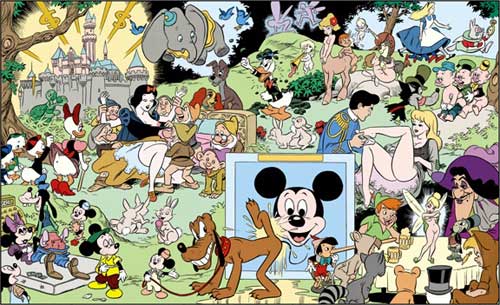
Tijuana Bibles also took on the most sacred cows of wholesome cartoon characters, those created under the auspices of Walt Disney. Featured in the Museum of Sex exhibit are two rare (and Disney wishes rarer) "bibles" featuring Donald Duck and Snow White and the Seven Dwarfs in compromising positions. Another artifact lampooning the squeaky-clean Disney characters is a centerpiece of the show. The Disneyland Memorial Orgy, a tableau drawn by Wally Wood, and published by Paul Krassner in his counterculture magazine, The Realist, hit the newsstands in 1967. Surprisingly, the ever litigious Magic Kingdom chose not to sue the orgy's creators, in order to avoid bringing any more attention to the blasphemy. (For those of you can't wait to see Goofy having his way with Minnie Mouse, a link is thoughtfully provided here.)


Joe Shuster's Cover Illustration
For The First Issue of Nights Of Horror.

(Image Courtesy of The Museum of Sex.)

But Goofy and Minnie Mouse were far from the only comic icons to be eroticized by the sexual comics, or comix, movement. Artist Joe Shuster, co-creator of DC Comics world-famous Superman, drew sadomasochistic scenarios featuring Lois Lane and Clark Kent for his Nights of Horror, a fetish comic book series. And Eric Stanton's Blunder Broad series starred a less-than-wonderful version of Wonder Woman, forever enduring sexual humiliations due to her own ineptitude. Five original issues of issues of Nights of Horror will be on display during the exhibition as well as six original illustrations from Blunder Broad.


Cover Image Of A Collection Of
Playboy Cartoons By Eldon Dedini.


The exhibit also features the erotic cartoon art of risque "men's magazines" from Captain Billy's Whiz Bang, through Ballyhoo, and on to Playboy. Of the Playboy cartoonists, the Museum's press release notes, "Visitors to Comics Stripped will enjoy original art, on loan from the Playboy Enterprises, Inc., of iconic Playboy artists Jack Cole (1914-1958) and Eldon Dedini (1921-2006). Cole may be best known for creating the superhero Plastic Man. His cartoons for Playboy became the gold standard for creating cartoons published in the popular men's magazine. Dedini's watercolor depictions of horny satyrs chasing voluptuous nymphs were an iconic Playboy feature."

A Candy Bar Wrapper Featuring R. Crumb's "Devil Girl."
(Image Courtesy of The Museum of Sex.)

Comics Stripped also examines the ongoing censorship of erotic comics in the United States, culminating in the creation of Comics Code Authority in 1954. The repressive legislation of the red-baiting McCarthy Era ironically led to the proliferation of underground publications, containing outrageous, shockingly graphic images, deliberately unsuitable for publication in even the raciest mass market men's magazine. The most famous artist who got his start in those publications was R.Crumb, the creator of such characters as Fritz the Cat, Mr. Natural and Devil Girl. Comics Stripped includes many of Crumb's original drawings, which have recently been on display at the Hammer Museum in Los Angeles, and the Whitechapel Art Gallery in London. Homoerotic comic art from gay underground publications is also on show at the Museum of Sex, including the iconic work of Tom of Finland, who proudly proclaimed: "If I don't have an erection when I'm doing a drawing, I know it's no good."

Craig Yoe's Well Reviewed Book On
The Fetish Art Of Joe Shuster.


Comics Stripped was created by Museum of Sex Curator Sarah Forbes, and Guest Curator Craig Yoe. Yoe has been called "Indiana Jones of comics historians," the "archivist of the ridiculous and sublime," and "a fine cartoonist and a comic book historian of the first water." He is the author of the definitive work on Superman's co-creator, Secret Identity: The Fetish Art of Joe Shuster (Abrams ComicArts, 2009). Yoe himself modestly says of his curatorial duties for Comics Stripped, "Many artists of 'dirty drawings' had full time gigs in mainstream entertainment. I consider myself to be following in a fine tradition of men who knew what they wanted and how to put it on paper." Knowing what you want, and knowing how to put it down on paper--a perfect description of the art of sexual fantasy.

Comics Stripped opened at the Museum of Sex on January 13, 2010, and continues indefinitely.
__________

Thursday, October 14, 2010

Graphic Novels Go Platinum At The School Of Visual Arts

By Nancy Mattoon


Illustration From Gant Powell’s Graphic Novel,
Letters to Guilford Norton Thomas Whitleim:
A Collection of First-class Problems.

(Image Courtesy of School Of Visual Arts.)


When French novelist Jean-Baptiste Alphonse Karr wrote in 1849, "Plus ca change, plus c'est le meme chose," he wasn't talking about graphic novels. That term, designating a book-length story for adults told in images with or without text, only came into popular use in 1978. But the roots of graphic story telling are ancient.

Illustration From: Poetry and Prose
By Maria Goldfarb.


Paleolithic cave paintings were meant to communicate a narrative, although modern readers can't be sure if the story is ceremonial, religious, or just another "fish story" about the big one that got away. Egyptian hieroglyphics were a combination of letters and pictographs, or characters that look like what they represent. And early Christian Church fathers used icons and illuminated manuscripts to help get their message across to would-be converts, most of whom were illiterate.


A Page From Miss Eggplant's American Boys,
By Jungyeon Roh.


Swiss artist Rodolphe Topffer (1799-1846) is considered to be the granddaddy of comic strip art and graphic novels. His comic tales of love and loss were told through sequential autography, a looser form of the lithograph. Toppfer encouraged artists to "invent some kind of play, where the parts are arranged by plan and form a satisfactory whole."

Philip Bowles' Illustration For
Reflections of Hilario: A Pictorial Essay.


The 21st century ancestors of Toffer are being celebrated in a new exhibit from Manhattan's School for Visual Arts (SVA). The Book Show, is an exhibition of 20 books created by students in the MFA Illustration as Visual Essay Department, curated by Department Chair Marshall Arisman and faculty member Carl Nicholas Titolo. Arisman is proud of the impact of the art form on the publishing world, "If you walked into Barnes & Noble 20 years ago, there was not a graphic novel section. Now it's huge...It's not just 14-year-olds."

Image For Ryan Hartley's
Age Of Exploration.


The range of subject matter in the show, which runs through mid-October 2010 with highlights available online, is staggering. Phillip Bowles' Reflections of Hilario: A Pictorial Essay is based on the true story of Hilario Arguimbau, a prisoner during the Spanish Civil War who produced cartoons to record his experiences. Ryan Hartley's The Age of Exploration is a resource guide and journal for lesbian, gay, bisexual, transgender, and questioning youth, which will be further shaped after the show by students in a Brooklyn after school program. And Jungyeon Roh's lyrical Miss Eggplant's American Boys is based on a 2008 hit single by singer Estelle. It tells the story of an Asian vegan on a quest to meet her ideal man in America.

Jonah By Ben Voldman.

Marshall Arisman notes that his highly selective 20-student MFA program used to produce primarily illustrators of magazines, newspapers, and children's books. These days he says more than 40 percent create graphic novels. SVA alumnus Dash Shaw, who began creating graphic novels as kid, explains, "It's really immediate, if you just have a pen and some paper you can make it. That's different from movies, which require a lot of money." The chair of the BFA Illustration and Cartooning Department of SVA, Thomas Woodruff believes the school's students are part of a brave new world for graphic novels, "We’re in the midst of the new platinum age for sequential art."
__________

Monday, August 16, 2010

The Man Who Hated Comics: Inside The Secret Files

Despite The Lurid Cover, Hal Ellson's Tomboy
Was Based On His Work With Teens At Bellvue Hospital.
Dr. Fredric Wertham Provided The Introduction.
(Bantam 1950)

In a move of great importance to an influential group book collectors and scholars, the Library of Congress (LC) has opened its archive of the papers Dr. Fredric Wertham. The papers were donated to the library in 1987, but their use was limited to those researchers who could obtain written permission to view them from the executors of Wertham's estate. This embargo was in effect until mid-2010, and during the last 25 years only two outsiders have seen this highly restricted collection (.pdf file) of correspondence, memoranda, writings, speeches and lectures, reports, research notes, case files, transcripts of court proceedings, biographical information, newspaper clippings, drawings, and photographs. What secrets are contained in these files? And why were they closed for all these years?

A Caricature From Ladies Home Journal,
November 1953.

(Image Courtesy of Official Seduction of the Innocent Site.)

Archive files are restricted for any number of reasons, and sometimes even the library holding the papers can't say for sure why a collection is off-limits. Libraries would rather not have to house files that take up shelf space, yet are unavailable to researchers. But rather than risk losing an important piece of history, the archive will agree to mark a collection: "Restricted Per: Donor's Wishes." Researcher Michael Barrier received this reply from Library of Congress staffer Leonard C. Bruno, when he inquired as to why his request to see the Wertham papers was denied:

For quite some time now, the Wertham executor has consistently rejected any and all requests for access. These are rejected outright, with no explanation, and apparently without consideration of the requestor's intent, affiliation, explanation, supplication, or anything else. Even requests that have been limited or targeted to only certain containers, rather than for total access, have failed. Unfortunately, you have joined a growing group of scholars unable to gain access.

An Exhibit At the 1954 Senate Hearings
On Juvenile Delinquency.

(Image Courtesy of Official Seduction of the Innocent Site.)

Unless you're already familiar with Fredric Wertham's work, you might be speculating as to what we're talking about here. Espionage? Top Secret Intelligence? Deep cover CIA operations? The Inner workings of the Mafia? The secret formula for Coca-Cola? Nope, Dr. Wertham AKA "The Man Who Hated Comics," was a prominent psychiatrist who became convinced that violent popular culture created violent children. Although Wertham was equally concerned with the detrimental effects of violence on television and in the movies, the area in which his work was most influential was the world of comic books. According to historian Jeet Heer, "For comic-book fans, Fredric Wertham is the biggest villain of all time, a real-life bad guy worse than the Joker, Lex Luthor, and Magneto combined."

First UK Printing of
Seduction of the Innocent.

By Dr. Fredric Wertham.
(Museum Press, 1955.)

(Image Courtesy of Wikipedia.)

Through his publication of the irresistibly entitled 1954 book, Seduction of the Innocent, Wertham crushed the genre known as "Crime Comics," and caused over a dozen comic-book publishers to close up shop. As a direct result, the industry chose to police itself by creating the Comics Code Authority in late 1954, rather than risk government censorship. The code mandated that "excessive violence; lurid, unsavory, gruesome illustrations; sex perversion and "all elements... considered violations of good taste or decency;" no longer debase the pages of American comic-books. Pop culture historian, Catherine Yronwode, believes Wertham's chilling effect on the comics cannot be overstated: "He and he alone virtually brought about the collapse of the comic book industry in the 1950s."

Panic #1
An EC Comic From February 1954.

(Image Courtesy of Wikipedia.)

Wertham has been demonized as a right-wing McCarthyite hell bent on censoring literature that violated his own priggish moral code. But the truth is more complicated than that. He was an extremely progressive voice in the psychiatric world from the 1930's onwards. He founded Harlem's famed Lafargue Clinic in 1946, with support and advice from such notables as Paul Robeson, Ralph Ellison, and Richard Wright, delivering low-cost mental health services to the poor for decades. Wertham's casework with his mostly African-American patients was even used as evidence of the psychological damage caused by racism in the landmark case against "separate but equal" schools, Brown v. Board of Education. The following year, he established the Quaker Emergency Service Readjustment Center in New York, a pioneering effort to treat sex offenders.

Shock SuspenStories #6
An EC Comic From Dec/Jan 1953

(Image Courtesy of Wikipedia.)

Michael Chabon, who featured Wertham as a minor character in his 2001 Pulitzer Prize winning novel, The Amazing Adventures of Kavalier & Clay wrote: "No one who does even the most rudimentary research into Wertham's career and accomplishments can fail to admire him for his compassion, his intelligence, his desire to help children, and his fairly snappy prose style. But Chabon continues, "It was Wertham's boneheaded inferences about the direct causal connection between...comics and 'deviance' in children, [and] the hysteria his inferences helped to foster (along with a counter-hysteria among comics fans) that have tarnished his admirable legacy."

Dr. Fredric Wertham Shocked At Shock
(Image Courtesy of Official Seduction of the Innocent Site.)

The opening of Fredric Wertham's archive by the Library of Congress will allow both detractors and defenders of "The Man Who Hated Comics," to get the straight dope direct from the man himself. There may or may not be any deep, dark secrets hiding in the 222 containers of the doctor's archive, but researchers at last have the opportunity to find out. A tantalizing tidbit from LC Curator Sara W. Duke, makes looking into the collection a must for anyone interested in either comic books or censorship: "The Manuscript Division is keeping the comic books [Wertham used] because he made notations on onion skin paper and inserted them in his comic books." A more direct pipeline into the mind of this complex figure, at least short of Superman's X-ray vision, is hard to imagine.

Note: For those unable to visit the Library of Congress, the Official Seduction of the Innocent Site offers an excellent overview of Fredric Wertham and his influence on popular culture.
__________

Friday, July 30, 2010

Remember The Maine Sardine

A 1960 Comic Book Published By
The Maine Sardine Council

(All Images Courtesy of the Maine Historical Society.)

What happens to the people in a string of small towns when the industry that has been their largest employer for over a century goes belly up? The citizens of coastal Maine are facing just such a crisis. In April of 2010, the last sardine cannery in the United States, located in tiny Prospect Harbor, was closed. The area called "Midcoast Maine" had relied on the many varieties of tiny silver herring, that when processed were sold as sardines, to provide jobs since 1875, when a New Yorker opened the Eagle Preserved Fish Co. in Eastport.

Vacationland Lives, But Sardineland Is Belly Up.

As many as 400 canneries have, at one time or another, been operating along the rocky shores of Maine. Now the sole survivor has been hooked, gutted, processed, consumed, and thrown in the trash can of history. With it not only the jobs, but the traditions and culture associated with the industry, are gone. A way of life taken for granted for generations vanishes. So what happens next?


Among the hardy residents of Maine, the reaction involves preserving and saluting the past, mourning the sad events of the present, and beginning to plan for the future. Mainers (please don't call them "Mainiacs") are among the most resilient people in the world. Whether it is the long, snowy winters; or the fact that Maine is the most sparsely populated state east of the Mississippi; or that it is geographically isolated, being the only state to border on exactly one other state; for whatever reason, the citizens of Maine are tough customers. The Sardine Extravaganza scheduled for August 2010 proves that one more time.


A couple of poets from the coast have proclaimed 2010 to be The Year of the Sardine. These two seemingly mild-mannered wordsmiths are dead set against the canning industry going gentle into this good night. Even their names are an ode to bravery: they are the fearless Karen Spitfire, and the renegade Gary Lawless. These Bards of Belfast and Brunswick have joined forces to organize a series of events which document and celebrate the history of the Pine Tree State's sardine industry.


Their blog, sardinesong.blogspot.com, is the pride of "Sardinistas" from Bath to Bucksport and back again. The site has even spawned a book: Sardine Songs/Herring Hymns collects the writings and images of the many contributors to the blog. Spitfire and Lawless will be on board for the Wayne-Cary Memorial Library's Sardine Poetry Night on July 30. The next day the two will be signing the anthology at the Maine State Museum's All About Sardines festival. Lastly, these two versifiers are trawling for chums to join them at the Herring Gut Learning Center (!) located at 59 Factory Road in Port Clyde to celebrate the village's sardine history and culture.


Up the coast at the Belfast Free Library an exhibit focusing on the city's now closed Stinson's Seafood factory will be on view throughout the month of August. The show will include photos, books, ephemera, and memorabilia from the Belfast Historical Society and Penobscot Marine Museum. Also on display will be original paintings by Barbara Marie and Julie Cyr, celebrating the sardine and the fishing industry. On Tuesday, Aug. 10 the library will host a "Fish Forever" program, including a sardine/herring industry slide show.

All this is just the appetizer for the feast that is Belfast's Sardine Extravaganza on August 21. This day long fair is a salute to fish, fishermen, and fish packers, including a live performance of an improvisational play, For Love of Herring. This one will lure in an audience from all over the State, and bait them into falling hook, line, and sinker, for those shining silver fish. The industry may have breathed its last, but these proud Mainers won't sink into depression. Somehow they'll find a way to fight the tide of unemployment and stay afloat.

__________

Friday, July 23, 2010

Secrets of King Tut's Tomb Revealed Online


 King Tut's First Gig As A Stand-up Comic,
Batman Confidential #26 (April 2009).

(Image Courtesy of Wikipedia.)

In 2009, almost 90 years after the discovery of his final resting place (and over 3,000 years after his burial) the Egyptian Pharaoh Tutankhamun was still famous enough to inspire a comic book villain and a traveling exhibition of relics from his tomb. He's so familiar that he's known by a nickname, "King Tut." But one Egyptologist believes that although we think we know all about our favorite Pharaoh, in fact his tomb still holds many mysteries.

Howard Carter And An Assistant
Examine Tut's Innermost Coffin
, 1922.
Photo By Harry Burton.
(Image ©Griffith Institute. Used by Permission.)

Jaromir Malek is an archivist at one of the finest Egyptology libraries in the world, the Griffith Institute, located in the basement of the Sackler Library at the University of Oxford. The prize collection here contains the notes, diaries, and photographs of Howard Carter, the Englishman who discovered King Tut's tomb in 1922. Amazingly, when Malek began working at the institute, he learned that fewer than one-third of the artifacts recovered from the tomb had been adequately studied and documented. This was a situation he found "unacceptable," so he began a project to "make sure that all of the excavation records are available to anyone who is interested."

A Statue Of Anubis, The God Of The Dead.
Photo By Harry Burton.
(Image ©Griffith Institute. Used by Permission.)

Malek began his database, Tutankhamun: Anatomy Of An Excavation, in 1993. It was an inspired idea, but also a huge undertaking. A total of 5,398 objects were found in the tomb. The artifacts themselves are located at the Museum of Egyptian Antiquities in Cairo, but Carter's notes and photographs were donated to the Griffith Institute, and nearly forgotten. And we're not talking about just a couple of spiral notebooks: Carter documented his finds on more than 3,500 densely written cards. And more than 1,000 images of the excavation were taken by the expedition's photographer, Harry Burton. There were also close to 60 maps and plans of the excavation site, and hundreds of pages in Carter's journals and diaries. Adding to the difficulties, many of these items were extremely fragile.

Howard Carter, On Left, Oversees
the Removal
of Artifacts From King Tut's Tomb.

Photo By Harry Burton.
(Image ©Griffith Institute. Used by Permission.)

As of July 2010, about 98% of the archive has been posted online. And this despite the fact that, due to lack of funding, Malek and his colleagues had to do the entire project in their spare time. Malek believes the are several reasons why so much of Howard Carter's documentation has been neglected by scholars. The sheer size of the find was daunting: Carter spent nearly 10 years cataloging it. And Carter died in 1939, only seven years after the excavation was completed, before he could publish all of his writings. "He started working on the final publication, but he was physically and mentally exhausted after a very hard 10 years," says Malek.

A Shrine Which Held
King Tut's Internal Organs.

Photo by John Ross.
(Image ©Griffith Institute. Used by Permission.)

Malek decided that the only way to be sure Carter's discoveries were studied was to post the entire archive online. "We can't make Egyptologists work on the material if they are not inclined to do so," he says. "But we could make sure that all of the excavation records are available ... then there will be no excuse." Malek not only wants to bring the archive to the general public, but also hopes to put "moral pressure" on Egyptologists, to goad them into studying this momentous collection. "Tutankhamun's is the only royal tomb... that wasn't gutted by [grave] robbers. If we want to know what an Egyptian pharaoh took with him to the afterlife," he says, "it's the only one we can look at. John H. Taylor, who looks after the Egyptian mummies collection at the British Museum in London, agrees. "A lot of the objects will be very unfamiliar to people. What is needed is for schools and people with a more general interest to have access to the basic data and see what's there."

The Sandals Found In Tut's Tomb.
Photo By Harry Burton.
(Image ©Griffith Institute. Used by Permission.)
André Veldmeijer of the PalArch Foundation in Amsterdam describes the online archive as "one of the best things in Egyptology". He has firsthand knowledge of the value of the original photographs taken of the exhumation. Carter and his colleagues, he states, "were the first to see the objects, and therefore saw them in the best condition possible." Veldmeijer looked to the online archive to help him with a study of the shoes found in the tomb. A trip to Cairo revealed that a pair of sandals from the excavation had deteriorated into "an oozing black mess." In the Carter photographs, the same pair was shown in pristine condition, with the leather, gold leaf, and beadwork intact. "It's a good example of how you can get so much more from archaeological research," he notes. "So many excavations have not been properly published."

The Interior of Tut's Tomb, 1922.
Photo By Harry Burton.
(Image ©Griffith Institute. Used by Permission.)

Jaromir Malek believes that the photographs and letters he has scanned into the online archive are the only documents which show the tomb as it was upon discovery. "It seems like just a pile of things, but there is a system...you can see what the thinking behind it was. Nothing in the tomb was accidental. We will not be able to understand the tomb as a unit until all of the objects are properly explained." He hopes the archive's documents will be studied by both scholars and curious armchair archaeologists. "This doesn't belong to Egyptologists only, or even to Egypt only. Everybody should have the right to see what's there."

Monday, January 18, 2010

Library's Keep MLK's Crucial Comic Book

The Comic Book That Changed A Nation.

"The comic book [is] the marijuana of the nursery, the bane of the bassinet, the horror of the home, the curse of the kids and a threat to the future."
John Mason Brown. (American literary critic, 1900-1969)

In December of 1957 a comic book was published that really did threaten the future--at least the future of American segregationists. Carefully preserved in the special collections of several academic libraries, such as The Smithsonian Institution, Morehouse College, and Stanford University, The Montgomery Story, a 14-page comic book is, credited with being one of the most influential teaching tools ever produced for the Civil Rights Movement.

The Comic Book's Depiction Of Press Attention For The Montgomery Bus Boycott.

Published by the Fellowship of Reconciliation (FOR), the comic book bears the name of neither author nor illustrator. It tells the story of the successful 1956 Montgomery Bus Boycott, led by Martin Luther King, Jr. Even more importantly for the future of the Civil Rights Movement, the little comic book that could outlines in a mere two pages the technique of passive resistance used by Gandhi to free India from British rule. The FOR is first and foremost a pacifist organization, and its national field secretary, Glenn E. Smiley, advised Dr. King on the use of Gandhian nonviolence. In a letter to a friend in 1956, Smiley wrote of his hopes for King: "If he can really be won to a faith in nonviolence there is no end to what he can do. Soon he will be able to direct the movement by the sheer force of being the symbol of resistance."

Gandhi's Tactic Of Passive Resistance Graphically Rendered.

By succinctly outlining a strategy for peaceful civil disobedience, the comic became a primer for the students who launched the sit-in movement. On February 1, 1960 four black students sat at the counter of a Woolworth's drugstore in Greensboro, NC, and waited to be served. The students knew that only whites were allowed to sit on the stools at the counter--blacks were to eat standing up. The four men remained, unserved, at the counter until the drugstore closed. The next day the four returned--along with 27 others--to continue the protest. The lunch counter sit-ins in Greensboro, NC attracted nationwide media coverage at a time when civil rights activities had slipped from the headlines. A whole new series of peaceful protests, and a desperately needed publicity boost, were the direct result of college kids reading The Montgomery Story, and putting the words (and the pictures) into practice.

King Preaches Peace In The Face Of Hate.

The use of a comic book as a text for the fight against Jim Crow was inspired on many levels. Comics are cheap to produce; lightweight; small in size; easy to disguise, hide or smuggle; and highly disposable. Joe Wos, founder and director of Pittsburgh's ToonSeum, spoke of the dangers of possessing a copy of The Montgomery Story in the segregated South of the 1960's: "People were told to read it, memorize it, and destroy it because if they were caught with it, they could be killed." It is estimated that 250,000 copies of the comic were printed, but few copies have survived intact.

Klan Violence Comic Book Style.

The use of a simple, graphic format to teach young freedom fighters the techniques Dr. King used in Montgomery was a stroke of genius. Many of the foot soldiers in the army for civil rights were teenagers who had been educated at sub-standard, separate but unequal schools. Those unable to read well can still learn quickly from the pictures in a comic book, and reluctant readers can be lured in by an eye-caching illustration. The Montgomery Story was written to inspire these young victims of segregation to nonviolent action, and to warn them of the consequences. The comic is daringly honest in depicting the Ku Klux Klan's use of cross burnings and bombings to terrorize those seeking equal rights. And time and again the tremendous effort necessary to truly "love your enemies" in the face of hatred and violence is underscored in both words and pictures.

The Montgomery Story In Four Languages.

The Montgomery Story's depiction of the monumental sacrifices, and the great rewards, that await those who seek to end oppression by nonviolent means still resonates around the world. The comic book was reprinted in Spanish shortly after its publication in English, but as recently as 2008 it was translated into Arabic, Farsi, and Vietnamese. The world still heeds these words from Martin Luther King: "Change does not roll in on the wheels of inevitability, but comes through continuous struggle." Sometimes, amazingly, that struggle for change begins with reading a comic book.

 
Subscribe to BOOKTRYST by Email