Showing posts with label Popular Culture. Show all posts

Monday, January 20, 2014

The Sorrowful Saga of Jack Ruby's Pants, Now At Auction

by Stephen J. Gertz

Snap your suspenders auction attenders, Jack Ruby's pants are for sale.

A pair of trousers personally owned and worn by the man who fatally shot Lee Harvey Oswald, assassin of JFK, is being offered by Nate D. Sanders Auctions in its sale ending January 30th at 5PM Pacific. The opening bid is $5,000.

Ruby was not wearing this pair of pants when he shot Oswald. But he may have worn them during courtroom appearances. Or, he may have had them on when he heard news of the President's assassination while placing an ad at the Dallas Morning News office. Perhaps they were hanging in his closet at the moment JFK was shot. Maybe he was wearing them while Tammy True, his "No. 1 girl," performed her striptease act at Ruby's Carousel Club. Secrets abound in the pockets, which, alas, are sans historical lint. If only pants could talk. But these pants, apparently, are under a gag order and forbidden to split their seams; 100% worsted wool lips as well as fly are zippered.


We do know, however, that someone wrote Ruby's name on the outer lining to one of the pockets. It wasn't Ruby; the handwriting is not his. Perhaps his mother wrote his name there before sending him  to summer camp. It was probably Earl, Jack Ruby's brother, who inked Jack's name on the pocket. He provided a notarized letter of authenticity to accompany the pants so you know they're the real Ruby. We do not know, however, and will likely never know whether Jack Ruby slipped his right or left leg in first when putting them on, whether he put his shoes on before or after donning them, nor where he positioned his privates within his pants, to the left or to the right? History will remain a beggar.


You may be asking yourself, as I am, why bother writing about a historical artifact of dubious historical value that has nothing to do with books? We've written about Ernest Hemingway's typewriter. We've written about Herman Melville's travel desk. We've even written about Hart Crane's sombrero, which is probably not Hart Crane's sombrero.

We feel it our duty. I am, after, all, the man who slept in Lee Harvey Oswald's coffin. But if someone feels that a pair of Jack Ruby's pants has collectible value who am I to judge? Yet caveat emptor: it'll take a moment of madness to fill these pants with a backstory worthy of their purchase.

Book inserted to lend relevance to post.

How 'bout this one: Jack Ruby, né Jacob Rubenstein, was wearing these pants when he slipped my uncle, Elmer Gertz (1906-2000), his appeal attorney (who was Clarence Darrow's protegé in youth, and got Ruby's sentence reduced from death to life), a two-page note in Judge Holland's Dallas courtroom on September 9, 1965 highlighting his hopelessness and paranoid delusions about an anti-Semitic, neo-Final Solution conspiracy being played out where he was incarcerated:


"Elmer, you must believe me, that I am not imagining crazy thoughts etc. This is all so hopeless, that they have everything in the bag and there isn't any chance or hope for me. These hearings are just to stall for time. What chance do I have, when I know at this time that they are killing our people now in this very building. You must believe me, as to  what is happening, they are torturing people right here. Why should I constantly repeat all these things over and over"

Jack Ruby's Crazy Pants. That's how you sell this footnote of historical haberdashery. The tag covers the whole spectrum of the man, who had a  history of mental illness in his family, a violent temper, poor impulse control, and a dog named Sheba he was nuts about. Ruby's roommate, George Senator, told the Warren Commission that Jack would often refer to Sheba as his "wife." He took her everywhere and catered to her every whim. She was waiting in the car for him while he sent a money order from the Western Union office adjacent to the Dallas police station garage where he observed a crowd and went in. He did her bidding; he had no choice. He was a slave to Sheba. She wore the pants in the marriage.

On January 3, 1967, Jack Ruby, sentenced to life, died after throwing a pulmonary embolism secondary to lung cancer. He passed in Parkland Hospital, where JFK and Lee Harvey Oswald were pronounced dead.

He was buried next to his parents but not in these pants.

Nor in the Ruby slippers.
__________

Pants images courtesy of Nate D. Sanders Auctions, with our thanks.

Image of Ruby note to Elmer Gertz courtesy of the Library of Congress.
__________
__________

Thursday, November 7, 2013

Bob Dylan's Legendary Tarantula Proofs Bite At $10,000

by Stephen J. Gertz


A copy of the pre-production uncorrected galley proofs of Bob Dylan's first book, Tarantula, has come to market. Spiral-bound in the original salmon-colored wrappers, it is being offered by Biblioctopus of Century City, California. The asking price is $10,000.

Why the hefty price tag? Tarantula was published in 1971. These proofs - of which only "a few copies" were produced, according to publisher Macmillan's press release - are dated 3 July, 1966 ("376") with "pub. date: Aug 1966 Price: $3.95 (tent.)" in holograph ink at the top of the front cover. In short, the proofs were printed five years before the book was actually published.

What happened?

Dylan's motorcycle accident happened.

Publication plans were in motion when Dylan had his fateful accident on July 29, 1966. Hospitalization and recovery surely distracted him but Dylan was never really committed to this collection of prose-poetry to begin with. 

"Things were happening wildly in that period," Dylan recalled to an interviewer in 2001. "I never had any intention of writing a book. I had a manager [Albert Grossman] who was asked: he writes all those songs, what else does he write? Maybe he writes books. And he must have replied: obviously, sure he writes books, in fact we're just about to publish one. I think it was on that occassion that he made the deal and then I had to write the book. He often did things like that."

Further movement on the book ground to a halt. 

Except from bookleggers, one of whom was in possession of a stolen copy of these proofs, photocopied it, and printed and published the result. Subsequent pirated editions (over a dozen) followed, each based upon third or later generation photocopies of that first pirated edition of these proofs.

First authorized edition, NY: Macmillan, 1971.

Here, then, is the fabled, earliest and scarcest of all editions of Tarantula in print, one of perhaps only 3-5 copies produced, eleven inches in height, seventy-eight pages in length, and $10,000 in cost.
_
__
___
____
_____
______
_______

here lies bob dylan
demolished by Vienna politeness -
which will now claim to have invented him
the cool people can
now write Fugues about him
& Cupid can now kick over his kerosene lamp -
bob dylan - filled by a discarded Oedipus
who turned
around
to investigate a ghost
& discovered that
the ghost too
was more
than one person


(From Tarantula, ©Bob Dylan).
__________

View some of the Tarantula piracies here.
__________

Images courtesy of Biblioctopus, with our thanks.
__________

Of Related Interest:

Greetings From Bob Dylan On Highway 51.
 
Very Early Bob Dylan Song Manuscripts Surface.
__________
__________

Monday, September 16, 2013

Progress Is Chanel No. 5 On The Rocks, Wrote Captain Beefheart

by Stephen J. Gertz


An original poem in manuscript composed by musician, artist, and poet Don Van Vliet (1941-2010), aka Captain Beefheart, in 1975 with an accompanying drawing of a foot surrounded by musical notes (a Beefheart "footnote") has come to market. Manuscript material and original drawings by Vliet are highly desirable and extremely scarce. Offered by Royal Books the asking price is $9,500.

A letter of provenance from music writer, record producer, concert promoter, and deejay  Bill Bentley explains the circumstances of this poem's composition:

"In 1975 I interviewed Captain Beefheart at the Armadillo World Headquarters for the Austin Sun. Beefheart was appearing there with Frank Zappa's band, recording a live album [Bongo Fury]. After the interview I asked Captain Beefheart to draw me a picture, since he was doodling as we spoke...

Poster verso to poem, 11 1/2 x 17 1/2 inches.

"He got a poster from another Armadillo show and on the back quickly wrote out this poem. The words flowed out of him spontaneously. He signed it and handed it to me, and then took it back. He added at the end, 'Progress is Chanel No. 5 on the rocks,' and then drew a foot around those words with notes circling it. He called it his 'footnote.' As I got ready to leave, I started to fold the poster. He said very loudly, 'No!' He took it from me and rolled it up before handing it back, and said 'Some day you'll thank me.' He didn't want me to crease the poster, knowing it would adversely affect the value. We ran the poem along with the interview shortly after in the Austin Sun."

The poem reads:

train the
Caboose
its not Zen
its
Zrite znow
when the ocean
is wounded it
takes the whole
world to heal.
Ah, Eden
[?] is
the thing that
runs down
the back of
your leg
that makes
your foot
work
Cough
it isn't worth
getting into the
bull's shit to find
Out what the bull ate.
ah joint is part of
today's anatomy
an artist is one
Who kids him
Self the most
gracefully
A psychiatrist is
one who wishes to
die in your other
life

Don Van Vliet '75

Progress is
Chanel Number 5
on the rocks


Don Van Vliet began his career in high school in Lancaster, CA as vocalist in a band with Frank Zappa on drums. The journey of Captain Beefheart and His Magic Band - whose third album, Trout Mask Replica (released by Zappa's Straight Records in 1969), is #60 on Rolling Stone's 500 Greatest Albums of All Time and, inspired, in part, by the free jazz of Ornette Coleman, redefined the boundaries of rock music and continues to influence - is too tortured to recount here. 

"On first listen, Trout Mask Replica sounds like a wild, incomprehensible rampage through the blues. Don Van Vliet growls, rants and recites poetry over chaotic guitar licks" (Rolling Stone).

"I thought [Trout Mask Replica] was the worst thing I'd ever heard. I said to myself, they're not even trying! It was just a sloppy cacophony. Then I listened to it a couple more times, because I couldn't believe Frank Zappa could do this to me – and because a double album cost a lot of money. About the third time, I realized they were doing it on purpose; they meant it to sound exactly this way. About the sixth or seventh time, it clicked in, and I thought it was the greatest album I'd ever heard" (Matt Groening, creator of The Simpsons).

Unsurprisingly, it's reported to be director David Lynch's favorite album of all time.


Of Vliet's poetry, it began to pour forth early on, separately and through his lyrics. It was first collected in Skeleton Breath, Scorpion Blush (1991), followed by Riding Some Kind Of Unusual Skull Sleigh (2003) and Don Van Vliet Paintings and Poetry (2007). Each volume has become highly collectable with prices continuing to rise with his reputation in the midst of a limited number of copies.


In a nod to carping ichthyologists who've been aching for a correction, yes, the trout in the cover shot of Trout Mask Replica is a carp. The trout, apparently, weren't running on the day of the shoot which is why Beefheart wears a trout mask replica and not a carp mask original.


At age twenty in 1971, I lived on Clark Street, a short distance up the hill north of the Whisky a Go Go on the Sunset Strip in Los Angeles. (Remind me to tell you about the time I met Wild Man Fischer at Sun-Bee Market across the street). When multiple guests came by and overstayed their welcome, I'd play Trout Mask Replica (with Stockhausen's Gesang de Junglinge as back-up) to clear the room and two minutes later be alone to enjoy it myself. It was easy listening music to my ears, divinely savaged at age thirteen when I heard Stravinsky's Le Sacre du Printemps for the first time and fell in love with dissonance and polyrhythms.  Discordant prose and poetry soon followed.

Click here for an index of Don Van Vliet's poetry. The poem under notice has, it seems, been forgotten; it is not included.
__________

Poem and poster images courtesy of Royal Books, with our thanks.
__________
__________

Thursday, August 15, 2013

Masterpiece Posters From The German Secession

by Stephen J. Gertz

LEENDERT (LEO) GESTEL (1881–1941)
PHILIPS ARGA LAMP
Lithograph in colors, c.1918.
Printed by Van Leer, Amsterdam.
41 x 30in. (104 x 78cm.)
£6,000–8,000. US$9,100–12,000. €6,800–9,000.

On October 2, 2013, Christie's-London is offering some of the finest posters to have ever been designed in its Graphic Masterworks: A Century of Design sale.

Here are eight masterworks from the German Secession, each a visual treat.

CHRIS LEBEAU (1878–1945)
DE MAGIËR
Lithograph in colors, c.1915.
49 x 35in. (125 x 90cm.)
£5,000–7,000. US$7,600–11,000. €5,700–7,900.
RICHARD NICOLAÜS (RIK) ROLAND HOLST (1868–1938)
GOETHE’S FAUST
Lithograph in colors, 1918,
Printed by Senefelder. 45 x 33in. (114 x 84cm..
£6,000–8,000. US$9,100–12,000. €6,800–9,000.
JOSEPH MARIA OLBRICH (1867–1908)
KÖLNER AUSSTELLUNG
lithograph in colors, 1905.
Printed by M.Dumont Schauberg, Köln.
40 x 25in. (101 x 64cm.)
£8,000–10,000 US$12,000–15,000 €9,000–11,000
GUSTAV KLIMT (1862–1918)
KUNSTAUSSTELLUNG DER VEREINIGUNG BILDENDER
KÜNSTLER ÖSTERREICHS SECESSION
Lithograph in colors, 1898.
Printed by Anst V.A.Berger, Wien. 25 x 18in. (64 x 47cm.)
£15,000–20,000. US$23,000–30,000. €17,000–22,000.
CARL KRENEK (1880–1948)
XXIX.K.K. STAATSLOTTERIE
lithograph in colors, 191. 25 x 19in.(63 x 48cm.)
£6,000–8,000. US$9,100–12,000. €6,800–9,000.
JOHAN THORN PRIKKER (1868–1932)
HOLLÄNDISCHE KUNSTAUSSTELLUNG IN KREFELD
lithograph in colors, 1903.
Printed by S.Lankhout & C.O., Haag. 33x 47in. (85 x 121cm.)
£8,000–10,000. US$12,000–15,000. €9,000–11,000.
JACOB (JAC.) JONGERT (1883–1942)
APRICOT BRANDY
Lithograph in colors, c.1920.
Printed by Immig.
40 x 30in. (101 x 77cm.)
£5,000–7,000. US$7,600–11,000. €5,700–7,900.
___________

All images courtesy of Christie's, with our thanks.
___________

Of Related Interest: 

Stunning Modernist Posters At Swann Galleries.

Seven More Stunning Modernist Posters.

___________
___________

Friday, March 8, 2013

If Classic Rock Albums Were Books

by Stephen J. Gertz

"Fast-paced 1958 thriller: a jilted train driver hijacks
his New York subway train to exact revenge upon his love
rival, only to threaten the life of his ex-lover.
The last 30 pages are missing. Don’t know if she survives."

Last year, Christophe Gowans, a British graphic designer who has worked as art director at Blitz, Hybrid, Esquire, Modern Painters, The Sunday Telegraph Magazine, and Stella, created The Record Books, a series of faux volumes based upon great, best-selling record albums. Booktryst is pleased to present a sampler. The blurbs are his own.

"Thorough and clear children’s reference book concerning
all things equine. Sadly, many of the illustrations
within have been disfigured with juvenile amendments
and additions, in biro.
"

"Gruesome schlock from the prolific Jackson. In this
relentless stalkerfest, private eye Dwight Blackman
takes on the ‘Shamone’ Killer for the 3rd time.
Will the psycho slip through the dick’s fingers yet again?
Yes.
"

"When a form of acid rain, caused by a comet plowing
into Uranus, appears to stunt the growth of every
living thing on Earth, mankind’s very existence is
on a knife edge. When a group of pygmies realize
that the peach is the only plant unaffected, they
found a new society, with the peach stone as its currency."

"Charismatic Harvard whizkid Hendrix’s self-help bible.
A spin-off from his phenomenally successful TV reality show,
’The Experience.’"

"A rags to glory autobiography by Bruce Reginald Grayson
Springsteen. The story of his rise from squalor to victory
in the 1932 Los Angeles Olympics is…
well, it’s a pretty dull book."

"War comic. Part of a very long series, an epic really,
recounting the journey of three boys from early
conscription to their various fates. Heroic, tragic,
moving. This one is covered in puerile sexual additions
in blue biro, though.
"
__________

All images courtesy of Christopher Gowans, with our thanks.

Images are available as prints and postcards here.
__________
__________

Monday, February 4, 2013

John Lennon's Bag One At $133,500

by Stephen J. Gertz


A complete copy of John Lennon's Bag One (1970) from its forty-five sets only hors commerce (not for sale) issue of the first edition has come into the marketplace. No complete copy of this iteration of the first edition has previously been offered for public sale; this is the first to come out of hiding. Numbered in pencil in Roman numerals "H.C.XXXIX" and signed by Lennon, it is being offered for £85,000 ($133,500) by Peter Harrington Rare Books of London..

Bag One is a series of fourteen signed original lithographs originally conceived and executed in 1969 to commemorate Lennon's wedding to  Yoko Ono and their subsequent honeymoon in Amsterdam.

It is the rarest, most desirable and difficult to find of all of Lennon's books, no matter the edition and issue. In addition to the 45 hors commerce copies the first edition was comprised of 300 signed copies.

Last year, an attractive complete copy of one of those 300 sets was offered by New England Book Auctions for $20,000-$30,000.

The hors commerce copies are held dearly by those privileged to have had one bestowed upon them by Lennon or Ono. This copy belonged to British advertising executive and fine arts publisher and author, Edward Booth-Clibborn, who won a rather spectacular claim to fame in 1991 while working for British agency D&D.

"Even by the ad industry's extravagant standards, Edward Booth-Clibborn's lunch bill for two at Mayfair's Le Gavroche in 1991 was a jaw-dropper… [a] £448 lunch for two - including a half bottle of wine costing £126 - that grabbed the headlines. Booth-Clibborn charged the lunch against "PR", causing The Independent to suggest later that the initials must have stood for 'profligate romp'" (Campaign, January 28, 2011). Adjusted for inflation that meal cost £750 ($1,185) in 2012.

Copies of the 45 hors commerce sets were reserved primarily for personal distribution by John and Yoko: 30 sets were given to their company, Bag One Productions, and presumably circulated by them amongst their friends. This set was given to Edward Booth-Clibborn as part of the negotiations in January 1970 over a marketing deal between his company, First Run Ltd, and the US licensee appointed by Lennon and Ono, Consolidated Fine Arts Ltd. Booth-Clibborn's British company proposed to produce mass-market posters of the images, and signed a contract to that effect on January 31, 1970.

On February 7, 1970, a jerk present at the New York opening night exhibition of the Bag One lithographs at Lee Nordness Galleries surreptitiously photographed them. Cheap reprints of the entire set were  publicly offered the very next day and Booth-Clibborn's contract was cancelled. He had invested $24,200 in the project; all he got was this copy of the suite. Forty-three years later he can now enjoy a few more profligate romps. Make sure he picks up the tab and leaves the tip.

Should another hors commerce copy enter the marketplace, one owned, perhaps, by Eric Clapton or any other super nova within Lennon's orbit, it will likely sell for at least $150,000-$175,000. Should Lennon or Yoko Ono's copy ever be offered for sale? I suspect an auction estimate beginning at $200,000-$250,000 and ending where the air is thin, leaving room for outer space before the hammer falls.


LENNON, John. Bag One. New York: Cinnamon Press, 1970. First edition, limited to 45 hors commerce sets, this copy being no. H.C.XXXIX. Folio. Title page, text leaf, and fourteen signed in pencil lithograph prints ( 58 x 76 cm) on BFK Rives paper, loose as issued. Lacking the leather bag, which was not included with hors commerce sets.
___________

Images courtesy of Peter Harrington Rare Books, currently offering this volume, with our thanks.
___________

Of Related Interest:

The Rarest, Most Desirable Book By John Lennon Comes To Auction.

Extraordinary Letter From John Lennon To Eric Clapton: Join My New Band!

Yoko Ono Collects Rare Books: The Booktryst Interview.

__________
__________

Wednesday, August 29, 2012

Madonna's Rare JHS Yearbook Comes To Auction: A Personal Overview

by Stephen J. Gertz


In Booktryst's ongoing effort to bring to readers the most important, indeed earth-shattering stories from the world of rare books, we herald the news that Madonna's rare 1971-1972 yearbook from West Junior High School in Rochester Hills, Michigan is currently being offered by Nate D. Sanders Auctions in an online sale ending tomorrow, August 30, 2012, at 5 PM

Minimum bid is $500. As of this writing (9 PM, PDT, 8/28/12) there have been no bidders.


The yearbook bears a warm inscription from the future Material Girl to a junior high school friend.

"Dear Nancy, I hope you have fun at Adams [local high school] and all the years to come, Madonna '76'."

The inscription possesses all that we expect from junior high school yearbook student-to-student graduation notes: gushy lotsa luck n' fun in high school and in the future, with a wee bit'o loopy syntax. Madonna notes that she will be a member of the high school class of '76. 

Madonna Louise Ciccione, age 14, 1972, page 7.

In 1977. a year after high school graduation, Madonna went to NYC to seek her fortune. In 1983 she found it with her eponymously titled debut record album.

School yearbooks are usually bound in hardcover so they will last long enough for you to forget everyone's name and face including your  own. I have never seen a school yearbook bound in wrappers but this one is, a softcover book measuring 8.5'' x 11 inches. There are only a handful of other inscriptions in the book, so the copy isn't crowded with ink from people collectors don't know and don't care about. The front cover is nearly detached at the spine with separation to the rear cover at the spine. The rear wrapper has toning and staining, otherwise the yearbook remains in collectible condition. That it has lasted as long as it has is something of a miracle. The yearbook is scarce with  Madonna's inscription.

Why have there been no bids so far for this Madonna fan must? Is it because few are aware of its sale? Or is it because Madonna, for all her efforts at remaking herself and career at critical junctures, is no longer relevant in 2012 as a creature-product-brand of popular culture that has moved on, and is now Queen of Pop emeritus with a dwindling fan base? 

My mistake: I now recall with wrenching pang that the yearbook for NYC Steinway Jr. High School 141 class of '65 was a staple-bound softcover. I'd forgotten only because I loaned my copy to former classmate Larry Newhouse in the late 1970s and have not seen it since. Hey. Larry! 

Within it was a brief, achingly intimate and plaintive inscription from a beautiful Hungarian girl with a cleft palate that left her speaking voice acutely nasal, particularly when raised, so she spoke in a whisper whenever possible. Two years my senior, she, sixteen, fully-formed and finely curved, had lost two school-years when she moved to the U.S.; we were classmates. She was my first experience with an "older woman," and in the inscription confessed her love (after throwing me over for a boy her own age a few months earlier during a school trip to Bear Mountain in upstate NY and, I suppose, regretting it  - he was an experienced jerk; I merely a callow fledgling).  It was the first time a girl expressed that to me. She signed the yearbook when they were handed out on the last day of school. She made the  approach, wrote, looked into my eyes for an eternal moment, then walked away without a word. I never saw her again. It turned my head and I have never forgotten Roxanne. More than once we'd be lying in each others' arms after making-out and she'd begin to weep and it wasn't because I was Mr. Young Teen Wonderful. Her eyes were all shades of hurt even when happy. This is the kind of thing that compels us to keep our school yearbooks. They can tap into the marrow and draw out a 14-year old heart.

Hey, Larry.
__________

Images courtesy of Nate D. Sanders Auctions, with our thanks.
__________

Of related interest:

The Stars in School! Collecting Celebrity Yearbooks.

Madonna and Sean Invite You To Their Wedding.
__________

UPDATE: 5 PM PST, 8/29/12. Auction closed with two bids and the yearbook sold for $550.
__________
__________

Tuesday, August 9, 2011

The First Wardrobe Malfunction (Monnier, 1830)

by Stephen J. Gertz

Explosion.
Plate 6 from Boutades by Henri Monnier, 1830.
Marie 460.

If you think that Janet Jackson's Nipplegate spearheaded the Wardrobe Malfunction movement (the movement of bare breasts beyond boundaries), you are mistaken.

If you think that the latest episode of These Errant Breasts, Kelly Rowland's Nipples Go Rogue, is shocking, simply shocking, you're in for a surprise.

In 1830, Henri Monnier, the master of whimsical caricature satirizing the pretensions of French society, published Boutades, an album containing six hand-colored lithographed plates depicting, with his characteristic jovial elán, the ridiculous, freakish caprices of the Parisian social set.

Plate number six, appropriately titled, Explosion, provides us with what is, to the best of my research, the first documented example of When Breasts Accidentally Go Wild. Here, it appears that a young Parisian woman, her size ten tetons stuffed into a size two blouse for maximum fashionably chic decolletage,  has become a victim of her vanity, physics winning this battle of the bulge, public safety  the loser. A person could get hurt, the dame's seins slapping passersby.

Though celebrity "nip-slips" - accidental or accidentally on purpose - have become all too common, Boutades is a color-plate album of extreme scarcity, with no copies coming to auction within the last thirty-six years. OCLC/KVK locate only one copy in libraries worldwide, at the Getty Research Institute Library.
_______

MONNIER, Henry. Boutades. Paris: Delpech, n.d. [1830].

First edition. Oblong quarto (10 1/4 x 13 1/4 in; 260 x 336 mm). Six hand-colored lithographs, lithographed title-plate with uncolored vignette.

Loose, as issued, within a hand-colored wrapper-folder, lettered in yellow and red, depicting a liveried black servant offering a group of caricatures for  our consideration, the image reiterated, uncolored, on the title-plate.

The Plates:
1. La Lecture du journal.
2. Dilettanti.
3. Idée riante.
4. Méditation.
5. Tapisseries.
6. Explosion.

Marie 454-460.
__________

Image courtesy of David Brass Rare Books, with our  thanks.
__________
__________

Wednesday, July 20, 2011

On 19th Century England's Master Thespian - and Acting!

by Stephen J. Gertz

Master Thespian.

Of all the actors to have ever graced the stage none have surpassed the bravura performance of he who  won the World Acting Association's Ultimate Acting Smackdown with Omlet's  soliloquy from The Existential Egg. ("I am darkly, starkly poached. O Gott im Himmel, to be sunny side up in S. Hoboken, New Jersey? Or not? How now, what gives?...").

Reviewers who were in attendance swoon at the mere recollection. Afterward, Meryl Streep, Sean Penn, and Robert De Niro announced their retirements; there was no point in continuing as long as the floodlights shone on the one who, having kicked Barrymore, Garrick, Gielgud, and Olivier to the curb, needs no name beyond that which captions his portrait in Theater's Grand Lobby: Master Thespian.

Master Thespian: [sitting st his desk, writing] Dear Diary: I am awaiting the arrival of my mentor and acting teacher, the great Baudelaire. Today's lesson is The Greatest Actor of All Time. Knowing Baudelaire, he will come over and try to fool me, as if there could possibly be another actor greater than I, Master Thespian. But today, it will be I who fools him. I hope.  [A knock is heard at the door] Yes?

Voice at Door: [mimicks trumpet fanfare] Make way for Her Royal Highness, Elizabeth II!

Master Thespian: One moment! [jumps up] Thank God! The Queen to see me! [at the door] Enter Your Majesty!

Baudelaire: [enters, disguised as the Queen] Thank you! I am looking for the greatest actor of all time! The theatrical community of all London told me I might be able to find him... here!

Master Thespian: Yes, your Majesty! The man you speak of stands before you!

Baudelaire: Ah-ha! Then you must be the great... Edmund Kean!

Master Thespian: [insulted] Don't be silly! I'm Master Thespian. Kean is merely a legend, and a very dead one. at that.

Frontispiece to The Life of an Actor.

Baudelaire: The dedicatee to Pierce Egan's The Life of an Actor,  the Poetical Descriptions by T. Greenwood, Embellished with Twenty-Seven Characteristic Scenes, Etched by Theodore Lane, Enriched also With Several Original Designs on Wood, Executed by Mr. Thompson, London: Printed for C.S. Arnold, 1825, merely a legendary actor?

Master Thespian: Yes! And barely one at that. An actor, that is.

Baudelaire: Oh, really? Why don't you try saying that... [removes crown and robe] ...to his face!

Master Thespian: Oh! Something is rotten in the state of Denmark: the ghost of Edmund Kean portraying Baudelaire playing Elizabeth II! You fooled me!

Edmund Kean: Acting! 


Master Thespian: Oh, please, forgive me..

Edmund Kean: No!

Master Thespian: Oh, please.. I beg you...[kneels]...on bended knee, from the very depths of my heart.

Edmund Kean: Oh, get up. I have already forgiven you, I was merely... acting!

Master Thespian: [fuming] Again?! You fooled me again! 


Edmund Kean: Thank you! Now, then.. what is the Question du Jour?

Master Thespian: Oh, Edmund Kean... Benjamin Franklin said, "The art of acting consists of keeping people from coughing." I've been offered to play the most difficult part of my entire career. I am to portray a dry cleaner with a wet nurse to satisfy his lactation fetish, trapped in the body of a woman with a hunchback seeking a female-to-male sex-change operation, playing the part of a five-year-old spayed chihuahua with a club foot who thinks she's a two-year-old neutered Persian cat with a ruptured left anterior cruciate ligament! My question is: How can I keep the audience from coughing?

Edmund Kean: [intensely considering. Then] Dose them with opium!

Master Thespian: Genius!

Edmund Kean: Thank you! And the audience will be spared the pain of your performance, too!


Master Thespian: [insulted] Oh, really? Riposte! The great Katherine Hepburn said, "acting is the perfect idiot's profession" -

Edmund Kean: - And you are perfect!

Master Thespian: Thank you! Wait a minute -

Edmund Kean: - Too late! Timing is everything. You really DO need to read Pierce Egan's The Life of an Actor, Dedicated to moi, Edmund Kean, Esq., The Poetical Descriptions by T. Greenwood, Embellished with Twenty-Seven Characteristic Scenes, Etched by Theodore Lane, Enriched also With Several Original Designs on Wood, Executed by Mr. Thompson, London: Printed for C.S. Arnold, 1825, the story of Peregrine Proteus, an actor forged on the anvil of Egan's imagination, and detailing the challenges facing the intensely stage-struck youth; the vicissitudes of an actor's life, and the world of the theater and its environs in early 19th century England. A British journalist on the popular culture scene, Egan is best known for Boxiana (1812-1828), Life in London (1821) and Sporting Anecdotes (1824); he coined the term, "the sweet science" to describe boxing. His was the best sportswriting since Pindar's coverage of the wide world of ancient Greek games.

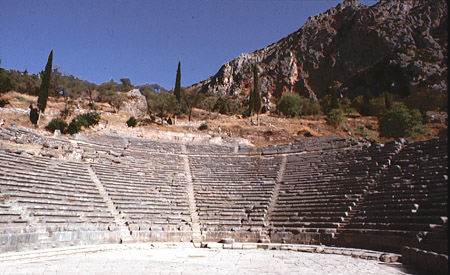
[As Pindar, declaiming in the theater at Delphi] "The fame of Pelops shines from afar in the races of the Olympic festivals, where there are contests for swiftness of foot, and the bold heights of toiling strength..."

 Master Thespian: You really captured Pindar. I felt like I knew the man. Genius!

Edmund Kean: No. Acting!

Now, then... have you prepared the fencing scene from Hamlet?

Master Thespian: Yes! [grabs fencing foils] Here is your foil.

Edmund Kean: Thank you! Very well, then. You shall play the part of  Hamlet. And I shall play the great...Edmund Kean! By the way, you were brilliant in  You're a Good Man, Charlie Brown as Linus in crisis.

Master Thespian: Oh, thank you. And, may I add, you were a perfectly raging queen! Elizabeth II, of course.

Edmund Kean: [an octave lower] Of course! [an octave higher] Now!

[They begin to fence furiously. Edmund Kean staggers backwards as Master Thespian swings his foil near him]

Edmund Kean: [covering his chest with his hand] Oh, Master.. M-master, you've cut me.. look how the blood gushes from my very veins!

Master Thespian: Oh, please forgive me, it was an accident..

Edmund Kean: Don't be silly! [opens his jacket to reveal no cut] Acting!

Master Thespian: Oh, you fooled me!

Edmund Kean: Of course I fooled you! I am the greatest actor of all time! I am...Kean! 


Master Thespian: [thrusts foil] En-garde!

[They begin fencing again. Suddenly, Master Thespian drops his foil and falls gracefully into Edmund Kean's arms]

Edmund Kean: Master? Are you hurt?

Master Thespian: Oh, Kean, I'm afraid we've played this acting thing too far. You've made worm's meat of me! Adieu.. adieu.. remember me. Look! [points] The face of death is near! And so.. I flail! [his legs kick before his body falls limp]

Edmund Kean: Master! [cries] I have killed my protege! How... how... how will you ever forgive me?

Master Thespian: [stands] Very good! I was merely acting!

Edmund Kean: So was I! I've fooled you again!

Master Thespian: No! It is I who fooled you! For I am dead... and merely acting alive!

Edmund Kean: Genius! Yet I've been dead, mort, cadaverous, extinct, deceased and defunct for over a hundred and fifty years! It is I who am the genius!

Master Thespian: Curses! I see I shall have to read The Life of an Actor by Pierce Egan, dedicated to what's-his-name, to learn the secret to acting alive while dead yet still alive but actually a ghost.


Edmund Kean: Ah, yes! Have I mentioned it? The classic tome dedicated to moi,  a life on the boards scarce in original boards, no copy in the original printed and illustrated boards at auction since 1975, unrecorded by Tooley, whose copy was that issued in parts within wrappers.

Master Thespian: A pox on your house! I shall read it anyway, yet, bringing the method of the great acting coach from Brooklyn, Stan Islavsky, to bear, I shall only be pretending to read, for I am...Master Thespian!

Edmund Kean: Genius!

Master Tespian: No. Acting!
__________


EGAN, Pierce. The Life of an Actor. Dedicated to Edmund Kean, Esq. The Poetical Descriptions by T. Greenwood. Embellished with Twenty-Seven Characteristic Scenes, Etched by Theodore Lane. Enriched also With Several Original Designs on Wood, Executed by Mr. Thompson. London: Printed for C.S. Arnold, 1825.

First edition. Quarto (10 x 6 1/8 in; 254 x 160 mm). xvi, 272 pp (a-b4, B-C8, D-Z4, Aa-Kk4). Twenty-seven aquatints with original hand-coloring. Nine text woodcuts. Printed and illustrated boards.

Abbey, Life 414. Prideaux. p. 308. Cf. Tooley 195.
__________

This post freely adapted from a sketch transcript from the December 7, 1985 episode of Saturday Night Live.
__________

Book images courtesy of David Brass Rare Books, currently offering this copy, with our thanks. Image of Jon Lovitz courtesy of NBC.
__________
__________

Monday, June 13, 2011

Very Early Bob Dylan Song Manuscripts Surface

by Stephen J. Gertz

Little Buddy (recto).
Hertzl Camp (Webster, WI), 1957.

Two scarce and very early Bob Dylan manuscripts of song lyrics have come to market.

Little Buddy, written for his summer camp's newspaper, the Hertzl Herald, in 1957 while Dylan, aged sixteen, was attending Hertzl Camp in Webster, Wisconsin, is the story of a boy and his dog. Buddy, alas, comes to a tragic end. The manuscript is signed, "Bobby Zimmerman."

Little Buddy (verso).

Little Buddy

Broken hearted and so sad
Big blue eyes all covered with tears
Was a picture of sorrow to see

Kneeling close to the side
Of his pal and only pride
A little lad, these words he told to me

He was such a lovely doggy
And to me he was such fun
But today as we played by the way

A drunken man got mad at him
Because he barked in joy
He beat him and he's dying here today

Will you call the doctor please
And tell him if he comes right now
He'll save my precious doggy here he lay

Then he left the fluffy head
But his little dog was dead
Just a shiver and he slowly passed away

He didn't know his dog had died
So I told him as he cried
Come with me son we'll get that doctor right away

But when I returned
He had his little pal upon his knee
And the teardrops, they were blinding his big blue eyes

Your [sic] too late sir my doggy's dead
And no one can save him now
But I'll meet my precious buddy up in the sky

By a tiny narrow grave
Where the willows sadly wave
Are the words so clear you're sure to find

Little Buddy Rest In Peace
God Will Watch You Thru The Years
Cause I Told You In My Dreams That You
Were Mine

Bobby
Zimmerman

As it turns out, however, the lyrics are not Bob Dylan's. Little Buddy was a slightly revised version of a song originally written by Canadian-born country-western star, Hank Snow, and first recorded by him in 1948 for the Canadian Bluebird label. The important thing to take from this is not that Dylan plagiarized but, rather, that teen-aged Bob Dylan was listening to country music and confounding expectations long before he was officially confounding expectations. Hell, Stanard Ridgway's Don't Box Me In (1983) could be his theme song, like Bob Hope's Thanks For the Memories or Jack Benny's Love in Bloom, though I don't think anyone has ever crooned it while in the shower or  housecleaning.

This Dylan manuscript first surfaced at Christie's on June 23, 2009. Estimated to sell for $10,000 - $15,000, the hammer fell at $12,500.

Man on the Street.
[In flight somewhere over America], 1961.

An early, if not the earliest, draft of Man on the Street, one of seventeen songs recorded at Dylan's first recording session, November 20, 1961, but unreleased, and then rerecorded as a demo for his then publisher, Leeds Music, on February 2, 1962, has also come to market. That demo recording remained buried treasure until October 2010, when it was included in  The Witmark Demos: 1962-1964 (The Bookleg Series Vol. 9)

The draft was written in-flight on TWA stationary.

Man in the Street (as recorded)

I'll sing you a song, ain't very long,
'Bout an old man who never done wrong.
How he died nobody can say,
They found him dead in the street one day.

Well, the crowd, they gathered one fine morn,
At the man whose clothes 'n' shoes were torn.
There on the sidewalk he did lay,
They stopped 'n' stared 'n' walked their way.

Well, the p'liceman come and he looked around,
"Get up, old man, or I'm a-takin' you down."
He jabbed him once with his billy club
And the old man then rolled off the curb.

Well, he jabbed him again and loudly said,
"Call the wagon; this man is dead."
The wagon come, they loaded him in,
I never saw the man again.

I've sung you my song, it ain't very long,
'Bout an old man who never done wrong.
How he died no one can say,
They found him dead in the street one day.

Dylan manuscript material is now exceedingly rare and precious. Most of what was available was vacuumed up by collector George Hecksher, who, in the late 1990s, gave them to the Morgan Library as a generous gift.

When Dylan manuscript material has appeared in the past it has been acquired at dear prices: A few scraps of Dylan's student  poetry sold at Christie's, November 22, 2005, for $78,000. On June 23, 2010 the manuscript lyrics for The Times They Are a-Changin' sold at Sotheby's for $422,500.

The Times They Are a-Changin'.
Image courtesy of Sotheby's.

In contrast, these two early items of manuscript Dylaniana are bargains.  Little Buddy is being offered  for $25,000,  Man on the Street, $35,000.

Both are currently offered by Biblioctopus.
__________

Images courtesy of Biblioctopus, except were noted, with our thanks.
__________
__________

Friday, January 14, 2011

Comics Get Stripped At The Museum Of Sex

By Nancy Mattoon


A History Of Dirty Drawings By Craig Yoe,
Curator of the
Comics Stripped Exhibit.


One of the greatest things about art, whether it consists of words or images, is that it can create fantasy worlds that have never existed, and never could. Mention the literary genre of fantasy, and the first images that come to mind might be unicorns, fairies, swords and sorcerers, or other stock elements of children's books. But another kind of fantasy, the adult, sexual kind, has also inspired a genre of art with its own instantly recognizable icons: voluptuous women and muscle-bound men; fetish clothing featuring six-inch stilettos, leather, lace, and latex; bondage gear including handcuffs, masks, and corsets; and sadomasochistic props like whips, chains, and ropes.

Craig Yoe's Arf Forum,
"Celebrating The Unholy Marriage
of Art & Comics."


Call it erotica or pornography, the art that sexual fantasies inspire is as transcendent, and as impossibly unrealistic, as anything found in the worlds of Harry Potter or The Wizard of Oz. New York City's Museum of Sex has just mounted (pun intended) a new exhibition of the erotic art of comic strips and comic books in the 20th and 21st centuries, to "reveal how the comic book medium has been used over time to depict sexual fantasy, poke fun at taboo topics and lampoon icons of popular culture." Comics Stripped, a show made up of over 150 artifacts, including original drawings, illustrated books, comic books, magazines and videos, chronicles the history of "dirty drawings" from the Great Depression to the present day.


A Selection Of Tijuana Bibles.
(Image Courtesy of The Museum of Sex.)

The exhibit begins with 18 examples of the rare, underground comic books known as "Tijuana Bibles." These cheaply-produced pulp paperbacks, clandestinely published in the 1930's, often featured well known mainstream comic strip characters, such as Blondie and Dagwood, or Popeye and Olive Oyl, engaged in graphic sexual activity. In what may well be the most shocking statement in the exhibit's press release, the Museum of Sex staff maintains these crude little comics were frequently used by teenagers as sexual "instruction books." (A reminder that responsible sex education in the home is always the smart move...) Despite their lowbrow pedigree, the Museum points out that some notable comic book artists moonlighted by producing "bibles," including Wesley Morse, who created the Bazooka Joe and Gang characters featured inside the wrappers of Topps' bubble gum.

Cartoonist Wally Wood's
Erotic Take On Superman.

(Image Courtesy of The Museum of Sex.)

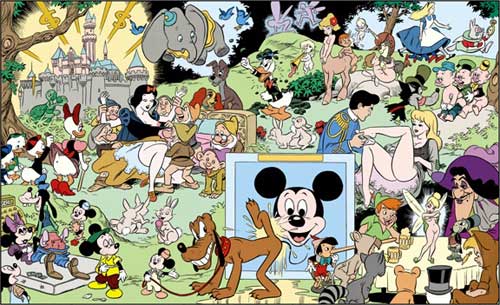
Tijuana Bibles also took on the most sacred cows of wholesome cartoon characters, those created under the auspices of Walt Disney. Featured in the Museum of Sex exhibit are two rare (and Disney wishes rarer) "bibles" featuring Donald Duck and Snow White and the Seven Dwarfs in compromising positions. Another artifact lampooning the squeaky-clean Disney characters is a centerpiece of the show. The Disneyland Memorial Orgy, a tableau drawn by Wally Wood, and published by Paul Krassner in his counterculture magazine, The Realist, hit the newsstands in 1967. Surprisingly, the ever litigious Magic Kingdom chose not to sue the orgy's creators, in order to avoid bringing any more attention to the blasphemy. (For those of you can't wait to see Goofy having his way with Minnie Mouse, a link is thoughtfully provided here.)


Joe Shuster's Cover Illustration
For The First Issue of Nights Of Horror.

(Image Courtesy of The Museum of Sex.)

But Goofy and Minnie Mouse were far from the only comic icons to be eroticized by the sexual comics, or comix, movement. Artist Joe Shuster, co-creator of DC Comics world-famous Superman, drew sadomasochistic scenarios featuring Lois Lane and Clark Kent for his Nights of Horror, a fetish comic book series. And Eric Stanton's Blunder Broad series starred a less-than-wonderful version of Wonder Woman, forever enduring sexual humiliations due to her own ineptitude. Five original issues of issues of Nights of Horror will be on display during the exhibition as well as six original illustrations from Blunder Broad.


Cover Image Of A Collection Of
Playboy Cartoons By Eldon Dedini.


The exhibit also features the erotic cartoon art of risque "men's magazines" from Captain Billy's Whiz Bang, through Ballyhoo, and on to Playboy. Of the Playboy cartoonists, the Museum's press release notes, "Visitors to Comics Stripped will enjoy original art, on loan from the Playboy Enterprises, Inc., of iconic Playboy artists Jack Cole (1914-1958) and Eldon Dedini (1921-2006). Cole may be best known for creating the superhero Plastic Man. His cartoons for Playboy became the gold standard for creating cartoons published in the popular men's magazine. Dedini's watercolor depictions of horny satyrs chasing voluptuous nymphs were an iconic Playboy feature."

A Candy Bar Wrapper Featuring R. Crumb's "Devil Girl."
(Image Courtesy of The Museum of Sex.)

Comics Stripped also examines the ongoing censorship of erotic comics in the United States, culminating in the creation of Comics Code Authority in 1954. The repressive legislation of the red-baiting McCarthy Era ironically led to the proliferation of underground publications, containing outrageous, shockingly graphic images, deliberately unsuitable for publication in even the raciest mass market men's magazine. The most famous artist who got his start in those publications was R.Crumb, the creator of such characters as Fritz the Cat, Mr. Natural and Devil Girl. Comics Stripped includes many of Crumb's original drawings, which have recently been on display at the Hammer Museum in Los Angeles, and the Whitechapel Art Gallery in London. Homoerotic comic art from gay underground publications is also on show at the Museum of Sex, including the iconic work of Tom of Finland, who proudly proclaimed: "If I don't have an erection when I'm doing a drawing, I know it's no good."

Craig Yoe's Well Reviewed Book On
The Fetish Art Of Joe Shuster.


Comics Stripped was created by Museum of Sex Curator Sarah Forbes, and Guest Curator Craig Yoe. Yoe has been called "Indiana Jones of comics historians," the "archivist of the ridiculous and sublime," and "a fine cartoonist and a comic book historian of the first water." He is the author of the definitive work on Superman's co-creator, Secret Identity: The Fetish Art of Joe Shuster (Abrams ComicArts, 2009). Yoe himself modestly says of his curatorial duties for Comics Stripped, "Many artists of 'dirty drawings' had full time gigs in mainstream entertainment. I consider myself to be following in a fine tradition of men who knew what they wanted and how to put it on paper." Knowing what you want, and knowing how to put it down on paper--a perfect description of the art of sexual fantasy.

Comics Stripped opened at the Museum of Sex on January 13, 2010, and continues indefinitely.
__________
 
Subscribe to BOOKTRYST by Email