Monday, October 25, 2010

Dancing With Death: A Scottish Doctor's Macabre Obsession

By Nancy Mattoon


Frontispiece From:
COMBE, William. The English dance of death,
from the designs of Thomas Rowlandson,

with metrical illustrations by the author of "Doctor Syntax."

London: R. Ackermann's Repository of Arts, 1815-1816.

(All Images Courtesy of University of Glasgow Library.)

William Gemmell, a Scottish physician, spent his life in Glasgow's Victorian era hospitals doing his best to help his patients cheat death. Upon retiring, he returned to pursuing his lifelong interest in history and archeology, and served on a national committee charged with overseeing Scotland's libraries. In 1919, at the relatively early age of 60, Dr. Gemmell had his own visit from the grim reaper he had outwitted for so many others.

Scottish Physician and Dancer With Death,
Dr. William Gemmell (1859-1919).


In his will, he left a collection of 76 rare books to the University of Glasgow, his alma mater. Not so unusual for a gentleman of his standing, but the subject matter of the books was rather unique. Every volume in the good doctor's collection was an illustrated text depicting the Dance of Death. This grisly corpus of texts all featured skeletons or decaying bodies leading the living in a merry conga line to the grave. In these works, a twinkled-toed Angel of Death is an equal opportunity assassin. From the wealthy and powerful to the poor and humble, all will find that Thanatos has signed the final line on their dance cards.

A Memento Mori From:
Todten-tantz wie derselbe in der löblichen
und weitberühmten stadt Basel.
Als ein spiegel menschlicher beschaffenheit.
Gantz künstlich gemahlet und zu sehen ist.
Mit beygefügten, aus H. Schrifft und denen alten
Kirchenlehrern gezogenen erinnerungen, vom todt.
Aufferstehung, jüngsten gericht,
verdammnüss der Gottlosen, und dem ewigen leben.
Nach dem original in kupffer gebracht,
und heraus gegeben;
durch Matth. Merians sel. erben.
Franckfurt : [s.n.], 1696.


No one knows why Dr. Gemmell became so preoccupied with this macabre procession, but his collection of ghoulish gambols covers almost 500 years of choreography for the condemned. The Dance of Death, also called the Danse Macabre or Todtentanz, first appeared as a motif in murals painted on the walls of medieval churches in response to the Black Death. (Its origins are murky, perhaps coming from early plays or poetry written by the clergy.) The concept soon crossed over onto manuscript pages, perhaps as early as 1460, but the Gemmell Collection begins with what is certainly the most famous and influential Todtentanz text, the 1538 volume featuring woodcuts designed by Hans Holbein the younger, and believed to have been engraved onto wood blocks by Hans Lütszelberger.

Hans Holbein Woodcut From:
Simolachri, historie, e figure de la morte
...

Lyone: Appresso Giovan Frellone, 1549.


Holbein's original work contained 41 small woodcut engravings, beginning with Adam and Eve leaving the Garden of Eden, accompanied by a new arrival, Death. In the remaining plates, Death comes calling on everyone from the King of France to the medieval equivalent of a bag lady. The wealthy are often depicted indulging in food and drink, surrounded by fine furnishings and architecture, enjoying lives of excess and greed. Their comfortable lives make Death all the more eager to bring them to their knees. Mr. Bones may have a bit more sympathy for the poor, but all are ultimately equally doomed to join the dance.

Hans Holbein Woodcut From:
Simolachri, historie, e figure de la morte
...

Lyone: Appresso Giovan Frellone, 1549.

Holbein's work has been called one of the greatest illustrated texts ever published. The work was not commissioned, which allowed Holbein free reign to indulge his talent for satire and social commentary. The original conception of the Danse Macabre was as a line of the cavorting damned led by a skeletal Pied Piper. Holbein chose to show a single individual's rendezvous with the Grim Reaper in each woodcut, allowing him to create in great detail a wide variety of landscapes, interiors, and costumes. In addition to the unifying theme of the skeleton surprising each victim at his daily tasks, every illustration also features an hourglass measuring the last precious seconds of life.
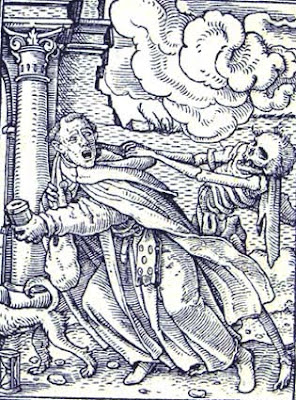
Hans Holbein Woodcut From:
Simolachri, historie, e figure de la morte
...

Lyone: Appresso Giovan Frellone, 1549.

The technical perfection of Holbein's woodcuts, their power, clarity, and masterful precision of line led to their tremendous popularity. More than 100 editions of his Dance of Death have been printed, and his influence can be seen in virtually every treatment of the theme since the 15th century. Many later artists produced illustrations almost line for line copies of Holbein's originals, being notable more for their use of advances in engraving and printing, rather than their artistic creativity. A tribute to Holbein's monumental work is the continuing tradition of Dances of Death consisting of a series of illustrations showing a single victim facing the music.

MUSAUS, Johann Karl August.
Freund Heins Erscheinungen in Holbeins Manier/
von J.R. Schellenberg.

Winterthur : Bey Heinrich Steiner und Comp., 1785.


The theme of the Dance of Death remained popular with artists through the centuries after Holbein. The first truly modern update of the theme came in 1785, with the publication of Freund Heins Erscheinungen in Holbeins Manier written by satirist Johann Karl August Musäus and illustrated by Johann Rudolf Schellenberg. Schellenberg was a master engraver, but more important than the fine quality of his work was his complete abandonment of Holbein's characters and scenes. Schellenberg's Death is a merry prankster and master of disguise, who often chooses to claim his victim through a particularly ironic accident. For example, a scholar finds himself felled by his overflowing bookcases.

COMBE, William. The English dance of death,
from the designs of Thomas Rowlandson,

with metrical illustrations by the author of "Doctor Syntax."

London: R. Ackermann's Repository of Arts, 1815-1816.

Another significant volume in the Gemmell collection is The English Dance of Death. Dating from 1815-6, this work combines the caustic and witty poetry of William Combe with the masterfully satiric caricatures of Thomas Rowlandson. If any Danse Macabre can be called light-hearted, it is this one. Here, Death is a happy hunter, gleefully claiming his prey, each of whom is such a comic grotesque that it is difficult to feel anything but relief at their exit from this earth. In one illustration, a hen-pecked husband looks on with delight as his shrewish wife is finally tamed by Mr. Bones. Behind him is a comely chambermaid, soon to find herself replacing the virago in her master's bedchamber.

COMBE, William. The English dance of death,
from the designs of Thomas Rowlandson,

with metrical illustrations by the author of "Doctor Syntax."

London: R. Ackermann's Repository of Arts, 1815-1816.

The Todtentanz continues to be a popular theme in literature to this day. Frank Wedekind, August Strindberg, and W.H. Auden all wrote plays entitled The Dance of Death. Novels by R.L. Stine, and Douglas Preston and Lincoln Child, have also used the title. And Stephen King published a non-fiction book entitled Danse Macabre. While not using the title, director Stanley Kubrick's film adaptation of William Makepeace Thackaray's nineteenth century novel, The Luck of Barry Lyndon, ends with a shot of printed text that perfectly sums up the enduring message of the Dance of Death: "It was in the reign of George III that the above named personages lived and quarreled; good or bad, handsome or ugly, rich or poor they are all equal now ..."

COMBE, William. The English dance of death,
from the designs of Thomas Rowlandson,

with metrical illustrations by the author of "Doctor Syntax."

London: R. Ackermann's Repository of Arts, 1815-1816.

A virtual exhibit of the Gemmell Collection, Dancing With Death, is available on the University of Glasgow Library's website.
__________

Friday, October 22, 2010

Petrified By Pests? Rare Books To Fuel Your Phobias

By Nancy Mattoon


HERBST, Johann Friedrich Willhelm
Kurze Einleitung zur Kenntniss der
Insekten für Ungeubte und Anfänger.

Berlin : G.A. Lange, 1784-1787.
(All Images Courtesy of W.E.B. Du Bois Library)

With Halloween nearly upon us, the time has come for Booktryst to feature some scary rare books. An online exhibit created by the W.E.B. Du Bois Library of the University of Massachusetts at Amherst was meant to celebrate the beauty of insects and arachnids, as shown in rare books from the 16th through 19th centuries. But if the image at the opening of this post gave you the shivers you're not alone. The number one phobia in the United States, affecting 50% of women and 25% of men is Arachnophobia, the irrational fear of spiders, scorpions, ticks, mites, and other eight-legged creepy-crawlies.

ROEMER, Johann Jakob
Genera insectorum Linnaei et Fabricii
iconibus
illustrata a Joanne Jacobo Roemer
Vitoduri Helvetorum, prostat apud Henrjc.
Steiner et socios, 1789

The irrational fear of insects in general is known as Entomophobia, and is an outgrowth of our instinctive recoil at the sensation of having swarms of tiny legs and feelers brush against our skin. Some scientists believe this is a form of self defense: one of the ecological functions of bugs is to transport small organisms. While harmless to their hosts, these microscopic creatures cause infection and disease in humans. This instinctive fear is normal, but the abnormal fear of insects is so pervasive it has spawned a slew of sub-phobias.

MOFFETT, Thomas.
Insectorum sive minimorum animalium theatrum:
olim ab Edoardo Wottono, Conrado Gesnero,
Thomaque Pennio inchoatum:
tandem Tho. Movfeti Londinâtis operâ sumptibusq;
maximis concinnatum, auctum, perfectum:
et ad vivum expressis iconibus suprá quingentis illustratum.

Londini : Ex officinâ typographicâ T. Cotes,
et venales extant apud Guiliel. Hope ... 1634

The fear of bees is a common phobia, known as Apiphobia or Melissophobia. And although it is doubtful a person in the grip of full blown panic could take the time to tell the difference, there is a separate name for fear of wasps, Spheksophobia. The previous phobias cover not just the fear of the insects, but also of their hives and nests. But if it's only the sting that frightens you, that's called Cnidophobia.

DONOVAN, Edward.
The natural history of British insects :
explaining them in their several states,
with the periods of their transformations, their food,
oeconomy,
&c. together with the history of such minute insects

as require investigation by the microscope :
The whole illustrated by coloured figures,
designed and executed from living specimens, vol. 16.

London : Printed for the author, and for F. and C. Rivington, 1792-1813

Fear of earthworms is especially common among children, and has close links to Ophidiophobia, or fear of snakes. If you find snake-handling a walk in the park, but The Very Hungry Caterpillar makes you reach for the Xanax, then you've got Scoleciphobia, fear of worms.

DRURY, Dru
Illustrations of natural history.
Wherein are exhibited
upwards of two hundred and forty
figures of exotic insects,
according to their different genera ...
With a particular description of each insect:

interspersed with remarks and reflections
on the nature
and properties of many of them. By D. Drury.

To which is added a translation into French, vol. 1.
London, Printed for the author and sold by B. White, 1770-82

Perhaps it isn't so surprising that some people have Mottephobia, the fear of and/or hatred of moths. Their dark outline, jagged wings, attraction to light and flame, and disregard for humans, make them the stuff of nightmares for some, rather like that other frightening winged creature, the bat. (See Chiroptophobia.) Dark, flying shapes in general seem to spark more than a few phobias: one of the birds that most often inspires Ornithophobia is the raven or crow.

EDWARD, William H.
The Butterflies of North America, vol. 1
Philadelphia: American Entomological Society, 1879

But what is unexpected is that there are two different words for the fear of the moth's magnificent cousin, the butterfly. Both Lepidophobia and Leptorrhinianphobia are used to name the fear of a creature most find among the most beautiful in the insect world. It appears that some who suffer from this fear find the metamorphosis of the butterfly, from egg, to larva, to pupa, to adult, extraordinarily disturbing. (And speaking of Metamorphosis, fear of the cockroach is known as Katsaridaphobia, rather than Kafkaphobia.)

REDI, Francesco
Esperienze intorno alla generazione
degl'insetti fatte

da Francesco Redi ...
e da lvi scritte in vna lettera all'illvstrissimo

Signor Carlo Dati..
Firenze, All'insegna della Stella, 1668.

Rounding out the hit parade of Zoophobias, insect branch, is Myrmecophobia, the fear of ants; Pteronarcophobia, the fear of flies; Pediculophobia or Phthiriophobia, the fear of lice; Isopterophobia, the fear of termites; and Coccinellidaephobia, the fear of ladybugs. And if it's the itching bites of the insect you fear, not the critter itself, you're a victim of Acarophobia, and always have your Raid at the ready to fight off mosquitoes, bedbugs, and fleas.

COCQUEBERT de MONTBRET, Antoine Jean
Illustratio iconographica insectorum quae in musaeis parisinis
observavit et in lucem edidit Joh. Christ.
Fabricius, praemissis ejusdem descriptionibus;
accedunt species plurimae, vel minus aut nondum cognitae, vol. 3
Paris: P. Didot, 1799

While many have a slight aversion to insects and arachnids, full blown phobias are much more extreme. Those with true insect phobias not only refuse to go outdoors, but often fear going to sleep, being certain an insect will find its way into their ears or nose. A pleasant day of reading at home becomes impossible once a spider is spied in the corner, or a moth approaches the reading lamp. In the most extreme cases, victims imagine their skin is literally crawling with insects. This is called Formication, (not to be confused with fornication) and may cause the sufferer to scratch the skin to ribbons. A variation is Delusional Parasitosis, in which a victim believes insects are crawling under the skin.

SWAMMERDAM, Jan
Historia insectorum generalis, ofte,
Algemeene verhandeling van de bloedeloose dierkens :
waar in, de waaragtige gronden van haare langsaame aangroeingen
in leedemaaten, klaarelijk werden voorgestelt :
kragtiglijk, van de gemeene dwaaling der vervorming,
anders metamorphosis genoemt, gesuyvert : ende beknoptelijk,
in vier onderscheide orderen van veranderingen,
ofte natuurelijke uytbottingen in leeden, begreepen
t'Utrrecht : By Meinardus van Dreunen ..., 1669.

All of which might lead you to think that being a psychiatrist who specializes in phobias must be the world's most disturbing job. Not so, however. That honor, at least according to one survey, went to the forensic entomologist, the professional who examines the effect of insects on dead bodies. An occupation which combines the triple-threat phobias of Necrophobia, Entomophobia, and Hemophobia. Happy Halloween!
__________

Thursday, October 21, 2010

Lost Dr. Seuss Manuscript Sells For $34,004

by Stephen J. Gertz


The heretofore lost and unpublished Dr. Seuss book in manuscript, whose existence Booktryst heralded last week, sold at Nate D. Sanders Auctions in Brentwood, CA for $34,004 plus 20% buyer's premium (total $40,800) when the auction ended today, Thursday, Oct. 21, 2010, at 5PM PDT.

The reserve was $7,500. Mr. Sanders is a happy man. "We really didn't know what to expect," Sanders said. "I told the owner it could go for more but there was no way know for sure until the auction closed."

All Sorts of Sports, the working title of the manuscript, had been abandoned by Seuss (neé Theodore S. Geisel) in the late Sixties; the story was not coming together as he'd hoped. The manuscript had remained in the possession of its project manager (with Dr. Seuss's blessing) and its existence was revealed only when she placed it with Sanders for sale.

It is safe to presume that she is very pleased. It is just as safe to presume that the person who was outbid is not.
__________
__________

Presenting the WrestleMania Reading Challenge Smackdown!

by Stephen J. Gertz


Madison Square Garden. Within a locked steel cage, two men, two books. Jay "The Great" Gatsby and Rowdy Roddy Reader square off, trading passages from the Barset Novels of Anthony Trollope until the audience begs for mercy and cries "Uncle!"

The WrestleMania Reading Challenge is now in its fifth year, and changes have been made to make double-sure that the challenge is real-real, not real-staged.  The result must be like Caesar's wife, beyond suspicion, the other caesar's wife, Linda McMahon, another matter altogether. The Challenge now will take place over seven days, during Teen Read Week. Registration, alas, is now closed.

Here's how the Challenge has been modified:

• Contestants will no longer be allowed to carry razor blades, typically used during the competition to draw blood and paint the drama in the sanguine hues fans crave.

• The Chokeslam, Moonsault, Piledriver, Brainbuster, Doomsday Device, Powerslam, and Powerbomb moves have been outlawed. They tend to upset concentration while perusin' text. The Speedread, Bookslam, Pageturner, and Leafblower, however, remain legit.

• To participate, students will pledge to read five books or graphic novels between Teen Read Week and WrestleMania 27 on April 3, 2011.

• Students who want a chance to win the trip to WrestleMania 27 in Atlanta will need to complete a special project.

• Grades 7-8 and Grades 9-12: Form a tag team of your favorite character from literature and your favorite WWE Superstar, and describe and/or illustrate on an 8.5x11-inch piece of paper the strategy you would use to defeat the current WWE Tag Team Champions (“Dashing” Cody Rhodes and Drew McIntyre). Teens may use art, drawing, collage, poetry and/or writing alone or in any combination in creating your project. All projects must be the original work of the individual teen. Only one entry per person.

• Grades 5-6: Design a bookmark illustrating a slogan created by you that promotes reading. All projects must be the original work of the individual tween. Only one entry per person.

The students chosen as Grand Prize Winners represent their libraries at the WrestleMania Reading Challenge World Finals in Atlanta on April 2, 2011 and win their libraries $2,000 grants and other prizes.

The WWE WrestleMania Reading Challenge is sponsored by YALSA (Young Adult Library Servicce Association) and World Wrestling Entertainment, with support from Mattel, Penguin, Cold Stone Creamery, DK Publishing, E1 Entertainment, and Topps. The program encourages teens and tweens to read during Teen Read Week and beyond. By doing so, they can win prizes donated by WWE and other organizations. The goal of this program is to reach reluctant readers and get more teens reading beyond Teen Read Week by implementing a reading incentive program that provides prizes from World Wrestling Entertainment (WWE) as a reward.

"This is the fifth year of the WrestleMania Reading Challenge, and we are expecting our strongest participation ever,” said Gary Davis, WWE Vice President, Global Public Affairs.   “WWE remains committed to encouraging teens to read through our efforts with YALSA.”

“Partnering with WWE provides YALSA the chance to reach a wide audience of teens and tweens with a message about the vital role books, reading and libraries can play in their lives,” said YALSA President Kim Patton.

According to Nielsen Media Research, WWE's programming reaches 15.8 million fans each week, of which 23 percent is under age 18. That's a long reach to an age group crucial to capturing the book bug.

Read what novelist Will Weaver had to say about being part of the 2009-2010 Challenge in the Huffington Post!

Read what Bambi Mansfield, a library director in Michigan, told WWE about how joining the program has brought new users into her library!

See teen readers twist themselves and each other into The Pretzel while trying to comprehend  Finnegan's Wake!
__________

With thanks to our friends at ALA-Direct for the lead (and much of the copy!).
__________
__________

Rare Book World's "Cabbages" Get Some Respect

By Nancy Mattoon

RUSS, Karl.
The speaking parrots : a scientific manual.
(London : L. Upcott Gill, 1884)
(All Images Courtesy of Monash University Library.)

"The time has come," the Walrus said,
"To talk of many things: Of shoes—and ships—and sealing-wax—Of cabbages—and kings...
Lewis Carroll, The Walrus and The Carpenter.

Art, literature, and history are the kings of the rare book world. Most library collections concentrate on these areas, and most organized exhibits feature them. Which is what makes a new exhibition of "useful books" from the Rare Book Collection of Australia's Monash University so refreshing. The show features books that offer practical advice helpful for everyday life. The books are historical, but they are works which concentrate on "the practicalities of the way people lived."

Winser, Keith.
Motor Manual's book of lightweight trailers :
plus plans for building caravanettes,

Enlarged 1952-53 edition.
(Melbourne : Keith Winser, 1952).

The introduction to the exhibition points out that "People have a fascination for how things work and these books help us understand the technology and the skills involved. We can see how men and women, professionals, craftsmen, and tradesmen made a living and how they amused themselves." The exhibition includes books on applied science and technology, instructional manuals, trade publications, and even mail-order catalogs. It proves that in the world of rare books, the everyday "cabbages" can be just as fascinating as the kings.

AGRICOLA, Georg, 1494-1555.
De re metallica.

(Basileae : [apvd Hieron. Frobenivm et Nicolavm Episcopivm], 1556)


De re metallica is the earliest complete treatise on mining and metallurgy. It describes, and illustrates with detailed woodcuts, all known methods of extracting metal ore from the earth. It remained unsurpassed for over two centuries, and in 1912, London's Mining Magazine published an English translation by future U.S. President Herbert Hoover and his wife Lou Henry Hoover.

SCHOTT, Gaspar, 1608-1666
Mechanica hydraulico-pneumatica.
(Herbipoli [i.e. Wurzberg] : Joannis Godefridi Schoönwetteri, 1657).

Mechanica hydraulico-pneumatica is a guide to the hydraulic and pneumatic instruments of Gaspar Schott’s teacher, the famous polymath Athanasius Kircher. It includes 42 full-page and partly-folded copper plates and 78 woodcuts illustrating fountains, musical instruments, and other pneumatic machinery, and even includes sheet music samples. Also depicted are fanciful interpretations of scientific experiments, such as a group of scientists watching four angels using a vacuum pump.

The Practical Mechanic's Journal.
(Glasgow, Scotland :
Practical Mechanic's Journal and Patent Office, 1849-1873).

Each issue of The Practical Mechanic's Journal listed newly granted "English patents," and “Scotch patents” as well as the registered "Designs for articles of utility." The illustration here, from the first volume, is the Jenny Lind locomotive. Named in honor of the famed operatic soprano know as "The Swedish Nightingale," it was the first of a class of ten steam locomotives built in 1847 for the London and Brighton South Coast Railway.

BRIGHT, Charles, 1863-1937
Submarine telegraphs : their history, construction, and working.
(London : Lockwood, 1898)

The laying of submarine cables to link distant parts of the world was the major advance in communication in the Victorian era. In 1872, Australia was linked by cable to Bombay via Singapore and China, and in 1876 the cable linked the British Empire from London to New Zealand.

Modern power generators:
steam, electric and internal-combustion, and
their application to present-day requirements/ ed. by James Weir French.
(London : Gresham Publishing Co., 1908)

This two-volume work was distinguished by 11 movable, color-plate illustrations. The plate seen here is simply entitled "Automobile."

KIRBY, John Joshua.
Dr. Brook Taylor's method of perspective made easy,
both in theory and practice.
In two books illustrated with fifty copper plates;
most of which are engrav'd by the author. 2nd ed.
(Ipswich : Printed by W. Craighton, for the author, 1755)

A practical treatise with illustrated exercises to enable readers to master perspective. This work was useful to artists, engravers, architects, bricklayers, plasterers and instrument makers, among others. The engraving here is captioned "Whoever makes a design without the knowledge of perspective will be liable to such absurdities as are shewn in this frontispiece."

WOOD, Samuel.
The British bird-preserver; or, How to skin, stuff, and mount birds and animals,
with a chapter on their localities, habits, and how to obtain them,
also instructions in moth and butterfly-catching, setting and preserving
.
New ed., with appendix. (London : Frederick Warne [1877])

Part of the “Warne’s Useful Books” series. The typical Victorian living room often featured a glass case with stuffed birds. The cover of Wood’s book has an illustration of one such case. He gives detailed instructions for amateurs in the art of taxidermy.

ARNOLD, Mary.
Let's drive better than men.
1934 ed. ([Melbourne?] : Vacuum Oil Co., 1934)


Issued by Vacuum Oil, which later became Mobil, this booklet begins with an extract from an article about women drivers, “Invading the masculine domain,” written in 1904, and reviews how far women have come in the professional and commercial world since then: "The coy little lady of 1904 has blossomed into the independent and capable girl of 1934, who has shed the veils, goggles and disfiguring garb of those motoring days, and, sensibly and attractively frocked, proves that the motor car has lost its terror for her, and that driving a car is just a simple, ordinary occurrence."

And finally the most useful book in the exhibition, in theory...

De la transformation metallique : Trois anciens traitez en rime francoise. Ascavoir. La Fontaine des amoureux des sciences : Autheur J. Dela Fontaine. Les remonstrances de nature à l'alchimiste errant : avec la response dudit alchimiste, par J. de Meung. Ensemble un traité de son romant de la rose, concernant ledit art. Le sommiare philosophique de N. Flamel, avec la deffense d'iceluy art, et des bonnetes personnages qui y vaquent : contetes efforts que I. Girard met à les outrager.
(France, 17--).

An 18th century French alchemy manuscript used for transmuting lead into gold. This volume contains the original "get rich quick scheme." It purports to aid in the discovery of the "Philosopher's Stone," with which base metals could be converted to gold. (See Bernie Madoff's The Last Investment Guide You'll Ever Need for a modern-day variation.)

Useful Books, curated by Dr. Seamus O’Hanlon of Monash University's School of Philosophical, Historical and International Studies, will remain on display at the Sir Louis Matheson Library through February of 2011. Highlights of the exhibition are available online.
__________

Wednesday, October 20, 2010

In Virgin Virginia, 1590 (Not Queen Elizabeth I)

by Stephen J. Gertz

De Bry, Theodor. Wunderbarliche, doch Warhafftige
Erklärung von der Gelegenheit und Sitten
der Wilden in Virginia welche newlich
von den Engelländern so im Jahr 1585.
Frankfurt: Johann Wechel, 1590.
First edition in German.
Engraved title page.
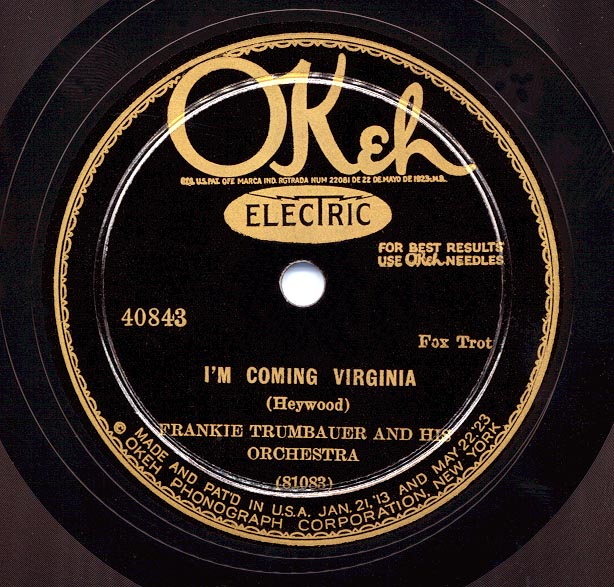
"I'm Coming Virginia"! (Bix Beiderbecke, 1927, with Frankie Trumbauer). Great for Bix. But what about Virginia?


In 1590, when Theodor De Bry, an engraver and publisher originally from Flanders who resettled in Germany, was in his early sixties, he and his two sons undertook a massive book project. With the assistance of British geographer Richard Hakluyt, they gathered up every illustration and description of the new voyages of exploration available, redrew the images and revised and re-imagined the tales that went with them. The project would end in 1634 with thirty stunningly illustrated volumes under the title Collectiones peregrinationum.

They are the most detailed reports of the 16th-century Americas that we have.

In that first year, 1590, De Bry published the first of these volumes, within which was a map of Virginia,  "one of the most significant cartographical milestones in Colonial North American history" (Burden), and "one of the most important type-maps in Carolina cartography" (Cumming). The map, in its first state, is extremely rare.

Plate: Indian Village.
The map had originally been drafted by John White, an English artist who had been sent by Sir Walter Raleigh as Sir Richard Grenville's artist-illustrator on his first voyage to the New World (1585-6) to establish a British colony. Illustrating Thomas Hariot's text of the expedition, White's was the most accurate map drawn in the sixteenth century of any part of the North American continent.

Plate 18. An Indian Water-Rite.
It was the first map to delineate the Chesapeake Bay and contains the first printed use of the name "Chesapiooc Sinus." De Bry had originally intended to use Jacques Le Moyne's drawings of the French expedition to the Southeast for the first part in his series, but Raleigh convinced him to devote the first book to Virginia instead, in an effort to encourage colonization. The White/De Bry map had an enormous influence on the mapping of both Virginia and Carolina.

Americae Pars Nunc Virginia 1st State, w/village to right of native woman
and child engraved "Ehesepiooc."
(Follow the "h" in "right," above,
in a straight line up to compass terminal  point).


This volume, the scarce first edition in German with the extraordinary map of Virginia in its first state, is being offered at Christie's - London on October 27, 2010 as lot 14 in The Arcana Collection Part II sale. The book has not been seen at auction for over thirty-five years. It is estimated to sell for $46,000 - $75,000.
__________ 

BRY, Theodor de (1528-1598). Wunderbarliche, doch Warhafftige Erklärung, von der Gelegenheit und Sitten der Wilden in Virginia welche newlich von den Engelländern so im Jahr 1585. Frankfurt: Johann Wechel, 1590. First edition in German.

2° (331 x 244mm). Collation: a4, b6, c4, d6, e2(e1 + \kc\K2 [map of Viriginia]), A6, B6(B4 + \kc\K2), C6(C3 + \kc\K2), D6, E4, [2E4], F6, complete with blank F6. German title and imprint on slips mounted on engraved title. Adam and Eve plate signed 'Theodore de Brij fe' not 'se.'  23 numbered half- or full-page engravings above or facing German letterpress descriptions (all but the first numbered), 5 plates of the Picts, all contemporaneously hand colored; hand-colored engraved arms on dedication leaf, woodcut tail-pieces.

Burden 76; Church 176; Cumming Southeast in Early Maps 12; Sabin III p.49.
__________

Images courtesy of Christie's.
__________

N.B.: "Virgin Virginia" should not be confused in any way with Virgin America, a carrier which recently blew any further chances with me when they canceled a flight for an  important, tight-budget  one-day trip  two days prior and then, two hours later, canceled the second flight they booked me on as an alternative.  Their other offered flights were a no-can-do day early or same day, too-late.  Refusing to find alternate flights for me on another carrier I had to scrub the entire trip; short notice with  dramatically higher fares precluded booking elsewhere. They initially lured me with a introductory discount mailer.

"Cheap deals and no hassle booking."

It's getting fliers off the ground that's a problem.
__________
__________

Tuesday, October 19, 2010

"Men Are Wicked But Their Books Are Good"

By Cokie Anderson


The magnum opus of the Ashendene Press, Dante's Tutte le Opere


The three great English private presses are considered to be the Kelmscott Press of the bohemian and socialist William Morris, the Doves Press of the eccentric and volatile T. J. Cobden-Sanderson, and The Ashendene Press of the astonishingly normal Charles Harry St. John Hornby (1867-1946).

The press was founded by Hornby as a hobby and named after the location of his family home in Hertfordshire. It issued 40 books, plus additional ephemeral pieces, from 1895-1935, pausing production only during the years of the Great War. Originally the work was done by Hornby, his sisters and, upon his marriage, his wife, Cicely Barclay - truly a family affair.


The Ashendene printer's device motto reads "Les hommes sont meschants mais leurs livres sont bons"
(“Men are wicked but their books are good”).


Less elaborate in appearance and design than William Morris' Kelmscott volumes, but more ornamental than the products of Cobden-Sanderson's Doves Press, the Ashendene books have long been considered the most satisfying of English private press books. Hornby’s considerable achievement in design and printing is all the more impressive when one considers that he had a full-time, demanding, and successful career with the bookseller W. H. Smith, then as now one of the largest chains of booksellers in the U. K.


It was Hornby who changed the focus of the Smith’s retail operations from stalls within the railway stations to shops, conveniently located very close to the stations. The railroad companies had demanded an outrageous increase in rent, which Hornby refused to accept. According to the DNB, “Hornby, anticipating the possible loss of the contracts, had set men scouting for possible shop sites, but it was still a considerable challenge to transfer so many of the firm's outlets while keeping the daily business of newspaper distribution running smoothly. Hornby relished a challenge: in ten weeks, 144 new shops were opened on the territory of the two railway companies. This most dramatic episode in the firm's history pointed the way to the future structure of its business, centred on shops rather than stalls, and established Hornby's position as the strategist of the firm.”


The Divine Comedy, in Subiaco type. Woodcut of the Gates of Hell.

In his spare time, as a form of relaxation, Hornby was creating some of the loveliest books of the 20th century. He sought the assistance of his friends Sydney Cockerell and Emery Walker, who created two memorable typefaces for his: Subiaco, based on the first roman typeface, the famous font used by Sweynheym and Pannartz at the press they established in 1465 in Subiaco, about 30 miles north of Rome, and Ptolemy, derived from the font used for the 1482 Ptolemy printed in Ulm.


The Ninth Circle of Hell, from Inferno


The books Hornby chose to print included excerpts from the Bible, essays by Francis Bacon, works by classical authors, and Italian literature, much beloved by Hornby. Two of the highlights of the press were the three-volume edition of Dante’s Divine Comedy and the folio-sized complete works of the Italian poet (“Tutte le Opere), both in Italian. The former was illustrated with delicate woodcuts here were drawn by R. Catterson Smith and cut by Charles Keates (with some assistance from W. H. Hooper) after the Venetian Dante of Petrus de Quarengiis of 1497. Fellow printer Emily Daniel of the Daniel Press wrote to Hornby, "I think it is the most beautiful modern book I have ever seen."

From Tutte le Opere

"Tutte le Opere" is considered not only the most impressive and important of Ashendene publications, but also one of the outstanding works of 20th century printing. In fact, the Ashendene Dante, the Doves Press Bible, and the Kelmscott Press Chaucer have been called the "triple crown of fine press printing." Franklin writes that "this first major folio from the Ashendene Press has always occupied the summit," and Charles M. Gere's illustrations, inspired by works of the early Renaissance, suit the spirit of Dante perfectly.


Typical Ashendene bindings, vellum with silk ties


Most Ashendene books were bound very simply in flexible vellum, with gilt titling on the spine and silk ribbons (usually green) that could be used to keep them tied shut. Occasionally the vellum would be dyed green or orange. A few works, among the the Cervantes and the Thucydides, were issued in white pigskin.

Deluxe Ashendene bindings


St. John (pronounced "Sinjin", in marvelously British fashion) Hornby proved that it is possible to create great art while still working full time in the mundane world of commerce, that it is possible to create great art while having a normal family life, that it is not necessary to be a tortured soul languishing in an attic or one's parents' basement. The soul of the artist does not have to be crushed by the routine of 9 to 5; creativity can soar in spite of that. I like to think of him as the patron saint of every artist, writer, and artisan who does what is necessary to provide for themselves and their families while never losing sight of their vision and remaining true to their art. So if you're sitting at your desk thinking of the novel you'd rather be writing, the painting or scupture you'd like to be working on, or the hand-crafted book you want to print, take heart. You can do that, too. St. John has shown us the way.

__________

Images courtesy of Phillip J. Pirages Fine Books & Manuscripts
__________
__________
 
Subscribe to BOOKTRYST by Email