Monday, February 11, 2013

The Elegantly Macabre Anatomical Plates Of Gautier-D'Agoty

by Stephen J. Gertz

A rare, stunning first edition, first issue copy of Jacques-Fabien Gautier-D'Agoty's  unsettlingly beautiful, elegantly macabre and disarming color-printed book, Anatomie des parties de la génération de l'homme et de la femme, published in 1773, has come to market. Within, what might best be described as fashionably attractive and eroticized living cadavers as still-life subjects depict the  reproductive as well as the musculatory, circulatory and nervous systems of man and woman.

Comprised of eight color mezzotints forming four pairs of figures with accompanying text, the plates are often found joined together, as reproduced here. Colin Franklin, in A Catalogue of Early Colour Printing From Chiaroscuro to Aquatint (1977), provides a spirited and enthusiastic description of the book:


"The Anatomie des Parties de la Génération begins with tall plates of a man and woman, each formed from two sheets and folding out from the book. All the old art is here, with a new discretion and moderation of tones. These first plates showing muscles, arteries and the nervous system are worked out and tabulated in detail. Behind the man is a ghostly arm and shoulder showing the patterns of veins. Among other adjuncts by his foot is an elegant wine-glass meant to demonstrate the texture of male semen mixed with water 'dans le moment de l'ejaculation.' Anyone may make this experiment, he says encouragingly, and repeat it several times.


"The female figure is a typical Gautier plate, stripped and dissected but with healthy head and throat, charming classical face and hair in perfect order, standing poised as a dancer. Indeed, a Gautier ballet might be devised with dancers in such disguise."

I'm thinking Saint-Saëns Danse Macabre, performed in Le Théâtre du Grand-Guignol.


Franklin continues: "These later learned works have longer descriptive and discursive texts than the merely explanatory sheets with accompanied the early plates [he produced in 1745-46, 1748, 1752 and 1754]. Gautier became fascinated by his subject. In the next folding illustration we find a fair instance of his semi-erotic treatment of a scientific theme - one woman standing in profile, her living head looking back to us above a naked breast; the womb open, with folded figure of a foetus. At her feet and knees, almost in a lesbian attitude, a nude figure finely modeled sits to show the 'parties de la génération' and from the front her dissected womb.


"The final folding illustration is of a similar sort, two figures of which the lower seems a curious relaxed classical nude with impeccable hair, her child just born and resting on her lap, the umbilical cord still uncut. Woman and child are in open dissection. At the mother's feet is a debris of palcenta and cords as if they have not yet been cleared from last night's party.

"That Gautier found the whole theme a fascinating one is clear from his text, which ranges from moral and physical distinctions on the nature of virginity, to an anecdote about Mary Queen of Scots" (pp. 47-48).

Jacques-­Fabien Gautier d’Agoty (1717–1785) studied briefly with Jacob Christoph Le Blon, the "inventor" of color printing, before embarking on his own career with a series of anatomical and natural history illustrations that successfully exploited the potential of color printing. Gautier worked with an anatomist, Guichard Joseph Duverney, lecturer in anat­omy at the Jardin du Roi. Duverney prepared the corpses, Gautier drew them, and then transferred each drawing  to four mezzotint plates, yellow, blue, red, and black, that were printed in succession to achieve the desired result. This printing technique demanded precision in registration, often absent in the images but present here. Many of the larger plates were then covered in varnish, in part to hide the imperfections in registration, as well as to give them the glossy look of varnished paintings. In this copy with sharp registration varnish was unnecessary and the plates (the first dated 1771, the remainder 1773) are far more attractive. 

No copies have come to auction within the last thirty-six years. The asking price is £16,500 ($26,070).
___________

GAUTIER D'AGOTY, Jacques-Fabien. Anatomie des parties de la génération de l'homme at de la femme: représentés avec leur couleurs naturelles, selon le nouvel art, jointe a l'angéologie de tout le corps humain, et ce qui concerne la grossesse et les accouchements. Paris: J.B. Brunet and Demonville, 1773. First edition, first issue. Folio (422 x 273 mm). [ii], 34, [4]. Eight color-printed mezzotint plates. Publisher's card portfolio with plates loose in pocket at rear as issued.

Wellcome III, p. 97. Blake, J., NLM 18th cent.,p. 169. Roberts and Tomlinson, Fabric of the Body n111.
___________

Images courtesy of William Patrick Watson Antiquarian Books, currently offering this volume, with our thanks.
___________
___________

Friday, February 8, 2013

Beelzebub Complains About Taxes In 1763

by Stephen J. Gertz


A scarce satirical hieroglyphic epistle dated April 1, 1763 and written by Beelzebub, one of the seven princes of Hell, has recently come to market. It was surely hell on the mail-carrier. Within, the Evil One complains about an excise duty on wines and spirits. People were going postal.

The letter, addressed to John Stuart, 3d Earl of Bute and Prime Minister of Great Britain (May 26, 1762- April 8, 1763),  mocks the 1763 cider tax of four shillings per hogshead  (a large wine cask holding approx. 300 liters) on apple cider or perry (pear cider), to be paid by the grower. It was imposed by the  rake, politician, and founder of the notorious Hellfire Club, Francis Dashwood - later Baron Le Despencer - who owed his appointment as Chancellor of the Exchequer to his dependence upon Lord Bute.

The tax was levied to pay down debts that the British government had accrued to finance the Seven Years War aka the French and Indian War. The tax was greeted with riots in the streets of London and Lord Bute's windows were smashed. The commotion led to Bute's resignation on April 8, 1763, a week after this engraved broadside was published. Highly unpopular, the new tax was eventually repealed in 1767.


The need for debt reduction an ongoing imperative after the War, in 1765 the British levied the American colonies with the Stamp Act, which required that printed material used in America be produced using British paper bearing a revenue stamp. That did not go over well and the reaction in the Colonies became the first instance of organized resistance to British rule, which ultimately led to the American revolution. 

In the letter Beelzebub suggests that the Earl might think of taxing other commodities such as bread, milk, beer and water, "for wh[eye] should the Vulgar (who are no more than Brutes in [ewer] Opinion) have any thing to Eat above Gr[ass] without paying Tribute [toe] their Superiors."

Hieroglyphic epistles, with emblematic figures substituting for words  as in the Hieroglyphic Bibles first seen in Germany in 1687 and later published in England and the United States to great popularity in the late 18th through 19th centuries, were a minor craze in Britain during the late eighteenth century. I'm aware of another example written by Beelzebub, from 1779.
__________

BEELZEBUB. Excise A Comical Hieroglyphical Epistle. London, Sold by I. Williams next the Mitre Tavern Fleet Street, April 1st, 1763. Engraved broadside, 13 3/4 x 10 1/4 inches (350 x 260mm).
__________

Image courtesy of Shapero Rare Books, currently offering this item, with our thanks.
__________
__________

Wednesday, February 6, 2013

The Greatest American Social Event of the 19th Century

by Stephen J. Gertz

On May 21, 1874, Ellen "Nellie" Grant, the 19-year old third child and only daughter of President Ulysses S. Grant, married Algernon Charles Frederick Sartoris, a member of a British theatrical family, wealthy English singer and nephew of Fanny Kemble, the famous actress.

It was considered one of the greatest social events in America during the nineteenth century. "To the public it was an irresistible, romantic story [met with] insatiable public demand" (Wead, All the President's Children).

The wedding was held in the Presidential Mansion, aka White House. It was a lavish affair, the ceremony held in the East Room followed by a wedding breakfast immediately afterward. The approximately 250 guests were each presented with the banquet's menu, as seen here, a  6 3/4 x 3 3/4 inch broadside printed by Beresford Print of Washington D.C. in blue ink on pink silk with white silk bow tied at top, the whole on mounting paper.


Gifts to the couple included “… a dessert-service of eighty four pieces [given] by Mr. George W. Childs, and a complete dinner-service by Mr. A.J. Drexel, the combined value of the two being $4500" (Harper's, June 6, 1874). "The couple received a 'little' gift of $10,000 from Mr. Grant, and a silver Tiffany fruit dish that the bride supposedly swooned over" (Christine Graham-Ward, Everyone Loves a Wedding, American Antiquarian Society).
 
This was not a marriage made in heaven. It began with a shipboard romance between Sartoris and Nellie when she was only seventeen. President Grant disapproved. His intuition was spot-on. Satoris brought Nellie to England and soon proved to be a cad, womanizer, gambler, and alcoholic, the four horsemen of the nuptial apocalypse.  The marriage ended in divorce in 1889 and Nellie returned to the United States.

The caterer was Frederick Freund, whose name appears at menu's bottom.  

The meal was typical American breakfast fare. Dig in:

Soft Crabs on Toast
Grimaux garais de Crabes & Champignons, Sauce a la Créme
Croquettes of Chicken with Green Peas.
Coteleties d'agneant, Sauce a la Tartare
Aspic de langues de boeuf a la Modern
Wood Cocks and Snipes on Toast, Decorated
Boiled Spring Chicken

Salade Sauce, Maillonais      Strawberries with Cream

BRIDE CAKE - Center-piece

Side-piece of Charlotte Russes and Croque en bouche
Corbeils glaces a la Jardiniere
Gateaux de trois frères

Epigraphe la fleur, de NELLIE GRANT

Pudding a la Nestlerode Sauce a la Creme
Corbeils d'Oranges garnis de fraises
Gelee, Blamangee a la Napoleon

Plombieres garnies de fruits a fleures glaces
Ice Cream of various flavors
Water Ices of various flavors
Small Fancy Cakes
Punch a la Romaine. Coffee. Chocolate. Fancy Boxes - with Wedding Cake


Punch au côlon implicit. Élixir de l'Alka-Seltzer, alas, not included.
__________

Menu image courtesy of Howard S. Mott, Inc., with our thanks.

Wedding photograph courtesy of the American Antiquarian Society, with our thanks.
__________
__________

Tuesday, February 5, 2013

Innocence Found in Scarce Dust Jacket

by Stephen J. Gertz


Take a good look; you'll likely never see another first edition copy of Edith Wharton's Pulitzer Prize-winning The Age of Innocence (1920) in its scarce first state dust jacket in this condition ever again. It's usually lost along with the innocence of the age it illuminates, America in the 1870s and the Victorian social standards of contemporary New York high society.

When seen at all the first state dust jacket usually proclaims "Chips Ahoy!" It's a rare cookie without divots aplenty at spine ends and along the edges as if leaf-eating insects chomped a banquet.

First edition, first printing (with "1" on p. 365) copies without dust jacket currently go for $2250-$9000. Copies in the first state dust jacket cost considerably more. The copy under notice, for instance, is being offered by Peter Harrington at $31,400 (£20,000).  Prices are extremely sensitive to DJ condition. Another copy in the first state dust jacket with a chunks missing at the spine head and upper right corner sold for $23,500 not too long ago.


This copy has a Wharton signature tipped-in to a prelim leaf. Per usual with clipped and mounted autographs it adds little to the value of the book. Inscribed and signed copies of The Age of Innocence in any edition, however, are even rarer than copies in the first state dust jacket. Only one such copy has entered the marketplace within the last thirty years, currently offered by Charles Agvent for $31,250.

Put this dj on that inscribed copy and you'd have a lollipazooza, easily worth more than double the price of the two sold separately. It becomes a $75,000-$100,000 book, greater than the sum of its parts.

Clearly, this is one very expensive dust jacket. It's not in the same class as the DJ to The Great Gatsby, which can add up to $175,000 to the price of a first edition copy, but, like Gatsby in DJ, it remains highly scarce and desirable and thus highly susceptible to fraud, i.e. restoration without declaration. Dust jackets to The Age of Innocence that raise suspicion should be examined under black light to reveal evidence of not-so-divine intervention.

First state dust jacket points:

• Quotes on rear panel by Percy Lubbock pulled from The Novels of Edith Wharton, an article that originally appeared in the January 1915 issue of the Quarterly Review.

In the second state dust jacket, Lubbock's quotes are replaced by those by William Phelps that originally appeared in the New York Times review, October 17, 1920.

• The price on the jacket is $2.

“There are only three or four American novelists who can be thought of as major and Edith Wharton is one" (Gore Vidal).
___________

WHARTON, Edith. The Age of Innocence. New York: D. Appleton, 1920. First edition, first printing. Octavo. 364, [2] pp. Publisher's original red cloth. Original first state dust jacket.

Hart 814. Garrison 30.I.a.
___________

Images courtesy of Peter Harrington, with our thanks.
__________

Of related Interest:

The $175,000 Dust Jacket Comes To Auction.
__________
__________ 

Guericke's Got Plenty O' Nothin', and Nothin's Plenty For Him (1672)

by Stephen J. Gertz


One day in 1656, the citizens of Magdeburg, Germany were startled by the appearance of strange unidentified flying objects hovering over their town. Documented by a now-famous contemporary engraving, it should have led to panic in the streets. The town's mayor, however, Otto von Guericke (1602-1686), calmed the crowd with confidence empty of any reassurance whatsoever: Nothing to worry about, it's nothing at all. Nothing's happening. You are seeing nothing in action.

It was a great day for nihilism.

What the good folks of Magdeburg actually saw were two teams of eight horses try to pull apart two 20-inch diameter copper hemispheres that were greased at their mating rims and sealed when all the air was pumped out. It couldn't be done. Guericke had dramatically demonstrated the existence of a vacuum, of nothingness within the sealed hemispheres. In short, he proved that nothing could exist within something.


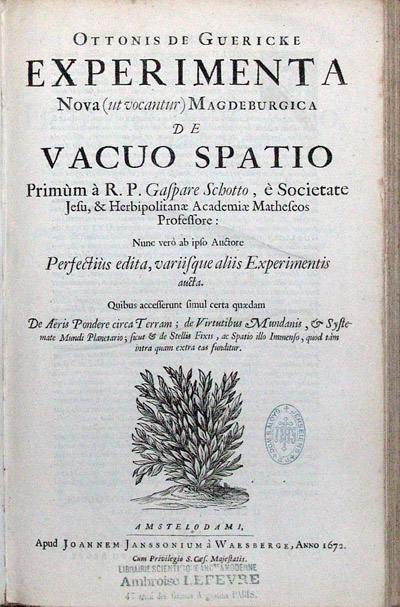
This was major. It was also controversial. The results are found in Guericks's Experimenta nova (1672), one of the great classics of science.

The subject of a vacuum or void, that is, nothingness, vexed natural philosophers and theologians. Ecclesiastic Jacques du Bois and Jesuit scholars Athanasius Kircher and his assistant and protégé, Gaspar Schott were in the middle of it along with Guericke, a scientist and inventor as well as politician.

"Schott first published what had originally been intended as a brief guide to the hydraulic and pneumatic  instruments in Kircher's Roman museum, expanding it into the first version of his Mechanica  hydraulico-pneumatica [1658]. But he added as an appendix [pp. 441-488] a detailed account of Guericke's experiments on vacuums, the earliest published report of this work. This supplement contributed greatly to the  success of Schott's compendium; and as a result he  became the center of a network of correspondence  as other Jesuits, as well as lay experimenters and  mechanicians, wrote to inform him of their inventions  and discoveries. Schott exchanged several letters  with Guericke, seeking to draw him out by  suggesting new problems, and published his later investigations" (DSB).


Schott, who Guericke cites in the subtitle to Experimenta nova, was a supporter of Guericke. His mentor, Kircher was not; a vacuum is impossible: God fills everything. 
This is one of the few examples of Kircher and Schott in disagreement.


Engraved titlepage.

 "Is it God's immensity or is it independent of God…Guericke's position on this matter emerges in the course of a summary account [in Experimenta nova] of the opinions of the ecclesiastics Jacques de Bois of Leyden and Athanasius Kircher, the eminent Jesuit scholar. In his Dialogus Theologicus-Astronomicus, published in 1653 and directed against Galileo and all his defenders of the heliocentric cosmology, Jacques du Bois had proclaimed the infinite omnipresence of God in an infinite void beyond the world. Du Bois should not have placed the divine essence in an infinite void, complained Guericke, but ought rather to to have declared that ' there is a place or space not in which the divine essence is, but which is itself the divine essence..."

"…[Guericke's] criticism of Kircher differed somewhat…Kircher believed that even if a void culled exist without a body, which he denied, it could not exist without God. In the passage cited by Guericke, Kircher explained that 'when you imagine this imaginary space beyond the world, do not imagine it as nothing, but conceive it as a fullness of the Divine Substance extended into infinity.'  In Guericke's judgment, Kircher was wrong to say that 'God fills all imaginary space, vacuum or emptiness by His substance and presence' and simultaneously deny the existence of empty space. 'For how can God fill what is not' [Experimenta nova, p. 64]. Rather, Kircher ought to have concluded with Lessius that 'imaginary space, vacuum, or the Nothing beyond the world, is God himself,' as he finally does when he announces that the space beyond the world is not Nothing, but is the fullness of Divine Substance.'

"But if space is God's immensity, or even God Himself, Guericke insisted that we must nevertheless understand that 'the infinite essence of God is not contained in space, or vacuum, but is in Himself for Himself" (Grant, Much Ado Abut Nothing: Theories of Space and Vacuum from the Middle Ages to the Scientific Revolution, p. 218-19).

Presuming that your brain, as mine, dissolved into mush during the preceding theologico-philisophico disquisition about nothing, allow me to sum things up: Guericke made something out of nothing, Kircher thought nothing of it, but nothing is divine so let's move on. Don't tell the Know-Nothings, they don't know anything much less nothing.

Someone who, like Guericke, knew something about nothing and possessed it, too, sang about it in 1963, courtesy Jerry Leiber and Mike Stoller.

  ____________


[KIRCHER, Athanasius. SCHOTT, Gaspar]. GUERICKE, Otto von. Experimenta Nova (ut vocantur) Magdeburgica de Vacuo Spatio Primùm à R.P. Gaspare Schotto . . . nunc verò ab ipso Auctore Perfectiùs edita, variisque aliis Experimentis aucta. Quibus accesserunt simul certa quaedam De Aeris Pon Amstelodami [Amsterdam]: Johannes Jansson zu Waesberge, 1672. 

First edition. Folio. 8 ff. (including the engraved title), 244, (4) pp., errata leaf. Engraved title, engraved portrait of the author, two double-page engraved plates ((including that of the famous Magdeburg experiment and twenty engravings, many full-page. 

Dibner, Heralds of Science, 55 (pp. 30 & 67). Dibner, Founding Fathers of Electrical Science, pp. 13-14. D.S.B., V, pp. 574-76. Evans, Exhibition of First Editions of Epochal Achievements in the History of Science (1934), 30. Horblit 44. Sparrow, Milestones of Science, p. 16.
___________

Images courtesy of Martayan Lan, with our thanks.
___________

Another existential brain-twister:

The Story of Nobody, By Somebody, Illustrated By Someone.
___________
___________

Monday, February 4, 2013

John Lennon's Bag One At $133,500

by Stephen J. Gertz


A complete copy of John Lennon's Bag One (1970) from its forty-five sets only hors commerce (not for sale) issue of the first edition has come into the marketplace. No complete copy of this iteration of the first edition has previously been offered for public sale; this is the first to come out of hiding. Numbered in pencil in Roman numerals "H.C.XXXIX" and signed by Lennon, it is being offered for £85,000 ($133,500) by Peter Harrington Rare Books of London..

Bag One is a series of fourteen signed original lithographs originally conceived and executed in 1969 to commemorate Lennon's wedding to  Yoko Ono and their subsequent honeymoon in Amsterdam.

It is the rarest, most desirable and difficult to find of all of Lennon's books, no matter the edition and issue. In addition to the 45 hors commerce copies the first edition was comprised of 300 signed copies.

Last year, an attractive complete copy of one of those 300 sets was offered by New England Book Auctions for $20,000-$30,000.

The hors commerce copies are held dearly by those privileged to have had one bestowed upon them by Lennon or Ono. This copy belonged to British advertising executive and fine arts publisher and author, Edward Booth-Clibborn, who won a rather spectacular claim to fame in 1991 while working for British agency D&D.

"Even by the ad industry's extravagant standards, Edward Booth-Clibborn's lunch bill for two at Mayfair's Le Gavroche in 1991 was a jaw-dropper… [a] £448 lunch for two - including a half bottle of wine costing £126 - that grabbed the headlines. Booth-Clibborn charged the lunch against "PR", causing The Independent to suggest later that the initials must have stood for 'profligate romp'" (Campaign, January 28, 2011). Adjusted for inflation that meal cost £750 ($1,185) in 2012.

Copies of the 45 hors commerce sets were reserved primarily for personal distribution by John and Yoko: 30 sets were given to their company, Bag One Productions, and presumably circulated by them amongst their friends. This set was given to Edward Booth-Clibborn as part of the negotiations in January 1970 over a marketing deal between his company, First Run Ltd, and the US licensee appointed by Lennon and Ono, Consolidated Fine Arts Ltd. Booth-Clibborn's British company proposed to produce mass-market posters of the images, and signed a contract to that effect on January 31, 1970.

On February 7, 1970, a jerk present at the New York opening night exhibition of the Bag One lithographs at Lee Nordness Galleries surreptitiously photographed them. Cheap reprints of the entire set were  publicly offered the very next day and Booth-Clibborn's contract was cancelled. He had invested $24,200 in the project; all he got was this copy of the suite. Forty-three years later he can now enjoy a few more profligate romps. Make sure he picks up the tab and leaves the tip.

Should another hors commerce copy enter the marketplace, one owned, perhaps, by Eric Clapton or any other super nova within Lennon's orbit, it will likely sell for at least $150,000-$175,000. Should Lennon or Yoko Ono's copy ever be offered for sale? I suspect an auction estimate beginning at $200,000-$250,000 and ending where the air is thin, leaving room for outer space before the hammer falls.


LENNON, John. Bag One. New York: Cinnamon Press, 1970. First edition, limited to 45 hors commerce sets, this copy being no. H.C.XXXIX. Folio. Title page, text leaf, and fourteen signed in pencil lithograph prints ( 58 x 76 cm) on BFK Rives paper, loose as issued. Lacking the leather bag, which was not included with hors commerce sets.
___________

Images courtesy of Peter Harrington Rare Books, currently offering this volume, with our thanks.
___________

Of Related Interest:

The Rarest, Most Desirable Book By John Lennon Comes To Auction.

Extraordinary Letter From John Lennon To Eric Clapton: Join My New Band!

Yoko Ono Collects Rare Books: The Booktryst Interview.

__________
__________

Friday, February 1, 2013

Fascinating Lawrence of Arabia Letter Comes To Market

by Stephen J. Gertz


Hold on to your keffiyeh: the asking price for a letter written by T.E. Lawrence aka Lawrence of Arabia that has recently come into the marketplace is $47,514 (€35,000). For Lawrence collectors it's an acquisition dream, for historians a must read. For Lawrence of Arabia fans, it's Peter O'Toole's  mythical hero three years before he got on his motorcycle for the last time.

Sent from Plymouth on October 12, 1932,  Lawrence wrote to Maj. Sir Hubert Young (1885-1950), who was attached to Prince Faisal I beginning in early 1918 as a British assistant political officer during the Arab Revolt against the Ottoman Empire. Later in 1918 he was awarded the DSO for gallantry in Mezerib, Syria. After the war, he joined the Foreign Office in London and at the time of this letter was First Minister of Baghdad.

Lawrence writes about reading what was, apparently, galleys or an early review copy of Young's book, The Independent Arab: The Author's Experiences with T.E. Lawrence, Etc (London: John Murray, 1933):

"This is unlikely to reach you in time. I saw Lady Young in London and talked an hour with her and heard much news. You are a fortunate person, I think ...

"I didn't dare tell G[orrell] that I thought your first part - - Turkey before the war - - a definitive evocation of the real thing. I felt every stage of your journey. The war was good - - but for subjective reasons I am out of liking the war. The politics were too restrained.

"Lady Young explained that as a still-serving official you couldn't let yourself go, politically. I see the point, but still regret it. It would have been a better book if you had sacrificed your future to it. When you are old and free the fire may have gone out of you.

"Parts of the book were so like you. I could hear and see you.

"It was not Constantinople [?] that burnt you into my memory, but your saying one day that you were afraid - - of some incident or other. That was my first encounter with a really thruthful person.

"I may have been wrong to suggest you for Bedouin actions during the war: but Nasir's Jurf-Hesa demolition was the biggest Bedouin demolition of the northern war, and it was your organizing. No, I don't think I was wrong. You took transport & H[?] work because its need was greater, that's all.

"It is very good news that you are for a governorship next [Nyassaland, i.e. Malawi]. I hope you & Lady Young like the life.

"Don't imagine that in refusing the puff to Gorrell I did it because I grudged it. You can command anything I have and am at any time. Look what you have done in Irak! That's a debt not easily to be paid."

Regarding the Nasir demolition that Lawrence refers to, Richard Aldington, in Lawrence of Arabia. A Biographical Enquiry (London, 1955), wrote: "Just before the New Year, 1918, Sharif Nasir attacked and captured the station of Jurf (between Maan and Hesa) with 200 prisoners. This result had been accomplished by Beni Sakr Bedouins and one mountain gun"  (p. 216).


Lawrence signs the letter "T.E.S." - Thomas Edward Shaw - his post-war pseudonym. Being Lawrence of Arabia had become an onerous burden to him and he simply wanted to be swallowed up into obscurity. It is no secret that he was bitterly disappointed and frustrated by how events in the Middle East had evolved during and after the war, as hinted at in the letter: "The politics [of your book] were too restrained."

The British and French were by no means restrained in their power grab in the region, carving it up under the secret Sykes-Picot Agreement of 1916 and in the immediate aftermath of the War establishing the boundaries for the Middle Eastern nations we now know under a mandate system sanctioned by the new League of Nations.

Very soon after that Arab resistance movements emerged to challenge the new system. Had it been written in 1919 instead of 1971, Arabs may have sung the following anthem:

Change it had to come
We knew it all along
We were liberated from the fall that's all
But the world looks just the same
And history ain't changed
'Cause the banners, they all flown in the last war

I'll pick up my guitar and play
Just like yesterday
Then I'll get on my knees and pray
We don't get fooled again
Don't get fooled again
No, no!

Meet the new boss
Same as the old boss


(Pete Townshend)

Lawrence of Arabia would have ruefully nodded his head. 
__________

LAWRENCE, T[homas] E[dward], British explorer, intelligence officer, and writer (1888-1935). Autograph letter signed ("T. E. S."). Plymouth, 12. X. 1932. Small 4to. 2 pp.
__________

Images courtesy of Inlibris, currently offering this item, with our thanks.
__________
__________
 
Subscribe to BOOKTRYST by Email