Showing posts with label Technology. Show all posts

Monday, August 19, 2013

The Glorious Future Of Detroit Under Glass, Including Television And The Hyperloop, In 1884

by Stephen J. Gertz

Poetical Drifts of Thought or, Problems of Progress. Treating Upon The Mistakes of the Church - The Mistakes of the Atheist Infidel and Materialist - God Not the Maker of the Universe - Progress the Evidence of a Merciful But Not All-Powerful God. Reconciliation of Science and Christianity. The Formation of a Solar System - Evolution - Human Progress - Possibilities of the Future - Including Spicy Explanatory Matter In Prose. Embellished with Nearly 200 Illustrations. Together with a Number of Fine Poems on Popular Subjects. Including Sketches of the City of the Straits - Past, Present and Future.
Speramus meliora; resurget cineribus (We hope for better things; it will arise from the ashes”) - Motto of Detroit.

Current reports of Detroit's collapse are premature. Lyman E. Stowe, a citizen of pre-Motor City, saw the present in 1884, was pleased, and predicted a future for the metropolis that makes anything H.G. Wells ever wrote seem the product of a pedestrian mind completely lacking in imagination.

The first three of fifty-five stanzas to be recited to the tune of Yankee Doodle.

It's a future based upon electricity, chemistry, the abolition of ignorance, and the reconciliation of science and religion. It's a future told, for the most part, in poems that threaten the very existence of poetry. Scansion, smansion, who needs it? When you write fifty-five quatrains in praise of Detroit's present and direct that they be recited to the tune of Yankee Doodle, Erato sticks a feather in her cap, calls it macaroni, gets buried in poetical snowdrifts of thought and prays for a St. Bernard to find her beneath the avalanche.

Detroit in 1884.

Poetical Drifts of Thought is one of the many eccentric self-published works of American 19th-century imaginative writing yet it stands out from the usual crowd of crazy texts by sewing utopian literature, futurology, freethought, Swedenborg, Darwin, and social engineering into a crazy quilt that just won't quit. Lyman E. Stowe was a rugged individualist in the sea of rabid individualists that emerged during the Second Great Awakening in the United States, when the American ethos of individualism met evangelicalism and singular opinions and beliefs were tossed into a Christian fruit salad to present to the world a medley of motley ideas, many radical, in search of acceptance by someone, anyone - please listen!

The Flying Machine of the near Future.

Amongst the many visions Stowe has of Detroit in the year 2100 are air travel; television (“Seeing Distant Friends by Electricity’s Aid”); control of global weather patterns...

Elon Musk's Hyperloop.

...and travel by cars through underground pneumatic tubes. And you thought Elon Musk's Hyperloop was futuristic?  Late!

Food inhaled, not eaten, with acid-reflux vanquished.
Inhaling nutriment in gaseous form via electrical and chemical process.

How 'bout the replacement of solid foods with “nutritive gasses”? Combined with nitrous oxide for belly laughs?

Manufacturing clothes by gathering the particles direct from
water, earth, and atmosphere by electricity and chemistry.

Clothes may make the man but in Detroit's future man doesn't make the clothes. In a stunning blow to the Amalgamated Clothing and Textile Workers Union, clothing will be manufactured using a combination of electricity and chemistry to process particles of water, earth, and atmosphere into a three-piece, custom-made 100% merino wool canvassed suit with structured waist, single vent, hand-rolled lapels, padded shoulders, and handsome silhouette.

Preface as excuse for the book.

Typical in books of this nature, the author has his own ideas about book format and punctuation. Since he believes that a preface is nothing more than an excuse for a writer to rev-up before mouthing off, he calls it like he sees it. Then makes his excuse for writing the book.

Super-sized quotations marks lest the author forget them,
to be inserted by the reader where appropriate.


Stowe makes every attempt to be scrupulous with crediting other writers "but for fear that I might sometimes miss, I place these large quotation marks, large enough for all to see, and ask the fastidious reader to place them where they belong." In short, he leaves the copy editing to the reader.

Eden on Lake Michigan in the year 2100.

Current denizens of Detroit will be pleased or piqued to learn that in the year 2100 they will become peasants under glass, sharing life with hothouse flowers and exotic fruits in a greenhouse gotham where it's sunny, warm, and wonderful all year 'round.

Detroit in the year 2100, the City covered in glass and iron for
20 square miles. Heated by the internal heats of the earth, lit up
with electricity, with perpetual summer days and tropical fruits and
flowers growing all year 'round.

La dolce far niete aside,

All have a certain work to do,
Yet all are gents and ladies too;
All free from strife and toil and care,
They float and breathe the perfumed air.
Sweet music's swelling chorus rings,
And soothing echoes outward flings,
From cheering bands, their sounds inspire
Like sweet Aeolian harp or lyre


Here, Stowe apparently references The Funk Brothers, the uncredited and largely unheralded studio musicians who were the house band hand-picked by Berry Gordy in 1959 for Detroit's Motown Records.

The Battle of the Future.
Detroit's favorite son, Ted Nugent, at upper far right
(of course), attacks those at left (naturally)
who would undermine the Bill of Rights.

You'd think that one who envisions a paradise city under glass would avoid war - the results would be shattering - but no. Aeriel ballets with bullets n' bombs will still have their place as long as man has an immortal soul.     
"The mind is but organized matter, there's no immortal soul.

In a blow, however, to Christianity as we know it, Christian Lyman E. Stowe asserts that "the mind is but organized matter, there's no immortal soul," a strange sentiment from an anti-materialist but "a foolish consistency is the hobgoblin of little minds, adored by little statesmen and philosophers and divines" (Ralph Waldo Emerson).

"
Discovery of the Art of Renewing Life.
 
Then again, who needs an immortal soul when life can renewed as if a subscription to LIFE magazine? I see Ford's River Rouge factory repurposed, renewing life on an assembly line.

In what will be major news to the faithful of all monotheistic religions, Stowe asserts that God didn't make the universe and God's not All-Powerful. Then who, Henry Ford? (Ford thought so). 

Other books by Lyman E. Stone include: My Wife Nellie and I; a Poetical Sketch of Love and Fancy with Other Poems, Including Blank Lines for Autograph and Remarks (1895); What Is Coming is a Wonderful Exposition of the Prophecies and Comparison with Ancient and Modern Historical and Political Events Together with an Ample, Though Concise History of Money from King Solomon's Time to the Present (1896); Stowe's Bible Astrology: the Bible Founded on Astrology (1907); Astrological Periodicity: A Book of Instructions, Showing Man, Beast and Plant are Subject to the Influences of the Planets ... [which gives good and evil periods, which can be taken advantage of and be a benefit, not only to the individual, but to all classes of people (1907); Right Hours to Success (1907); Karmenia; or, What the Spirit Told Me, "Truth Stranger Than Fiction" a Series of Short Occult Stories, Real Experiences During the Life of a Man 72 Years of Age, Garnished in the Clothes of Fiction (1918).

All to be read to the tune of Yankee Doodle.


As for Poetical Drifts of Thought, "The book is what the title implies - 'Drifts of Thought.' You say you don't believe it or agree with it all. Well, I don't blame you, for I don't know as I do my self. Yet my theory is grounded upon logic that seems indisputable within the bounds of anything come-at-able.

"We all have a right to express our thoughts, and by free expression of our thoughts we learn from one another, but I must now say for the present, Good By. Good By."

See you later, alligator. Bankruptcy? Don't have a goiter, you Detroiter. This, too, shall pass - like that gaseous meal you just inhaled.
__________


STOWE, Lyman E. Poetical Drifts of Thought or, Problems of Progress. Treating Upon The Mistakes of the Church - The Mistakes of the Atheist Infidel and Materialist - God Not the Maker of the Universe - Progress the Evidence of a Merciful But Not All-Powerful God. Reconciliation of Science and Christianity. The Formation of a Solar System - Evolution - Human Progress - Possibilities of the Future - Including Spicy Explanatory Matter In Prose. Embellished with Nearly 200 Illustrations.. Together with a Number of Fine Poems on Popular Subjects. Including Sketches of the City of the Straits - Past, Present and Future. Detroit, Mich.: Lyman E. Stowe, Publisher, 1884.

First edition. Tall octavo. 319, [1] pp. Illustrated throughout with woodcuts. Publisher's gilt-pictorial green cloth over beveled boards.

Not in Negley, Utopian Literature, nor in Sargent, British and American Utopian Literature. 
__________
__________

Tuesday, June 11, 2013

Alan Turing Takes Off At Christie's

by Stephen J. Gertz


A copy of Alan Turing's On Computable Numbers, With an Application to the entscheidungsproblem (1936), the foundation of modern digital computing and Turing's most important and lasting achievement to mathematics, is being offered by Christie's-London in its Valuable Printed Books and Manuscripts sale tomorrow, June 12, 2013. It is estimated to sell for between $22,830 - $30,440 (£15,000-£20,000).

It's one of ten lots of Turing material being offered, a trove for the collector of rare science, mathematics, or technology books.

"In 1935 while at Cambridge, Turing attended M.H.A. Newman's course on the Foundations of Mathematics. While Kurt Gödel had demonstrated that arithmetic could not be proved consistent, and it was certainly not consistent and complete (see lots 137 and 138), the last of mathematics' fundamental problems as posed by David Hilbert remained: is mathematics decidable? In other words, was there a definite method which could be applied to any assertion which was guaranteed to produce a correct decision as to whether that assertion was true. Known by its German name Entscheidungsproblem, Newman posed the question as to whether a mechanical process could be applied to this. By the words 'mechanical process' what Newman really meant was 'definite method' or 'rule;' but for Turning 'mechanical' meant 'machine.'

"Turing imagined a machine set up with a table of behavior to add, multiply, divide, etc. If one assembled lots of different tables for lots of different calculations, and then ordered them by rank of complexity, starting with the simplest, then in theory it would be possible to produce a list of all computable numbers. However, no such list could possibly contain all the real numbers (i.e. all infinite decimals), and therefore the computable could give rise to the uncomputable. Thus Turing understood that no machine -- or "definite method" "mechanical process" -- could ever solve all mathematical questions; and therefore the answer to the Entscheidungsproblem was that mathematics was undecidable.

"Unfortunately, Alonzo Church had fractionally pre-empted Turing by coming to the same conclusion on the Entscheidungsproblem. However, Church had used the very different approach of lambda calculus, and Newman realized the greatness of Turing's paper lay in his unique approach and conception of machines to attack mathematical problems. Thus, this paper also laid the foundations for modern digital computing. It was a brilliant amalgamation of pure mathematical logic and theory with a practical engineering component. The abstract machines described in 'On computable numbers' would become the reality of Colossus and modern microprocessors."


This copy was the property of acclaimed mathematician and author R.O. Gandy, who inscribed the first leaf in ink below half-title "with a few corrections to misprints etc. by ROG," and added some pencil marginalia.

• • •

My thanks to Sven Becker of Christie's for tolerating my wholesale reprint of his catalog note for this lot. If I had to study the material all by myself I'd be thrown back to 1979, when I gamely attempted to read and understand Douglas R. Hofstadter's Pulitzer Prize-winning Godel, Escher, Bach. An Eternal Golden Braid: A Metaphorical Fugue on Minds and Machines in the Spirit of Lewis Carroll,  and soon ran out of luck when I ran out of smarts, this area of thought lost in a fifth cerebral ventricle which only I possess: the sinkhole at the center of my brain.
__________

TURING, Alan. On computable numbers, with an application to the Entscheidungsproblem. Offprint from: Proceedings of the London Mathematical Society, ser. 2, vol. 42. London: November 12th 1936. Octavo (275 x 184mm). 34pp., 230-262 (only, lacking last two leaves, pp.263-266). Stapled (lacking the original wrappers, first leaf almost detached, soiling and staining). Provenance: R.O. Gandy.

[With:] 

On Computable Numbers, with an Application to the Entscheidungsproblem. A correction. Offprint from: Proceedings of the London Mathematical Society, ser. 2, vol. 43. London: 1937. 8° (275 x 184mm). 4pp., 544-546. (Creasing and soiling to gutter.) Original olive-green wrappers, stapled (one staple lacking, the remaining one rusted, soiling and staining, wrappers detached. Provenance: R.O. Gandy (small correction in pencil to first page).
__________

UPDATE 6/15/2013: Sold for $29,325 (£18,750), incl premium.
__________

Images courtesy of Christie's, with our thanks.
__________
__________

Friday, June 7, 2013

Laptop Computer Discovered On Ancient Greek Vase

by Stephen J. Gertz

μήλο φορητό υπολογιστή

Evidence that ancient Greek civilization possessed advanced technology beyond the Antikythera mechanism, the earliest complex mechanical instrument, used for calculating the movements of the stars and predicting solar and lunar eclipses - in short, a prototype computer - has been strengthened by the discovery of a laptop computer depicted on an ancient Greek vase.

The image is of the Oracle of Orpheus, the head of Orpheus offering prophecies to a young man who records the predictions on his laptop while Apollo observes at right.

Identified on the vase as μήλο φορητό υπολογιστή, tech-anthropologists have yet to discern how the device's mechanism worked; there is no visible evidence of power cord or battery. The young man appears to be operating a crude pedal with his right foot, apparently the source for power generation.

In what is, perhaps, the most troubling aspect of this image, Orpheus's head, supposedly buried near Antissa on the island of Lesbos after his body was torn apart by Thracian Maenads, is depicted as a late 20th century news anchor, a typical "talking head." This is radical because in ancient myth the head of Orpheus is usually singing mournful torch songs for Eurydice. It's tantamount to Frank Sinatra transmogrifying into the Oracle at Delphi and delivering a cryptic message as a late night news bulletin:

It's a quarter to three, there's no one in the shrine 'cept you and me.
So set 'em up Zeus, I gotta little story that ends in a noose.
We're drinkin' mead,  friend,
To the end
Of a brief episode.
So make it one for Eurydice,
And one more for the road


Orpheus rejected worship of all Gods except the sun, whom he called Apollo. But even Apollo had his limits and after listening to the Oracle of Orpheus until he couldn't stand it any longer, gave Orpheus the hook and shut his mouth. Here, Apollo seems to be saying, "Hey, I want one of those things!" It is entirely possible that this vase and its message went ancient-world viral.

In a telling detail, the young man is using a stylus to depress the computer's keys, conclusively demonstrating that from the very beginning laptop makers presumed everyone had toothpick fingers able to navigate a cramped keyboard design inspired by canned sardines.
__________
__________

Tuesday, February 5, 2013

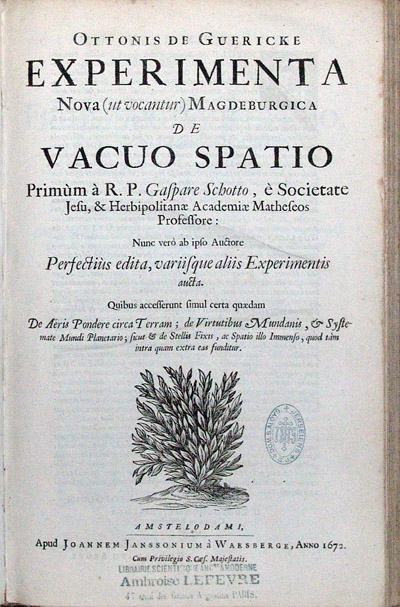
Guericke's Got Plenty O' Nothin', and Nothin's Plenty For Him (1672)

by Stephen J. Gertz


One day in 1656, the citizens of Magdeburg, Germany were startled by the appearance of strange unidentified flying objects hovering over their town. Documented by a now-famous contemporary engraving, it should have led to panic in the streets. The town's mayor, however, Otto von Guericke (1602-1686), calmed the crowd with confidence empty of any reassurance whatsoever: Nothing to worry about, it's nothing at all. Nothing's happening. You are seeing nothing in action.

It was a great day for nihilism.

What the good folks of Magdeburg actually saw were two teams of eight horses try to pull apart two 20-inch diameter copper hemispheres that were greased at their mating rims and sealed when all the air was pumped out. It couldn't be done. Guericke had dramatically demonstrated the existence of a vacuum, of nothingness within the sealed hemispheres. In short, he proved that nothing could exist within something.


This was major. It was also controversial. The results are found in Guericks's Experimenta nova (1672), one of the great classics of science.

The subject of a vacuum or void, that is, nothingness, vexed natural philosophers and theologians. Ecclesiastic Jacques du Bois and Jesuit scholars Athanasius Kircher and his assistant and protégé, Gaspar Schott were in the middle of it along with Guericke, a scientist and inventor as well as politician.

"Schott first published what had originally been intended as a brief guide to the hydraulic and pneumatic  instruments in Kircher's Roman museum, expanding it into the first version of his Mechanica  hydraulico-pneumatica [1658]. But he added as an appendix [pp. 441-488] a detailed account of Guericke's experiments on vacuums, the earliest published report of this work. This supplement contributed greatly to the  success of Schott's compendium; and as a result he  became the center of a network of correspondence  as other Jesuits, as well as lay experimenters and  mechanicians, wrote to inform him of their inventions  and discoveries. Schott exchanged several letters  with Guericke, seeking to draw him out by  suggesting new problems, and published his later investigations" (DSB).


Schott, who Guericke cites in the subtitle to Experimenta nova, was a supporter of Guericke. His mentor, Kircher was not; a vacuum is impossible: God fills everything. 
This is one of the few examples of Kircher and Schott in disagreement.


Engraved titlepage.

 "Is it God's immensity or is it independent of God…Guericke's position on this matter emerges in the course of a summary account [in Experimenta nova] of the opinions of the ecclesiastics Jacques de Bois of Leyden and Athanasius Kircher, the eminent Jesuit scholar. In his Dialogus Theologicus-Astronomicus, published in 1653 and directed against Galileo and all his defenders of the heliocentric cosmology, Jacques du Bois had proclaimed the infinite omnipresence of God in an infinite void beyond the world. Du Bois should not have placed the divine essence in an infinite void, complained Guericke, but ought rather to to have declared that ' there is a place or space not in which the divine essence is, but which is itself the divine essence..."

"…[Guericke's] criticism of Kircher differed somewhat…Kircher believed that even if a void culled exist without a body, which he denied, it could not exist without God. In the passage cited by Guericke, Kircher explained that 'when you imagine this imaginary space beyond the world, do not imagine it as nothing, but conceive it as a fullness of the Divine Substance extended into infinity.'  In Guericke's judgment, Kircher was wrong to say that 'God fills all imaginary space, vacuum or emptiness by His substance and presence' and simultaneously deny the existence of empty space. 'For how can God fill what is not' [Experimenta nova, p. 64]. Rather, Kircher ought to have concluded with Lessius that 'imaginary space, vacuum, or the Nothing beyond the world, is God himself,' as he finally does when he announces that the space beyond the world is not Nothing, but is the fullness of Divine Substance.'

"But if space is God's immensity, or even God Himself, Guericke insisted that we must nevertheless understand that 'the infinite essence of God is not contained in space, or vacuum, but is in Himself for Himself" (Grant, Much Ado Abut Nothing: Theories of Space and Vacuum from the Middle Ages to the Scientific Revolution, p. 218-19).

Presuming that your brain, as mine, dissolved into mush during the preceding theologico-philisophico disquisition about nothing, allow me to sum things up: Guericke made something out of nothing, Kircher thought nothing of it, but nothing is divine so let's move on. Don't tell the Know-Nothings, they don't know anything much less nothing.

Someone who, like Guericke, knew something about nothing and possessed it, too, sang about it in 1963, courtesy Jerry Leiber and Mike Stoller.

  ____________


[KIRCHER, Athanasius. SCHOTT, Gaspar]. GUERICKE, Otto von. Experimenta Nova (ut vocantur) Magdeburgica de Vacuo Spatio Primùm à R.P. Gaspare Schotto . . . nunc verò ab ipso Auctore Perfectiùs edita, variisque aliis Experimentis aucta. Quibus accesserunt simul certa quaedam De Aeris Pon Amstelodami [Amsterdam]: Johannes Jansson zu Waesberge, 1672. 

First edition. Folio. 8 ff. (including the engraved title), 244, (4) pp., errata leaf. Engraved title, engraved portrait of the author, two double-page engraved plates ((including that of the famous Magdeburg experiment and twenty engravings, many full-page. 

Dibner, Heralds of Science, 55 (pp. 30 & 67). Dibner, Founding Fathers of Electrical Science, pp. 13-14. D.S.B., V, pp. 574-76. Evans, Exhibition of First Editions of Epochal Achievements in the History of Science (1934), 30. Horblit 44. Sparrow, Milestones of Science, p. 16.
___________

Images courtesy of Martayan Lan, with our thanks.
___________

Another existential brain-twister:

The Story of Nobody, By Somebody, Illustrated By Someone.
___________
___________

Tuesday, July 31, 2012

A Lean. Mean Machine For Those Who Use Their Brains To Earn a Buck

By Stephen J. Gertz


The Royal Standard Typewriter is the ideal machine for the Author or Journalist, because of its versatility - added convenience. A literary man MUST be original: he should use the writing machine whose whole keynote is originality.

The Royal is not made especially for the use of writers, but for EVERYBODY who needs a typewriter. It is essentially the businessman's machine, complete in every detail.

Everything Included.
No Extras.
$75.

You've heard of the "master key" that fits every lock - did you ever hear of a Master-Model of a typewriter?

ONE STANDARD MODEL FOR ALL PURPOSES
One Typewriter With the Combined Advantages of Many!

Think of all the combined advantages of several typewriters you have seen, concentrated in ONE standard writing-machine that handles perfectly every known form of general correspondence and does card-writing and condensed billing besides - without a single extra attachment to complicate the mechanism or add extra cost to your typewriter equipment - and you will have a fairly good conception of the MASTER-MODEL of the Royal!

The Best Built Typewriter in the World
Write for the "Royal Book" - or send for a "Royal Man"
ROYAL TYPEWRITER COMPANY
Room 93, Royal Typewriter Building, NEW YORK
Branches and Agencies in All Parts of the World

__________

A literary man MUST be original: he should use the writing machine whose whole keynote is originality. Which is why I used a Royal Standard Typewriter to compose this post. I simply thought about it and the machine responded with original text. It's magic! And with the Royal Standard Typewriter I never experience the blue screen of death, so common with inferior machines of later invention.
__________

Full Disclosure: In 1913, the year this advertisement appeared and  thirty-eight years before I was born, I received a lifetime supply of typewriter ribbons from the Royal Typewriter Company in exchange for product placement and personal endorsement.
__________
__________

Thursday, December 8, 2011

Tycho Brahe's Sculpture Garden of Scientific Instruments

by Stephen J. Gertz


Tycho Brahe (1546-1601), a Danish nobleman and gentleman scientist,  made the most precise astronomical and planetary observations to date by designing and building the best, most sophisticated scientific instruments available until  the invention of the earliest known telescope in 1608.


His discoveries in astronomy were made from  Uranibourg, an observatory on an estate on the island of Hveen in the sound between Denmark and Sweden, which King Frederick II of Denmark had granted him, with funding as well for construction of the observatory and its instruments.


His observations of planetary motion, particularly that of Mars, provided the crucial data for later astronomers like Johannes Kepler, who was Brahe's assistant, to construct our present model of the solar system.


Brahe's observatory and his scientific instruments were splendidly documented by Joan Blaeu in his Grand Atlas. Blaeu’s magnificent hand-colored copperplate engravings were revised from wood-cuts originally published in Brahe’s own Astronomiae Instauratiae Mechanicae (1598).


Joan (John) Blaeu (1596-1673) was born a cartographer and died as one in Amsterdam. He was the son of Willem Blaeu, who established the family business as a globe and instrument maker in 1599 and soon expanded into maps and atlases. Joan shared his father's passion for this work. After Willem died in 1638, Joan and his brother, Cornelius, continued to expand the business. After Cornelius's death Joan continued to direct the work alone.


He produced a whole series of 6 volumes of maps (1655), which completed the work that his father had begun. The next, massive project resulted in the production of the 'Atlas Major', or Grande Atlas. This extended to eleven volumes (later editions ranged from 9-12 volumes), the first publication being in 1662. The work contained 3,000 pages of text and near 600 double-page maps.


It was and remains the most extraordinary cartographic work ever produced. The engraving was exquisite as was the calligraphy, coloring, heraldic detail, pictorial work and the intricate cartouches, which dramatically added to the Grande Atlas's appeal. Some of the maps produced by Blaeu are considered to be the finest published during the seventeenth century.


The hand-colored engravings of Brahe's instruments and observatory are unforgetable. They stand out not only as sophisticated scientific instruments of the period but as works of art, bold geometric constructions that would be welcome and admired in any sculpture garden.


__________


BLAEU, Johan (1596-1673). Le grand atlas ou cosmographie Blaviane, en laquelle est exactement descritte la terre, la mer et le ciel.  Amsterdam: chez Jean Blaeu, 1663. 12 folio volumes. 

Title from half-title to volume 1. Title of volume 1: Geographie qui est la première partie de la Cosmographie Blaviane. Title of vols. 2-12: Second [etc.] volume de la Geographie Blaviane./ Vol. 1 has general half title for the complete work, and special t.p. with imprint date 1663./ Some parts have additional engraved title page, some with imprint in Latin: Amsterdami : Apud Ionnanem Blaeu, 1662.

Cf. Potter, p. 171.
__________

Images courtesy of Bruun Rasmussen Auctions of Denmark, which recently offered this edition of the Blaeu Grande Atlas, with our thanks.
__________
__________

Thursday, September 16, 2010

Seventeenth Century Television's Mr. Wizard

CARAMUELIUS, Aspasius [Gaspar Schott]. Ioco-Seriorum Naturae et Artis sive Magiae Naturalis Centuriaetres. Neapoli. N.p. [Würzburg], n.d. [1666].
From 1951 through 1965, a television show appeared that changed the course of science. In my house.

HERBERT, Don. Mr. Wizard's Science Secrets.
New York: Popular Mechanics Press, 1952.
Watch Mr. Wizard, starring Don Herbert, a general science and English major in college and an aspiring actor, was a staple in Casa Gertz when I had control of the horizontal and vertical (yes, my son, there was a time when you could  - and had to - manually control how the TV behaved). 

Though the family survived  my first science experiment, at age four (Q: What happens if you stick a paper napkin into a lit stove burner and throw the flaming thing into the wastebasket? A: Four fire  trucks and FEMA magically appear!) and may have been dubious about my prospects for safely making it to age five, the folks still provided chemistry sets and Remco Thinking Boy's Toys. What they were thinking, I have no idea. Nor, what I was thinking, if I was thinking at all.


Mr. Wizard helped set me on the right path. His stock and trade was creating  tricks based upon scientific principles. It was magic! Just as Bill Nye the Science Guy served a later generation anxious to make  magical things happen with their own hands, Mr. Wizard served the Boomers.


Mr. Wizard's early forerunner was Gaspar Schott, a Jesuit priest and protege of the great seventeenth century polymath, Athanasius Kircher.


A popularizer of science rather than an original researcher, in Ioco-Seriorum Naturae et Artis (1666), the last book published in his lifetime, Schott illustrates how fascinating and amusing science can be through a series of three hundred magic tricks/experiments based upon natural phenomena, geometry and trigonometry. 


This was a very exciting time in science, at the crossroads of the casual, irrational thinking of the past and the rigorous, experiment-based scientific method then beginning to emerge. The public was fascinated by what was going on and much of the credit for that keen interest is due to Schott and this book, which has become quite rare in general and positively scarce in better than very good condition. Only two copies have come to auction within the last thirty-five years.


Amongst the described tricks and devices are a water-clock, optical illusions, a perpetual motion machine, a dark chamber, cryptography, and more. Some chapters treat subjects of medical interest, i.e. healing toothache, syphilis, poison antidotes; others are of a more fanciful nature, i.e. how to walk on water, and how to catch fish with your bare hands. This book was Schott's most popular and was reprinted several times. Schott's interest in linguistics and polygraphy is expressed in homage to his mentor, Kircher, who Schott heralds a pioneer in the field.


Gaspar Schott (1608-66) was a Jesuit, student and long time assistant of Kircher. "Schott is most widely known for his works on hydraulic and mechanical instruments. His treatise on 'chronometric marvels' contains the first description of a universal joint and the classification of gear teeth. He was the author of a number of works on mathematics, physics, and magic [the present volume]." He devoted the remainder of his career to editing and defending Kircher's works" (Findlen and Huisman, p. 34).


We were fortunate to discover an ancient Kinetoscope of Schott demonstrating a few science tricks to a young, contemporary maiden. The first thing to amaze is the quality of the picture; television reception in the seventeenth century was notoriously poor to non-existent. You will also be startled by the modern dress. It's as if it was filmed in early 1960-something. It's magic!


__________

CARAMUELIUS, Aspasius [Gaspar Schott]. Ioco-Seriorum Naturae et Artis sive Magiae Naturalis Centuriaetres Neapoli. N.p. [Würzburg], n.d. [1666].

First edition, variant B (catchword "autem" to page one). Small quarto. [2], 363, [1, blank], [8, Index] pp. Engraved title page. Twenty-two engraved plates, including one foldout. Head- tailpieces. 

Merrill 16n. DSB XII, pp.201-211. De Backer - Sommervogel IV, 1059.18. Thorndike VII, 591. Caillet 5545.
__________

All images from Ioco-Seriorum Naturae et Artis courtesy of David Brass.
__________
__________
 
Subscribe to BOOKTRYST by Email